
Level:
Correct: 0
Incorrect: 0
Marks: 0/0
Practice
Course:
Topics:
11+ Maths Smart practice A mixed round aimed at your weak spots
Unit 1
Number and place value
Unit 2
Calculation
Unit 3
Factors, multiples and primes
Unit 4
Fractions, decimals and percentages
Unit 5
Ratio and proportion
Unit 6
Algebra
Unit 7
Measures, time and money
Unit 8
Shape and angles
Unit 9
Area, perimeter and volume
Unit 10
Position and direction
Unit 11
Statistics
Unit 12
Probability
Unit 13
Problem solving
Avg
score:
–
Topics
done:
0/71

Reflections

Practise 25 questions on Reflections for 11+ Maths. Tap your answer and find out straight away if you are right, with the Study Helper on hand if you get stuck.

  • 25 questions
  • 1–2 marks each
  • Instant marking
  • No sign-up needed
20 questions, marked as you go

Sample questions with model answers

Here are 4 of the questions in this topic, each with a model answer, an explanation of why it earns the marks and the mark scheme.

Question 1

1 mark

The point \((-7, 2)\) is reflected in the y-axis.

What are the coordinates of its image?

Model answer

The point is 7 to the left of the y-axis.
Its image is 7 to the right, at the same height.
Image \(= (7, 2)\)

Answer: \((7, 2)\)

Explanation

Reflecting in the y-axis flips a point from left to right. (−7, 2) is 7 squares left of the y-axis, so its image is 7 squares right of it, still 2 up: (7, 2). The y-coordinate does not change. A common mistake is to change the y-coordinate.

Mark scheme
  1. 1 mark

    \((7, 2)\)

    Only \((7, 2)\). \((-7, -2)\): reflects in the x-axis instead of the y-axis. \((2, -7)\): swaps the coordinates. \((-2, 7)\): swaps the coordinates and changes both signs. \((7, -2)\): changes the sign of both coordinates.
Question 2

1 mark

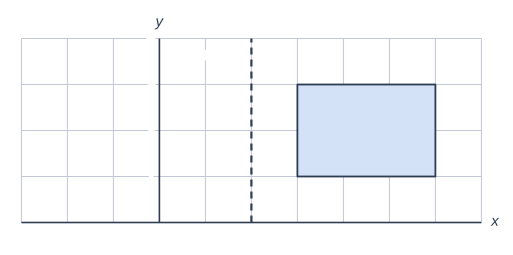
The grid shows rectangle PQRS and a dashed vertical mirror line. The rectangle is reflected in the mirror line.

What are the coordinates of the image of R?

A coordinate grid with x from −3 to 7 and y from 0 to 4; each grid square is 1 unit across, and the axes cross at the origin O. Quadrilateral PQRS (shaded) is drawn with vertices P(3, 1), Q(6, 1), R(6, 3) and S(3, 3). The line labelled "mirror line" is a vertical straight line crossing the x-axis at (2, 0) (the line x = 2).

Model answer

The mirror line goes through 2 on the x-axis.
R \((6, 3)\) is \(6 - 2 = 4\) squares to the right of it.
Its image is 4 squares to the left: \(2 - 4 = -2\).
Image of R \(= (-2, 3)\)

Answer: \((-2, 3)\)

Explanation

Measure from the mirror line, not from the y-axis. R is 4 squares to the right of the line through 2, so its image is 4 squares to the left of it, at x = −2, at the same height: (−2, 3). A common mistake is to reflect in the y-axis, giving (−6, 3).

Mark scheme
  1. 1 mark

    \((-2, 3)\)

    Only \((-2, 3)\). \((1, 3)\): gives the image of S instead of R. \((2, 3)\): moves R 4 squares left, which only reaches the mirror line. \((-6, 3)\): reflects in the y-axis instead of the dashed line. \((-3, 3)\): goes one square too far past the mirror line.

Question 3

1 mark

The point \((2, 3)\) is reflected in the vertical line through \((2, 0)\).

What are the coordinates of the image?

Model answer

The point has x-coordinate 2, so it is on the mirror line.
It is 0 units from the mirror line, so its image is 0 units from it too.
The image is \((2, 3)\): the point does not move.

Answer: \((2, 3)\)

Explanation

A point on the mirror line is 0 squares from it, so its image is also 0 squares from it: the point stays where it is. This is like touching a mirror with your finger: the finger and its reflection meet. A common mistake is to think every point must move.

Mark scheme
  1. 1 mark

    \((2, 3)\)

    Only \((2, 3)\). \((2, -3)\): reflects in the x-axis instead. \((0, 3)\): moves the point 2 to the left, onto the y-axis. \((4, 3)\): moves the point 2 to the right, the distance of the mirror line from the y-axis. \((-2, 3)\): reflects in the y-axis instead.

Question 4

1 mark

Point P \((4, 1)\) is reflected in the x-axis to give point Q. Then Q is reflected in the y-axis to give point R. Each unit is 1 cm.

What is the area of triangle PQR, in cm²?

Model answer

Q is \((4, -1)\) and R is \((-4, -1)\).
PQ goes straight down: from \(y = 1\) to \(y = -1\), 2 cm.
QR goes straight across: from \(x = 4\) to \(x = -4\), 8 cm.
There is a right angle at Q.
Area \(= \dfrac{1}{2} \times 8 \times 2 = 8\) cm²

Answer: 8 cm²

Explanation

First find Q and R: reflecting in the x-axis gives Q (4, −1), and reflecting Q in the y-axis gives R (−4, −1). PQ is vertical and QR is horizontal, so the triangle has a right angle at Q with sides 2 cm and 8 cm. Its area is half of 2 × 8, which is 8 cm². A common mistake is to forget to halve.

Mark scheme
  1. 1 mark

    8 cm²

    Accept 8 only. Do not accept 16 (not halved) or 10 (adding 2 and 8).

Ready to try the rest? Tap your answers and see straight away how you did.

Study Helper Hints first, answers after you try

Stuck on this one? Ask for a hint and I’ll point you in the right direction, without giving the answer away. Once you’ve checked your answer, I’ll show you how the marks are awarded.