Practise 31 questions on Angles in triangles for 11+ Maths. Tap your answer and find out straight away if you are right, with the Study Helper on hand if you get stuck.
31 questions
1–2 marks each
Instant marking
No sign-up needed
20 questions, marked as you go
Sample questions with model answers
Here are 4 of the questions in this topic, each with a model answer, an explanation of why it earns the marks and the mark scheme.
Question 1
1 mark
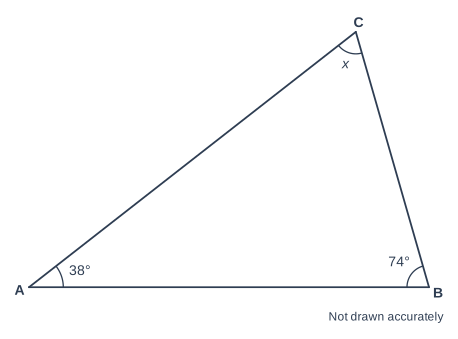
The diagram shows triangle ABC.
What is the size of angle \(x\)?
Model answer
The angles of a triangle add up to \(180^\circ\). \(38 + 74 = 112\) \(x = 180 - 112 = 68\)
Answer: \(68^\circ\)
Explanation
Add the two angles you know, 38 + 74 = 112 degrees, and take the total from 180 degrees to get 68 degrees. A common mistake is to stop at 112, which is the total of the two angles you were given.
Mark scheme
1 mark
\(68^\circ\)
Only \(68^\circ\). \(78^\circ\): works out 180 − 112 in columns but forgets to take the borrowed ten from the tens, getting 78. \(106^\circ\): takes only the 74° angle from 180°. \(112^\circ\): adds 38 and 74 and stops. \(248^\circ\): takes 112 from 360.
Question 2
1 mark
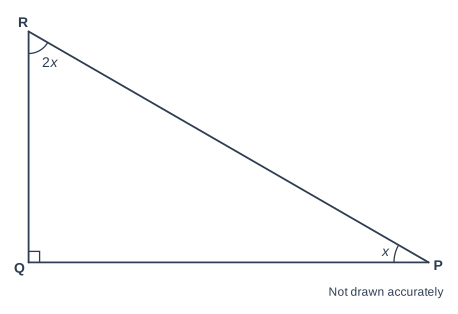
The diagram shows a right-angled triangle PQR.
What is the value of \(x\)?
Model answer
The angles add up to \(180^\circ\) and one of them is \(90^\circ\). \(x + 2x = 180 - 90 = 90\) \(3x = 90\), so \(x = 30\).
Answer: \(30^\circ\)
Explanation
The two angles x and 2x share the 90 degrees that the right angle leaves, and together they make 3 lots of x. So 3x = 90 and x = 30, which makes the angles 30, 60 and 90 degrees. A common mistake is to forget the right angle and solve 3x = 180.
Mark scheme
1 mark
\(30^\circ\)
Only \(30^\circ\). \(45^\circ\): shares 90° equally between x and 2x. \(60^\circ\): forgets the right angle: 3x = 180. \(90^\circ\): uses 360° instead of 180°: 3x = 270. \(120^\circ\): uses 360° and forgets the right angle: 3x = 360.
Question 3
1 mark
Which of these triangles cannot exist?
Model answer
Two right angles already make \(90 + 90 = 180\) degrees, leaving nothing for the third angle. So a triangle cannot have two right angles. The other triangles can exist, for example with angles 45°, 45°, 90°; 60°, 60°, 60°; 30°, 30°, 120°; 100°, 50°, 30°.
Answer: a triangle with two right angles
Explanation
The three angles of a triangle add up to 180 degrees. Two right angles would use up all 180 degrees, leaving 0 for the third angle, so no such triangle exists. A right-angled triangle can be isosceles (45, 45, 90), and an isosceles triangle can have an obtuse angle (30, 30, 120).
Mark scheme
1 mark
a triangle with two right angles
Only a triangle with two right angles. a right-angled triangle with two equal sides: thinks a right-angled triangle cannot be isosceles. an isosceles triangle with an obtuse angle: thinks an isosceles triangle cannot have an obtuse angle. a triangle with one obtuse angle: thinks an obtuse angle is too big to fit in a triangle. a triangle with three acute angles: thinks every triangle needs a right angle or an obtuse angle.
Question 4
2 marks
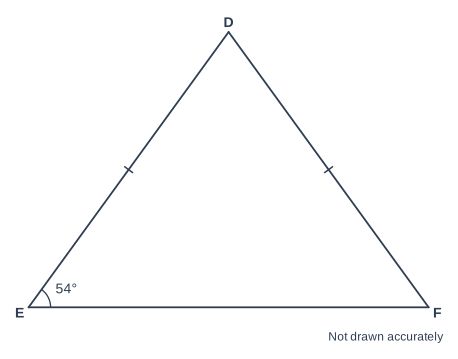
The diagram shows an isosceles triangle DEF with DE = DF. Angle DEF is \(54^\circ\).
What are the sizes of angle DFE and angle EDF?
Model answer
DE = DF, so the angles opposite them are equal: angle DFE = angle DEF \(= 54^\circ\). Angle EDF \(= 180 - 54 - 54 = 72^\circ\).
The equal sides DE and DF meet at D, so the two base angles at E and F are equal: both 54 degrees. The angle at D is what is left from 180 degrees: 180 - 108 = 72. A common mistake is to think the angle at D is one of the equal angles.
Mark scheme
1 mark
54 °
Accept 54 with or without the degree sign. Do not accept 72 or 126.
1 mark
72 °
Accept 72 with or without the degree sign. Follow through: 180 minus twice their angle DFE.
Ready to try the rest? Tap your answers and see straight away how you did.
Ctrl + Enter to check
Study HelperHints first, answers after you try
Stuck on this one? Ask for a hint and I’ll point you in the right direction, without giving the answer away. Once you’ve checked your answer, I’ll show you how the marks are awarded.