
Level:
Correct: 0
Incorrect: 0
Marks: 0/0
Practice
Course:
Topics:
11+ Maths Smart practice A mixed round aimed at your weak spots
Unit 1
Number and place value
Unit 2
Calculation
Unit 3
Factors, multiples and primes
Unit 4
Fractions, decimals and percentages
Unit 5
Ratio and proportion
Unit 6
Algebra
Unit 7
Measures, time and money
Unit 8
Shape and angles
Unit 9
Area, perimeter and volume
Unit 10
Position and direction
Unit 11
Statistics
Unit 12
Probability
Unit 13
Problem solving
Avg
score:
–
Topics
done:
0/71

Speed, distance and time

Practise 25 questions on Speed, distance and time for 11+ Maths. Tap your answer and find out straight away if you are right, with the Study Helper on hand if you get stuck.

  • 25 questions
  • 1–3 marks each
  • Instant marking
  • No sign-up needed
20 questions, marked as you go

Sample questions with model answers

Here are 4 of the questions in this topic, each with a model answer, an explanation of why it earns the marks and the mark scheme.

Question 1

1 mark

Priya runs 100 m in 20 seconds.

What is her average speed, in metres per second?

Model answer

speed = distance รท time
\(100 \div 20 = 5\) metres per second

Answer: 5

Explanation

Metres per second means how many metres she runs each second, so divide the metres by the seconds. A common mistake is to divide the wrong way round, which gives 0.2.

Mark scheme
  1. 1 mark

    5

    Only 5. 0.2: divides the time by the distance. 50: divides 100 by 2, dropping the 0 from 20. 80: takes the time away from the distance. 2,000: multiplies the distance by the time.
Question 2

1 mark

Ella cycles 30 km in 2 hours. Tom cycles 24 km in 1 hour 30 minutes.

Who cycles faster on average, and by how much?

Model answer

Ella: \(30 \div 2 = 15\) km/h.
Tom: in 30 minutes he cycles \(24 \div 3 = 8\) km, so in 1 hour he cycles \(2 \times 8 = 16\) km. His speed is 16 km/h.
\(16 - 15 = 1\), so Tom is faster by 1 km/h.

Answer: Tom, by 1 km/h

Explanation

Compare speeds, not distances. Tom's 1 hour 30 minutes is three half hours, so he cycles 8 km each half hour and 16 km each hour. Ella's speed is 15 km/h. A common mistake is to compare 30 km and 24 km, which ignores the different times.

Mark scheme
  1. 1 mark

    Tom, by 1 km/h

    Only this answer: Tom, by 1 km/h. Ella, by 6 km/h: compares the distances instead of the speeds. Tom, by 9 km/h: forgets the extra 30 minutes, so gives Tom a speed of 24 km/h. Ella, by 1 km/h: works out both speeds but picks the wrong person. Tom, by 16 km/h: gives Tom's speed instead of the difference.

Question 3

1 mark

Isla cycles 15 km at a steady 12 km per hour. She leaves home at 08:45.

At what time does she arrive?

Model answer

In 1 hour Isla cycles 12 km, leaving 3 km.
3 km is a quarter of 12 km, so it takes a quarter of an hour more: 15 minutes.
Journey time: 1 hour 15 minutes.
08:45 + 1 hour = 09:45, and 15 minutes more makes 10:00.

Answer: 10:00

Explanation

Find the journey time first: 12 km takes an hour, and the other 3 km is a quarter of 12 km, so it takes a quarter of an hour. Then add 1 hour 15 minutes to 08:45, going past 10:00 carefully. A common mistake is to write 1.25 hours as 1 hour 25 minutes.

Mark scheme
  1. 1 mark

    10:00

    Only 10:00. 09:00: adds 1 hour 15 minutes but forgets to move into the next hour when the minutes reach 60. 09:48: counts the last 3 km as 3 minutes. 09:45: adds 1 hour for the first 12 km and forgets the other 3 km. 10:10: works out 1.25 hours and adds it as 1 hour 25 minutes.

Question 4

1 mark

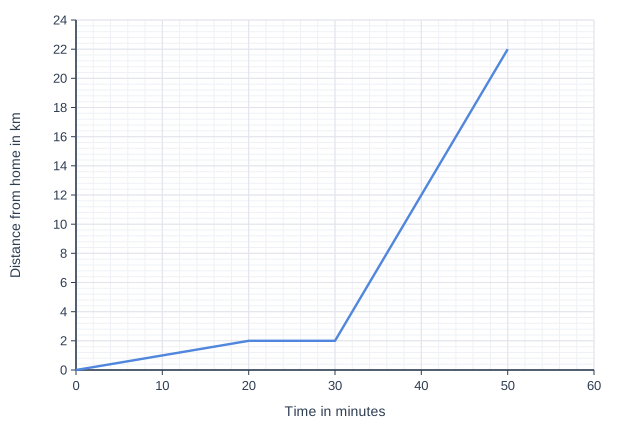
The graph shows Ravi's journey to his grandparents' house. He walks to the station, waits for a train, and then travels by train.

What is the average speed of the train, in km per hour?

Line graph of distance from home in km (y-axis, 0 to 24) against time in minutes (x-axis, 0 to 60). The line joins the points (0, 0), (20, 2), (30, 2), (50, 22).

Model answer

The train part is the steep part, from 30 minutes to 50 minutes.
The train travels from 2 km to 22 km: \(22 - 2 = 20\) km in 20 minutes.
20 minutes is \(\dfrac{1}{3}\) of an hour, so in 1 hour it would go \(3 \times 20 = 60\) km.

Answer: 60

Explanation

Find the train part of the graph (the steepest line) and read the distance and time for that part only: 20 km in 20 minutes. That is 1 km a minute, or 60 km per hour. A common mistake is to use the distance or time for the whole journey.

Mark scheme
  1. 1 mark

    60

    Only 60. 1: works out the speed in km per minute and stops. 20: gives the distance the train travels. 40: takes the train part as 30 minutes, from 20 to 50 minutes, so includes the wait at the station. 66: uses 22 km, the distance from home, instead of the 20 km the train travels.

Ready to try the rest? Tap your answers and see straight away how you did.

Study Helper Hints first, answers after you try

Stuck on this one? Ask for a hint and I’ll point you in the right direction, without giving the answer away. Once you’ve checked your answer, I’ll show you how the marks are awarded.