Practise 30 questions on Missing digits and inverse operations for 11+ Maths. Tap your answer and find out straight away if you are right, with the Study Helper on hand if you get stuck.
30 questions
1–3 marks each
Instant marking
No sign-up needed
20 questions, marked as you go
Sample questions with model answers
Here are 4 of the questions in this topic, each with a model answer, an explanation of why it earns the marks and the mark scheme.
Question 1
1 mark
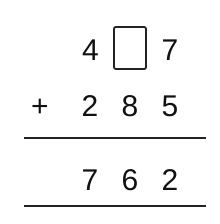
In the column addition shown, one digit of the top number is hidden by a box.
What digit is in the box?
Model answer
Ones: \(7 + 5 = 12\). Write 2 and carry 1. Tens: the missing digit + 8 + 1 must make 16 (write 6 and carry 1 to the hundreds). Missing digit \(= 16 - 8 - 1 = 7\). Hundreds: \(4 + 2 + 1 = 7\). This matches. Check: \(477 + 285 = 762\).
Answer: 7
Explanation
Work through the columns from the ones, keeping track of carries. The ones carry 1 into the tens, so the missing digit plus 8 plus 1 makes 16. A common mistake is to forget the carried 1 and get 8.
Mark scheme
1 mark
7
Only 7. 2: takes the 6 from the 8 in the tens column instead. 6: copies the tens digit of the answer into the box. 8: forgets the 1 carried from the ones column. 9: adds the carried 1 instead of taking it away: \(16 - 8 + 1\).
The box is multiplied by 7 and then 15 is taken away, so undo these in reverse order: add 15, then divide by 7. A common mistake is to stop at 91, which is 7 times the missing number.
Mark scheme
1 mark
13
Only 13. Do not accept 91 (forgetting to divide by 7).
Question 3
1 mark
What number goes in the box to make this correct?
\(45 + 27 = \square + 30\)
Model answer
Left-hand side: \(45 + 27 = 72\). So \(\square + 30 = 72\), and \(\square = 72 - 30 = 42\). Or: 30 is 3 more than 27, so the box must be 3 less than 45, which is 42.
Answer: 42
Explanation
The equals sign means both sides have the same value, 72. The box plus 30 makes 72, so the box is 42. A common mistake is to write 72 in the box, as if the equals sign meant 'the answer is'.
Mark scheme
1 mark
42
Only 42. 15: takes 30 from 45 and forgets the 27. 48: sees that 30 is 3 more than 27 but adds 3 to 45 instead of taking it away. 72: writes the answer to \(45 + 27\) in the box. 102: adds 30 to 72 instead of subtracting.
Question 4
2 marks
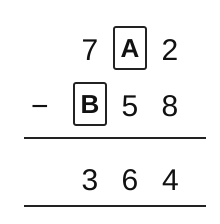
Two digits in the column subtraction shown are covered by the letters A and B.
Find the digits A and B.
Model answer
Check by adding: \(364 + B58\) must make \(7A2\). Ones: \(4 + 8 = 12\). Write 2, carry 1. Tens: \(6 + 5 + 1 = 12\). Write 2, carry 1. So A = 2. Hundreds: \(3 + B + 1 = 7\), so B = 3. Check: \(722 - 358 = 364\).
Answer: A: 2 B: 3
Explanation
Turn the subtraction into an addition: the answer plus the number taken away gives the top number. Then work from the ones, carrying as you go. A common mistake is to forget the carries, which gives A = 1 and B = 4.
Mark scheme
1 mark
2
Only 2. Do not accept 1 (forgetting the carry).
1 mark
3
Only 3. Do not accept 4 (forgetting the carry).
Ready to try the rest? Tap your answers and see straight away how you did.
Ctrl + Enter to check
Study HelperHints first, answers after you try
Stuck on this one? Ask for a hint and I’ll point you in the right direction, without giving the answer away. Once you’ve checked your answer, I’ll show you how the marks are awarded.