Practise 30 questions on Time and the 24-hour clock for 11+ Maths. Tap your answer and find out straight away if you are right, with the Study Helper on hand if you get stuck.
30 questions
1–3 marks each
Instant marking
No sign-up needed
20 questions, marked as you go
Sample questions with model answers
Here are 4 of the questions in this topic, each with a model answer, an explanation of why it earns the marks and the mark scheme.
Question 1
1 mark
Sports day at Kofi's school lasts 5 hours.
How many minutes is this?
Model answer
There are 60 minutes in 1 hour. \(5 \times 60 = 300\) minutes
Answer: 300 minutes
Explanation
Each hour is 60 minutes, so multiply the number of hours by 60. A common mistake is to treat an hour as 100 minutes, which gives 500.
Mark scheme
1 mark
300 minutes
Accept 300. Do not accept 500 (uses 100 minutes in an hour) or 65 (adds 60 and 5).
Question 2
1 mark
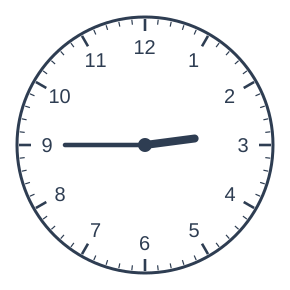
The clock below shows the time a school coach left for the museum one afternoon.
What time did the coach leave, on the 24-hour clock?
Model answer
The minute hand points at the 9: \(9 \times 5 = 45\) minutes past. The hour hand is between the 2 and the 3 and has not reached the 3, so the hour is 2. The time is 2:45, which in the afternoon is 14:45.
Answer: 14:45
Explanation
At quarter to the hour, the hour hand is close to the next number but has not reached it, so the hour is still 2. Add 12 for an afternoon time. A common mistake is to read the hour as 3 because the hour hand is so close to it.
Mark scheme
1 mark
14:45
Only 14:45. 15:15: reads the hour as 3 and takes the minute hand at the 9 as quarter past. 02:45: forgets to add 12 hours for an afternoon time. 15:45: reads the hour as 3 because the hour hand is nearly at the 3. 14:09: reads the minute hand pointing at the 9 as 9 minutes.
Question 3
1 mark
A kitchen timer counts down from 5 minutes. It now shows 2:35, which means there are 2 minutes 35 seconds left.
How many seconds have passed since the timer started?
Change both times into seconds, then subtract: 300 − 155 = 145. Another way is to count on from 2:35 left to 5:00, which is 25 seconds to 3:00 and then 2 minutes. A common mistake is to treat 2:35 as the number 235.
Mark scheme
1 mark
145 seconds
Only 145 seconds. 65 seconds: reads 2:35 as 235 seconds and takes it from 300. 155 seconds: gives the time left in seconds, not the time passed. 215 seconds: works out 5:00 − 2:35 by taking the smaller digit from the larger, so gets 3:35, which is 215 seconds. 265 seconds: uses 100 seconds in a minute and works out 500 − 235.
Question 4
2 marks
Amara's train journey takes 130 minutes.
How long is this in hours and minutes?
Model answer
60 minutes = 1 hour and 120 minutes = 2 hours. \(130 - 120 = 10\) So 130 minutes is 2 hours 10 minutes.
Answer: Hours: 2 hours Minutes: 10 minutes
Explanation
Take away as many whole hours (lots of 60 minutes) as you can: two hours use 120 minutes, leaving 10. A common mistake is to split 130 as 1 and 30, as if an hour had 100 minutes.
Mark scheme
1 mark
2 hours
Accept 2. Do not accept 1 (from using 100 minutes in an hour).
1 mark
10 minutes
Accept 10. Do not accept 30 (from using 100 minutes in an hour).
Ready to try the rest? Tap your answers and see straight away how you did.
Ctrl + Enter to check
Study HelperHints first, answers after you try
Stuck on this one? Ask for a hint and I’ll point you in the right direction, without giving the answer away. Once you’ve checked your answer, I’ll show you how the marks are awarded.