Level:
Correct: 0
Incorrect: 0
Marks: 0/0
Practice
Course:
Topics:
11+ Maths Smart practice A mixed round aimed at your weak spots
Unit 1
Number and place value
Unit 2
Calculation
Unit 3
Factors, multiples and primes
Unit 4
Fractions, decimals and percentages
Unit 5
Ratio and proportion
Unit 6
Algebra
Unit 7
Measures, time and money
Unit 8
Shape and angles
Unit 9
Area, perimeter and volume
Unit 10
Position and direction
Unit 11
Statistics
Unit 12
Probability
Unit 13
Problem solving
Avg
score:
–
Topics
done:
0/71

Problems with patterns

Practise 30 questions on Problems with patterns for 11+ Maths. Tap your answer and find out straight away if you are right, with the Study Helper on hand if you get stuck.

  • 30 questions
  • 1–2 marks each
  • Instant marking
  • No sign-up needed
20 questions, marked as you go

Sample questions with model answers

Here are 4 of the questions in this topic, each with a model answer, an explanation of why it earns the marks and the mark scheme.

Question 1

1 mark

The diagram shows a pattern of triangles made from matchsticks. Pattern 10 uses 21 matchsticks.

How many matchsticks does pattern 11 use?
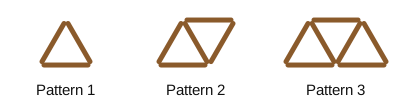
Three patterns made from matchsticks. Pattern 1 is one triangle. Pattern 2 is 2 triangles in a row, one pointing up and one pointing down, sharing a side. Pattern 3 is 3 triangles in a row, pointing up, down, up, each sharing a side with the next.

Model answer

Each new triangle shares a side with the one before, so it adds 2 matchsticks: 3, 5, 7, ...
Pattern 11: \(21 + 2 = 23\)

Answer: 23

Explanation

Look at how the pattern grows: each new triangle shares a side with the triangle before it, so it needs only 2 more matchsticks. Pattern 11 uses 21 + 2 = 23. A common mistake is to add 3 matchsticks, as if the new triangle did not share a side.

Mark scheme
  1. 1 mark

    23

    Accept 23 only. Do not accept 24 (adding 3 for a whole new triangle) or 22 (adding 1).
Question 2

1 mark

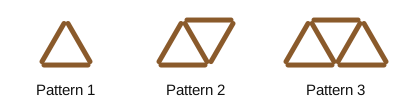
The diagram shows a pattern of triangles made from matchsticks.

How many matchsticks are needed to make pattern 30?

Three patterns made from matchsticks. Pattern 1 is one triangle. Pattern 2 is 2 triangles in a row, one pointing up and one pointing down, sharing a side. Pattern 3 is 3 triangles in a row, pointing up, down, up, each sharing a side with the next.

Model answer

Pattern n uses \(2n + 1\) matchsticks (3, 5, 7, ...).
Pattern 30: \(2 \times 30 + 1 = 61\)

Answer: 61

Explanation

Each triangle adds 2 matchsticks and there is 1 extra at the start, so the rule is 2 × pattern number + 1. Check it with pattern 3: \(2 \times 3 + 1 = 7\). A common mistake is to use 3 matchsticks for every triangle.

Mark scheme
  1. 1 mark

    61

    Only 61. 59: takes 1 away instead of adding it. 60: works out \(2 \times 30\) and forgets the extra matchstick. 63: starts with 3 and adds 2 thirty times instead of twenty-nine times. 90: uses 3 matchsticks for every triangle.

Question 3

1 mark

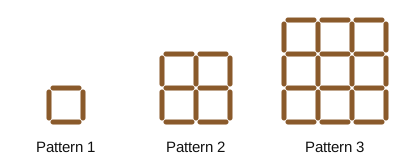
The diagram shows square grids made from matchsticks. Pattern 1 is a 1 by 1 grid, pattern 2 is a 2 by 2 grid, and so on.

How many matchsticks are needed for pattern 4?

Three square grids made from matchsticks. Pattern 1 is a single square. Pattern 2 is a 2 by 2 grid of squares. Pattern 3 is a 3 by 3 grid of squares.

Model answer

A 4 by 4 grid has 5 horizontal lines, each 4 matchsticks long: \(5 \times 4 = 20\).
It has 5 vertical lines, each 4 matchsticks long: 20.
Total: \(20 + 20 = 40\)
Check the pattern: 4, 12, 24, 40 goes up by 8, 12, 16.

Answer: 40

Explanation

Count the lines of matchsticks: a 4 by 4 grid has 5 rows of 4 across and 5 columns of 4 down, making 40. The jumps between patterns grow by 4 each time (8, 12, 16), so they are not all the same. A common mistake is to repeat the last jump of 12.

Mark scheme
  1. 1 mark

    40

    Only 40. 32: repeats the first jump, 8, instead of seeing that the jumps grow. 36: adds 12 again, the same jump as from pattern 2 to pattern 3. 48: doubles the 24 matchsticks of pattern 3. 64: uses 4 matchsticks for each of the 16 small squares, forgetting the shared sides.

Question 4

2 marks

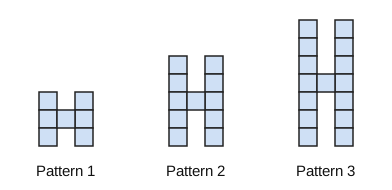
The diagram shows a pattern of H shapes made from square tiles.

Three H shapes made from square tiles. Each H has two upright columns of tiles joined by one tile in the middle. In pattern 1 each column is 3 tiles tall, in pattern 2 each column is 5 tiles tall, and in pattern 3 each column is 7 tiles tall.

Model answer

Tiles: pattern 1: 7, pattern 2: 11, pattern 3: 15. Up by 4 each time.
Each side of the H has \(2n + 1\) tiles, plus 1 tile in the middle: \(4n + 3\).
Pattern 6: \(4 \times 6 + 3 = 27\)
63 tiles: \(63 - 3 = 60\), \(60 \div 4 = 15\).

Answer: How many tiles are in pattern 6?: 27
Which pattern has 63 tiles?: 15

Explanation

Each new pattern adds 2 tiles to each side of the H, 4 tiles in all, so the rule is 4 × pattern number + 3. Work backwards for 63 tiles: take off 3, then divide by 4. A common mistake is to forget the 3 tiles that are there before the pattern grows.

Mark scheme
  1. 1 mark

    27

    Accept 27 only. Do not accept 24 (forgetting the 3 starting tiles) or 31 (pattern 7).

  2. 1 mark

    15

    Accept 15 only. Do not accept 16 (adding 1 instead of taking off 3) or 21 (\(63 \div 3\)).

Ready to try the rest? Tap your answers and see straight away how you did.

Study Helper Hints first, answers after you try

Stuck on this one? Ask for a hint and I’ll point you in the right direction, without giving the answer away. Once you’ve checked your answer, I’ll show you how the marks are awarded.