
Level:
Correct: 0
Incorrect: 0
Marks: 0/0
Practice
Course:
Topics:
11+ Maths Smart practice A mixed round aimed at your weak spots
Unit 1
Number and place value
Unit 2
Calculation
Unit 3
Factors, multiples and primes
Unit 4
Fractions, decimals and percentages
Unit 5
Ratio and proportion
Unit 6
Algebra
Unit 7
Measures, time and money
Unit 8
Shape and angles
Unit 9
Area, perimeter and volume
Unit 10
Position and direction
Unit 11
Statistics
Unit 12
Probability
Unit 13
Problem solving
Avg
score:
–
Topics
done:
0/71

Rounding and estimating

Practise 30 questions on Rounding and estimating for 11+ Maths. Tap your answer and find out straight away if you are right, with the Study Helper on hand if you get stuck.

  • 30 questions
  • 1–3 marks each
  • Instant marking
  • No sign-up needed
20 questions, marked as you go

Sample questions with model answers

Here are 4 of the questions in this topic, each with a model answer, an explanation of why it earns the marks and the mark scheme.

Question 1

1 mark

A bakery made 6,750 bread rolls last month.

Round 6,750 to the nearest hundred.

Model answer

6,750 is between 6,700 and 6,800.
The tens digit is 5, so round up.
6,750 rounds to 6,800.

Answer: 6800

Explanation

To round to the nearest hundred, look at the tens digit. 6,750 is exactly halfway between 6,700 and 6,800, and the rule is that a 5 rounds up. A common mistake is to round a 5 down and give 6,700.

Mark scheme
  1. 1 mark

    6800

    Accept 6800 with or without a comma. Do not accept 6,700 (rounds a 5 down) or 7,000 (the nearest thousand).
Question 2

1 mark

Which of these numbers rounds to 3.7 when it is rounded to one decimal place?

Model answer

Numbers that round to 3.7 are from 3.65 up to (but not including) 3.75.
3.65: hundredths digit 5, so it rounds up to 3.7.
3.64 rounds to 3.6, 3.75 and 3.76 round to 3.8, and 3.07 rounds to 3.1.

Answer: 3.65

Explanation

To round to one decimal place, look at the hundredths digit: 3.65 is exactly halfway between 3.6 and 3.7, and a 5 rounds up. 3.64 rounds down to 3.6, 3.75 and 3.76 round up to 3.8, and 3.07 rounds to 3.1. A common mistake is to think a 5 rounds down, or to cut off the last digit instead of rounding.

Mark scheme
  1. 1 mark

    3.65

    Only 3.65. 3.07: sees the digits 3 and 7. 3.64: rounds up whenever there is a digit after the tenths. 3.75: thinks 5 rounds down, so 3.75 rounds to 3.7. 3.76: cuts off the last digit instead of rounding (3.76 rounds to 3.8).

Question 3

1 mark

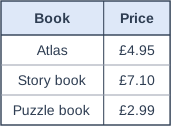
The table shows the prices of three books. Freya buys one of each. She estimates the total cost by rounding each price to the nearest pound.

What is her estimate?

Table with columns "Book", "Price". Book: Atlas; Price: £4.95 | Book: Story book; Price: £7.10 | Book: Puzzle book; Price: £2.99.

Model answer

£4.95 rounds to £5.
£7.10 rounds to £7.
£2.99 rounds to £3.
\(5 + 7 + 3 = 15\), so her estimate is £15.

Answer: £15

Explanation

Round each price to the nearest pound by looking at the pence: 50p or more rounds up. £4.95 and £2.99 round up, and £7.10 rounds down. A common mistake is to drop the pence from every price, which always rounds down.

Mark scheme
  1. 1 mark

    £15

    Only £15. £12: adds only the first two prices, leaving out the puzzle book. £13: rounds every price down. £14: rounds £2.99 down to £2. £16: rounds every price up.

Question 4

2 marks

A label on a giant jar says that it holds 5,600 beads, to the nearest hundred.

What is the smallest number of beads the jar could hold, and what is the largest?

Model answer

Halfway between 5,500 and 5,600 is 5,550, which rounds up to 5,600. So the smallest is 5,550.
Halfway between 5,600 and 5,700 is 5,650, which rounds up to 5,700. So the largest is 5,649.

Answer: Smallest number of beads: 5550
Largest number of beads: 5649

Explanation

Numbers that round to 5,600 start at the halfway point below it, 5,550, and stop just before the halfway point above it, 5,650. Beads are counted in whole numbers, so the largest is 5,649. A common mistake is to give 5,650, which rounds up to 5,700.

Mark scheme
  1. 1 mark

    5550

    Accept with or without a comma. Do not accept 5,500 or 5,551.

  2. 1 mark

    5649

    Accept with or without a comma. Do not accept 5,650 (it rounds to 5,700) or 5,699.

Ready to try the rest? Tap your answers and see straight away how you did.

Study Helper Hints first, answers after you try

Stuck on this one? Ask for a hint and I’ll point you in the right direction, without giving the answer away. Once you’ve checked your answer, I’ll show you how the marks are awarded.