Practise 25 questions on Likelihood and the probability scale for 11+ Maths. Tap your answer and find out straight away if you are right, with the Study Helper on hand if you get stuck.
25 questions
1–3 marks each
Instant marking
No sign-up needed
20 questions, marked as you go
Sample questions with model answers
Here are 4 of the questions in this topic, each with a model answer, an explanation of why it earns the marks and the mark scheme.
Question 1
1 mark
A tin holds 14 plain biscuits and 2 chocolate biscuits. Ruby takes one biscuit without looking.
Which word best describes the chance that she takes a plain biscuit?
Model answer
There are 14 + 2 = 16 biscuits. 14 out of 16 are plain, which is much more than half. There are chocolate biscuits too, so a plain one is not certain. So it is likely.
Answer: likely
Explanation
Most of the biscuits are plain, so taking a plain one is likely. It is not certain, because Ruby could take one of the 2 chocolate biscuits. A common mistake is to think two kinds of biscuit means an even chance, ignoring how many there are of each.
Mark scheme
1 mark
likely
Only likely. even chance: thinks two kinds of biscuit means a 50-50 chance. certain: thinks that nearly all of the biscuits means all of them. unlikely: looks at the chocolate biscuits instead of the plain ones. impossible: looks at the 2 chocolate biscuits instead of the plain ones, and thinks so few out of 16 cannot be taken.
Question 2
1 mark
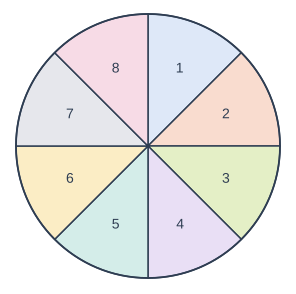
The diagram shows a fair spinner with 8 equal sections numbered 1 to 8. Wei spins it once.
Which word best describes the chance that it lands on a number greater than 6?
Model answer
The numbers greater than 6 are 7 and 8: 2 sections. 2 out of 8 is less than half but more than 0. So it is unlikely.
Answer: unlikely
Explanation
Only 2 of the 8 equal sections, 7 and 8, are greater than 6. That is less than half of the spinner, so it is unlikely, but it can happen. A common mistake is to count the numbers up to 6 instead, which gives likely.
Mark scheme
1 mark
unlikely
Only unlikely. even chance: thinks the number either is or is not greater than 6, so it is 50-50. certain: counts the 6 numbers that are not greater than 6, and thinks 6 sections out of 8 makes it certain. likely: counts the numbers that are not greater than 6. impossible: thinks 2 sections out of 8 are too few to come up, mixing up unlikely with impossible.
Question 3
1 mark
A month of the year is picked at random.
Which word best describes the chance that the month has 31 days?
Model answer
The months with 31 days are January, March, May, July, August, October and December: 7 months. 7 out of 12 is more than half, but not all of them. So it is likely.
Answer: likely
Explanation
Seven of the twelve months have 31 days, which is more than half, so it is likely. It is not certain, because five months have fewer days. A common mistake is to think the months are split evenly between 30 and 31 days.
Mark scheme
1 mark
likely
Only likely. even chance: thinks the months are half 30-day months and half 31-day months. impossible: thinks a month always has 30 days, so no month has 31. certain: thinks every month has 31 days, forgetting the shorter months. unlikely: counts the months that have 30 days or fewer instead.
Question 4
1 mark
Nadia rolls a fair dice with 12 faces, numbered 1 to 12.
The diagram shows a probability scale. Which arrow shows the probability that she rolls a multiple of 3?
Model answer
The multiples of 3 up to 12 are 3, 6, 9 and 12: 4 numbers. The probability is \(\dfrac{4}{12} = \dfrac{1}{3}\). From 0 to \(\dfrac{1}{2}\) there are 6 small parts, so each small part is \(\dfrac{1}{12}\). \(\dfrac{4}{12}\) is 4 small parts from 0: arrow C.
Answer: C
Explanation
Four of the twelve numbers are multiples of 3, so the probability is four twelfths, or one third. Each small division is one twelfth, because there are 6 of them between 0 and one half. A common mistake is to forget 12, which gives three twelfths.
Mark scheme
1 mark
C
Only C. B: forgets that 12 is a multiple of 3, counting only 3, 6 and 9. A: counts only the number 3. E: counts the numbers that are not multiples of 3. D: thinks the number either is or is not a multiple of 3, so it is an even chance.
Ready to try the rest? Tap your answers and see straight away how you did.
Ctrl + Enter to check
Study HelperHints first, answers after you try
Stuck on this one? Ask for a hint and I’ll point you in the right direction, without giving the answer away. Once you’ve checked your answer, I’ll show you how the marks are awarded.