
Level:
Correct: 0
Incorrect: 0
Marks: 0/0
Practice
Course:
Topics:
11+ Maths Smart practice A mixed round aimed at your weak spots
Unit 1
Number and place value
Unit 2
Calculation
Unit 3
Factors, multiples and primes
Unit 4
Fractions, decimals and percentages
Unit 5
Ratio and proportion
Unit 6
Algebra
Unit 7
Measures, time and money
Unit 8
Shape and angles
Unit 9
Area, perimeter and volume
Unit 10
Position and direction
Unit 11
Statistics
Unit 12
Probability
Unit 13
Problem solving
Avg
score:
–
Topics
done:
0/71

Area of triangles and parallelograms

Practise 30 questions on Area of triangles and parallelograms for 11+ Maths. Tap your answer and find out straight away if you are right, with the Study Helper on hand if you get stuck.

  • 30 questions
  • 1–2 marks each
  • Instant marking
  • No sign-up needed
20 questions, marked as you go

Sample questions with model answers

Here are 4 of the questions in this topic, each with a model answer, an explanation of why it earns the marks and the mark scheme.

Question 1

1 mark

Isla draws a triangle on a grid of centimetre squares.

What is the area of Isla's triangle?
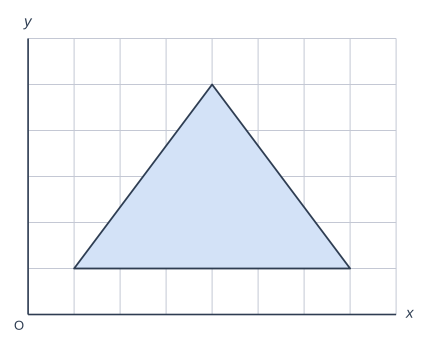
A sketch on a pair of axes (x across, y up) with no scale marked, the axes crossing at the origin O. A shaded triangle with vertices (1, 1), (7, 1) and (4, 5).

Model answer

The base is 6 squares long and the height is 4 squares.
\(\dfrac{1}{2} \times 6 \times 4 = 12\) cm²

Answer: 12 cm²

Explanation

Count the base along the grid (6 cm) and the height straight up from the base to the top corner (4 cm). The area is half of 6 × 4, which is 12 cm². The triangle is half of a 6 by 4 rectangle, so you can check by counting that rectangle's squares and halving.

Mark scheme
  1. 1 mark

    12 cm²

    Only 12 cm². 6 cm²: counts only the whole squares inside the triangle (4 in the bottom row and 2 in the next). 10 cm²: adds the base and the height. 15 cm²: counts 5 grid lines going up from the base instead of the 4 squares, so uses a height of 5: 6 × 5 ÷ 2. 24 cm²: multiplies the base (6) by the height (4) and forgets to halve.
Question 2

1 mark

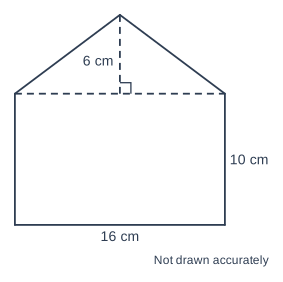
The diagram shows the front of a bird box. It is a rectangle with a triangle on top. The dashed lines show where they join and the height of the triangle.

What is the area of the front of the bird box?

Geometry diagram, marked "Not drawn accurately". A pentagon (its vertices are not labelled). A dashed horizontal line with no labelled ends is drawn. A dashed vertical line with no labelled ends is drawn. The angle at an unlabelled point is marked as a right angle (90°). The unlabelled side going to the right is labelled 16 cm. The unlabelled side going upwards is labelled 10 cm. An unlabelled line going downwards is labelled 6 cm.

Model answer

Rectangle: \(16 \times 10 = 160\) cm²
Triangle: \(\dfrac{1}{2} \times 16 \times 6 = 48\) cm²
Total: \(160 + 48 = 208\) cm²

Answer: 208 cm²

Explanation

Split the shape into a rectangle and a triangle. The triangle's base is the top of the rectangle, 16 cm, and its height is 6 cm, so it is half of 16 × 6 = 48 cm². Add the rectangle's 160 cm² to get 208 cm². A common mistake is to forget to halve the triangle.

Mark scheme
  1. 1 mark

    208 cm²

    Only 208 cm². 48 cm²: finds the area of the triangle only. 160 cm²: finds the area of the rectangle only. 184 cm²: halves the triangle twice (160 + 24). 256 cm²: forgets to halve the triangle (160 + 96).

Question 3

1 mark

A triangle on a centimetre grid has its corners at (2, 1), (10, 1) and (6, 8).

What is the area of the triangle?

Model answer

The base joins (2, 1) and (10, 1): it is \(10 - 2 = 8\) cm long.
The top corner (6, 8) is \(8 - 1 = 7\) cm above the base.
\(\dfrac{1}{2} \times 8 \times 7 = 28\) cm²

Answer: 28 cm²

Explanation

Two corners have the same y-coordinate, so they make a horizontal base: 10 − 2 = 8 cm. The height is how far the third corner is above that base: 8 − 1 = 7 cm. Half of 8 × 7 is 28 cm². A common mistake is to use a coordinate as a length instead of the difference between two coordinates.

Mark scheme
  1. 1 mark

    28 cm²

    Only 28 cm². 15 cm²: adds the base and the height. 32 cm²: uses 8, the y-coordinate of the top corner, as the height instead of 8 − 1 = 7. 35 cm²: uses 10, the x-coordinate of a corner, as the base instead of 10 − 2 = 8. 56 cm²: multiplies the base by the height and forgets to halve.

Question 4

2 marks

A triangle has a base of 14 cm and a perpendicular height of 9 cm. A parallelogram has a base of 7 cm and a perpendicular height of 9 cm.

What is the area of each shape?

Model answer

Triangle: \(\dfrac{1}{2} \times 14 \times 9 = 7 \times 9 = 63\) cm²
Parallelogram: \(7 \times 9 = 63\) cm²

Answer: Area of the triangle: 63 cm²
Area of the parallelogram: 63 cm²

Explanation

The triangle is half of base × height: half of 14 is 7, and 7 × 9 = 63 cm². The parallelogram is base × height with no halving: 7 × 9 = 63 cm². The two areas are the same, because the triangle's base is twice as long. A common mistake is to halve the parallelogram too.

Mark scheme
  1. 1 mark

    63 cm²

    Do not accept 126 (not halved).

  2. 1 mark

    63 cm²

    Do not accept 16 (7 + 9, the base and height added).

Ready to try the rest? Tap your answers and see straight away how you did.

Study Helper Hints first, answers after you try

Stuck on this one? Ask for a hint and I’ll point you in the right direction, without giving the answer away. Once you’ve checked your answer, I’ll show you how the marks are awarded.