Practise 25 questions on Venn and Carroll diagrams for 11+ Maths. Tap your answer and find out straight away if you are right, with the Study Helper on hand if you get stuck.
25 questions
1–2 marks each
Instant marking
No sign-up needed
20 questions, marked as you go
Sample questions with model answers
Here are 4 of the questions in this topic, each with a model answer, an explanation of why it earns the marks and the mark scheme.
Question 1
1 mark
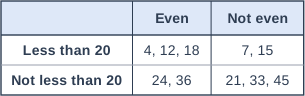
The Carroll diagram sorts some numbers.
In which box does the number 27 belong?
Model answer
27 is odd, so it is not even. 27 is more than 20, so it is not less than 20. It goes in the box for not even and not less than 20 (with 21, 33 and 45).
Answer: Not even and not less than 20
Explanation
Check each property in turn: one decides the column and the other decides the row. Every number fits exactly one box of a Carroll diagram. A common mistake is to judge whether a number is even by its tens digit instead of its ones digit.
Mark scheme
1 mark
Not even and not less than 20
Only this answer: Not even and not less than 20. It does not belong in any box: thinks a number must already be in the diagram; every number fits exactly one box. Even and less than 20: makes both mistakes: judges evenness by the tens digit, 2, and reads 'not less than 20' the wrong way round. Not even and less than 20: reads "not less than 20" the wrong way round. Even and not less than 20: looks at the tens digit, 2, which is even, instead of the whole number.
Question 2
1 mark
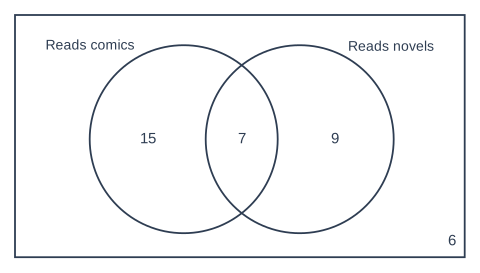
Year 6 children were asked whether they read comics and whether they read novels. The Venn diagram shows the results.
How many children read novels?
Model answer
Everyone in the Reads novels circle reads novels, including the overlap. \(9 + 7 = 16\)
Answer: 16
Explanation
The children who read novels are in the whole Reads novels circle: the part for novels only and the overlap for children who read both. A common mistake is to count only the part of the circle that does not overlap.
Mark scheme
1 mark
16
Only 16. 7: counts only the children who read both. 9: counts only the children who read novels but not comics. 22: adds the whole comics circle (15 + 7). 31: counts every child inside the circles, including those who read only comics.
Question 3
1 mark
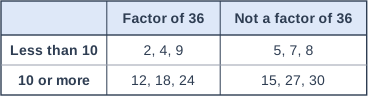
Kai sorted some numbers into the Carroll diagram. He put one number in the wrong box.
Which number is in the wrong box?
Model answer
Factors of 36, in pairs: \(1 \times 36\), \(2 \times 18\), \(3 \times 12\), \(4 \times 9\), \(6 \times 6\). 24 is in the Factor of 36 column, but \(36 \div 24\) is not a whole number, so 24 is not a factor of 36. It belongs in the box for numbers that are not factors of 36 and are 10 or more.
Answer: 24
Explanation
List the factors of 36 in pairs, then check every number in the diagram against the list. 24 and 36 are both in the 12 times table, but 24 does not divide into 36. A common mistake is to think a number that shares a times table with 36 must be a factor of it.
Mark scheme
1 mark
24
Only 24. 8: thinks 8 is a factor of 36, but \(36 \div 8\) is not a whole number. 12: thinks 12 is not a factor of 36, but \(3 \times 12 = 36\). 18: thinks 18 is not a factor of 36, but \(2 \times 18 = 36\). 27: thinks 27 is a factor of 36 because both are in the 9 times table.
Question 4
2 marks
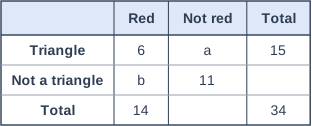
A Carroll diagram sorts 34 shapes into red or not red, and triangle or not a triangle. It shows how many shapes are in each box. Some numbers are missing.
Work out the values of a and b.
Model answer
a: the triangles add up to 15, so \(a = 15 - 6 = 9\) b: the red shapes add up to 14, so \(b = 14 - 6 = 8\) Check: \(6 + 9 + 8 + 11 = 34\)
Answer: a: 9 b: 8
Explanation
Each row and each column of the diagram adds up to its total. Use the triangle row to find a and the red column to find b, then check that all four boxes make 34. A common mistake is to add instead of subtract.
Mark scheme
1 mark
9
Do not accept 21 (6 + 15).
1 mark
8
Do not accept 20 (14 + 6).
Ready to try the rest? Tap your answers and see straight away how you did.
Ctrl + Enter to check
Study HelperHints first, answers after you try
Stuck on this one? Ask for a hint and I’ll point you in the right direction, without giving the answer away. Once you’ve checked your answer, I’ll show you how the marks are awarded.