Level:
Correct: 0
Incorrect: 0
Marks: 0/0
Practice
Course:
Topics:
11+ Maths Smart practice A mixed round aimed at your weak spots
Unit 1
Number and place value
Unit 2
Calculation
Unit 3
Factors, multiples and primes
Unit 4
Fractions, decimals and percentages
Unit 5
Ratio and proportion
Unit 6
Algebra
Unit 7
Measures, time and money
Unit 8
Shape and angles
Unit 9
Area, perimeter and volume
Unit 10
Position and direction
Unit 11
Statistics
Unit 12
Probability
Unit 13
Problem solving
Avg
score:
–
Topics
done:
0/71

Tables and two-way tables

Practise 25 questions on Tables and two-way tables for 11+ Maths. Tap your answer and find out straight away if you are right, with the Study Helper on hand if you get stuck.

  • 25 questions
  • 1–2 marks each
  • Instant marking
  • No sign-up needed
20 questions, marked as you go

Sample questions with model answers

Here are 4 of the questions in this topic, each with a model answer, an explanation of why it earns the marks and the mark scheme.

Question 1

1 mark

The table shows how the children in Year 5 and Year 6 travel to school.

How many children in these two years travel by car?
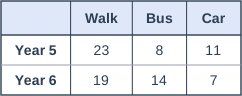
Table with columns (row headings), "Walk", "Bus", "Car". Year 5; Walk: 23; Bus: 8; Car: 11 | Year 6; Walk: 19; Bus: 14; Car: 7.

Model answer

Car: Year 5 has 11 and Year 6 has 7.
\(11 + 7 = 18\)

Answer: 18

Explanation

The question asks about both years, so add the two numbers in the Car column. A common mistake is to give only one year's number, or to read down the wrong column.

Mark scheme
  1. 1 mark

    18

    Only 18. 4: subtracts 7 from 11 instead of adding. 7: gives the Year 6 children only. 11: gives the Year 5 children only. 22: adds the bus column instead of the car column.
Question 2

1 mark

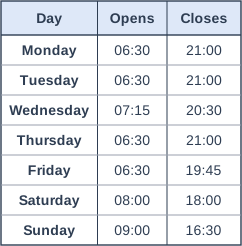
The table shows the opening times of a swimming pool.

For how long is the pool open on Wednesday?

Table with columns "Day", "Opens", "Closes". Day: Monday; Opens: 06:30; Closes: 21:00 | Day: Tuesday; Opens: 06:30; Closes: 21:00 | Day: Wednesday; Opens: 07:15; Closes: 20:30 | Day: Thursday; Opens: 06:30; Closes: 21:00 | Day: Friday; Opens: 06:30; Closes: 19:45 | Day: Saturday; Opens: 08:00; Closes: 18:00 | Day: Sunday; Opens: 09:00; Closes: 16:30.

Model answer

Wednesday: opens 07:15, closes 20:30.
From 07:15 to 20:15 is 13 hours.
From 20:15 to 20:30 is 15 minutes.
So it is open for 13 hours 15 minutes.

Answer: 13 hours 15 minutes

Explanation

Count whole hours from the opening time, then the extra minutes. 20:30 on the 24-hour clock is 8:30 pm. A common mistake is to read 20:30 as a morning time or to add the minutes instead of finding the difference.

Mark scheme
  1. 1 mark

    13 hours 15 minutes

    Only 13 hours 15 minutes. 13 hours 45 minutes: adds the 15 and 30 minutes instead of finding the difference. 14 hours 30 minutes: reads Monday's times instead of Wednesday's. 1 hour 15 minutes: reads 20:30 as 8:30 am instead of 8:30 pm. 14 hours 15 minutes: counts the hours 7, 8, 9, ..., 20 as 14 hours.

Question 3

1 mark

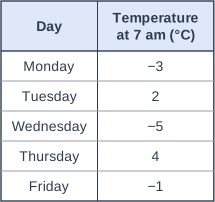
The table shows the temperature at 7 am on each weekday (Monday to Friday) of one week in February.

What is the difference between the highest and the lowest temperature in the table?

Table with columns "Day", "Temperature at 7 am (°C)". Day: Monday; Temperature at 7 am (°C): −3 | Day: Tuesday; Temperature at 7 am (°C): 2 | Day: Wednesday; Temperature at 7 am (°C): −5 | Day: Thursday; Temperature at 7 am (°C): 4 | Day: Friday; Temperature at 7 am (°C): −1.

Model answer

Highest: 4°C (Thursday). Lowest: −5°C (Wednesday).
From −5 up to 0 is 5 degrees, and from 0 up to 4 is 4 degrees.
\(5 + 4 = 9\) degrees

Answer: 9°C

Explanation

The lowest temperature is the negative number furthest from zero, −5°C. To find the difference, count up from −5 to 0 and then from 0 to 4. A common mistake is to ignore the minus sign and subtract 4 from 5.

Mark scheme
  1. 1 mark

    9°C

    Only 9°C. 1°C: ignores the minus sign and works out 5 − 4. 7°C: uses −3°C as the lowest temperature instead of −5°C. 5°C: uses −1°C as the lowest temperature. 10°C: counts the numbers from −5 to 4 (−5, −4, ..., 4), which makes 10 numbers, instead of the steps between them.

Question 4

1 mark

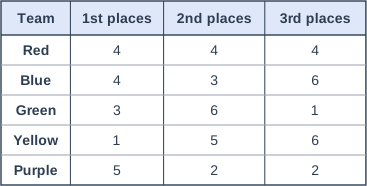
At a sports day, each 1st place scores 5 points, each 2nd place scores 3 points and each 3rd place scores 1 point. The table shows the places won by each team.

Which team scored the most points?

Table with columns "Team", "1st places", "2nd places", "3rd places". Team: Red; 1st places: 4; 2nd places: 4; 3rd places: 4 | Team: Blue; 1st places: 4; 2nd places: 3; 3rd places: 6 | Team: Green; 1st places: 3; 2nd places: 6; 3rd places: 1 | Team: Yellow; 1st places: 1; 2nd places: 5; 3rd places: 6 | Team: Purple; 1st places: 5; 2nd places: 2; 3rd places: 2.

Model answer

Red: \(4 \times 5 + 4 \times 3 + 4 \times 1 = 36\)
Blue: \(4 \times 5 + 3 \times 3 + 6 \times 1 = 35\)
Green: \(3 \times 5 + 6 \times 3 + 1 \times 1 = 34\)
Yellow: \(1 \times 5 + 5 \times 3 + 6 \times 1 = 26\)
Purple: \(5 \times 5 + 2 \times 3 + 2 \times 1 = 33\)
Red scored the most points.

Answer: Red

Explanation

Work out each team's points: multiply each number of places by its points and add the three answers. Red has neither the most 1st places nor the most places, but scores the most points. A common mistake is to pick the team with the most 1st places.

Mark scheme
  1. 1 mark

    Red

    Only this answer: Red. Blue: has the most places altogether (13), but scores only 35 points. Green: leaves out the 3rd places; Green scores 34 points. Purple: has the most 1st places (5), but scores only 33 points. Yellow: gives 1 point for 1st and 5 points for 3rd, the wrong way round.

Ready to try the rest? Tap your answers and see straight away how you did.

Study Helper Hints first, answers after you try

Stuck on this one? Ask for a hint and I’ll point you in the right direction, without giving the answer away. Once you’ve checked your answer, I’ll show you how the marks are awarded.