Practise 30 questions on Properties of 2D shapes and circles for 11+ Maths. Tap your answer and find out straight away if you are right, with the Study Helper on hand if you get stuck.
30 questions
1–3 marks each
Instant marking
No sign-up needed
20 questions, marked as you go
Sample questions with model answers
Here are 4 of the questions in this topic, each with a model answer, an explanation of why it earns the marks and the mark scheme.
Question 1
1 mark
I am a quadrilateral. I have two pairs of parallel sides. My sides are not all the same length, and I have no right angles.
What am I?
Model answer
Two pairs of parallel sides: a parallelogram, rhombus, rectangle or square (a trapezium has only one pair and a kite has none). No right angles: not a rectangle or square. Sides not all equal: not a rhombus. So it is a parallelogram.
Answer: a parallelogram
Explanation
Use the clues one at a time to rule shapes out. Two pairs of parallel sides leaves the parallelogram family; no right angles rules out the rectangle and square; sides not all equal rules out the rhombus. A common mistake is to stop after the first clue.
Mark scheme
1 mark
a parallelogram
Only a parallelogram. a kite: forgets that a kite has no parallel sides. a rectangle: forgets the clue that there are no right angles. a rhombus: forgets the clue that the sides are not all the same length. a trapezium: forgets that a trapezium has only one pair of parallel sides.
Question 2
1 mark
How many pairs of parallel sides does a regular hexagon have?
Model answer
In a regular hexagon each side is parallel to the side opposite it. 6 sides make \(6 \div 2 = 3\) pairs.
Answer: 3
Explanation
Each side of a regular hexagon has a side directly opposite it, pointing the same way, so they are parallel. The 6 sides make 3 opposite pairs. A common mistake is to count the 6 sides instead of the pairs.
Mark scheme
1 mark
3
Only 3. 0: thinks only quadrilaterals have parallel sides. 1: thinks a shape can only have one pair of parallel sides, like a trapezium. 2: misses one of the three pairs of opposite sides. 6: counts the sides, not the pairs.
Question 3
1 mark
A round pizza has a diameter of 30 cm. It is cut into 6 equal slices, with every cut going from the centre to the edge.
How long is each straight edge of a slice?
Model answer
Each straight edge goes from the centre to the edge of the pizza, so it is a radius. \(30 \div 2 = 15\) cm.
Answer: 15 cm
Explanation
Every cut goes from the centre to the edge, so each straight edge of a slice is a radius, half the diameter: 15 cm. The number of slices does not change how long the edges are. A common mistake is to divide by the number of slices.
Mark scheme
1 mark
15 cm
Only 15 cm. 2.5 cm: finds the radius, 15 cm, then divides it by the 6 slices as well. 5 cm: divides 30 by 6, the number of slices. 30 cm: uses the diameter instead of the radius. 60 cm: doubles the diameter instead of halving it.
Question 4
2 marks
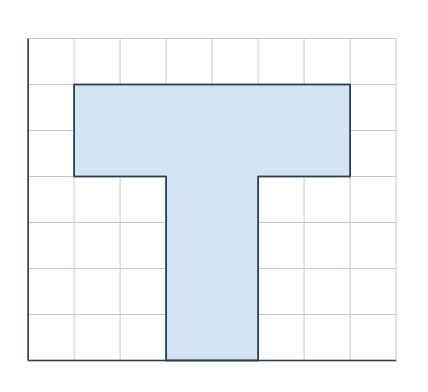
The diagram shows an octagon drawn on squared paper.
How many of its angles are right angles? How many are reflex angles?
Model answer
The octagon is shaped like a T. It has 8 corners. The 6 outer corners are right angles. The 2 corners where the stem meets the top bar point inwards: the angle inside the shape there is \(360 - 90 = 270^\circ\), a reflex angle.
Answer: Right angles: 6 Reflex angles: 2
Explanation
Look at the angle inside the shape at each corner. Six corners turn outwards and are right angles. At the two corners where the stem joins the bar, the inside angle is three right angles, 270 degrees, which is reflex. A common mistake is to count those two corners as right angles because they look square from outside.
Mark scheme
1 mark
6
Accept 6. Do not accept 8 (counting the two reflex corners as right angles).
1 mark
2
Accept 2. Do not accept 0.
Ready to try the rest? Tap your answers and see straight away how you did.
Ctrl + Enter to check
Study HelperHints first, answers after you try
Stuck on this one? Ask for a hint and I’ll point you in the right direction, without giving the answer away. Once you’ve checked your answer, I’ll show you how the marks are awarded.