Level:
Correct: 0
Incorrect: 0
Marks: 0/0
Practice
Course:
Topics:
11+ Maths Smart practice A mixed round aimed at your weak spots
Unit 1
Number and place value
Unit 2
Calculation
Unit 3
Factors, multiples and primes
Unit 4
Fractions, decimals and percentages
Unit 5
Ratio and proportion
Unit 6
Algebra
Unit 7
Measures, time and money
Unit 8
Shape and angles
Unit 9
Area, perimeter and volume
Unit 10
Position and direction
Unit 11
Statistics
Unit 12
Probability
Unit 13
Problem solving
Avg
score:
–
Topics
done:
0/71

Reading scales

Practise 25 questions on Reading scales for 11+ Maths. Tap your answer and find out straight away if you are right, with the Study Helper on hand if you get stuck.

  • 25 questions
  • 1–3 marks each
  • Instant marking
  • No sign-up needed
20 questions, marked as you go

Sample questions with model answers

Here are 4 of the questions in this topic, each with a model answer, an explanation of why it earns the marks and the mark scheme.

Question 1

1 mark

Wei weighs a bag of carrots on the weighing scales shown. The arrow points to the mass.

What is the mass of the carrots?
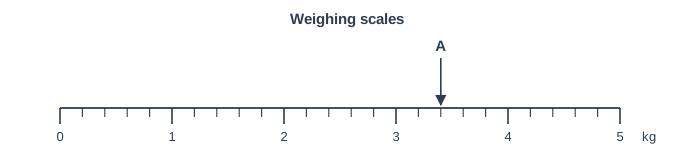
Weighing scales. A horizontal scale from 0 to 5 kg, divided into 5 equal parts by long marks, each split into 5 small divisions by short marks. Every long mark is numbered (0, 1, 2, 3, 4 and 5). An arrow labelled A points to a mark on the scale.

Model answer

Between 3 and 4 there are 5 small spaces, so each one is \(1 \div 5 = 0.2\) kg.
The arrow is 2 small marks after 3.
\(3 + 2 \times 0.2 = 3.4\) kg

Answer: 3.4 kg

Explanation

Each kilogram is split into 5 equal spaces, so each small mark is 0.2 kg. Two marks after 3 is 3.4 kg. A common mistake is to assume each small mark is 0.1 kg, which gives 3.2 kg.

Mark scheme
  1. 1 mark

    3.4 kg

    Only 3.4 kg. 3.04 kg: writes 4 tenths as 4 hundredths. 3.2 kg: counts each small mark as 0.1 kg instead of 0.2 kg. 3.6 kg: counts 3 small marks after 3 instead of 2. 34 kg: leaves out the decimal point.


Question 2

1 mark

Maya puts a leaf on a ruler. The leaf starts at arrow A and ends at arrow B.

How long is the leaf?

A ruler from 0 to 10 cm, divided into 10 equal parts by long marks, each split into 10 small divisions by short marks. Every long mark is numbered (0, 1, 2, 3, 4, 5, 6, 7, 8, 9 and 10). An arrow labelled A points to a mark on the scale. An arrow labelled B points to a mark on the scale.

Model answer

Arrow A is at 2.5 cm and arrow B is at 9.1 cm.
\(9.1 - 2.5 = 6.6\) cm

Answer: 6.6 cm

Explanation

When an object does not start at 0, read both ends and subtract. Here 9.1 − 2.5 = 6.6 cm. A common mistake is to read only the end of the leaf, which gives 9.1 cm.

Mark scheme
  1. 1 mark

    6.6 cm

    Only 6.6 cm. 7.1 cm: takes away only the whole 2 cm at the start and forgets the half centimetre. 7.4 cm: takes the smaller tenths digit from the larger (5 − 1 = 4) instead of exchanging. 9.1 cm: reads arrow B as if the leaf started at 0. 11.6 cm: adds the two readings instead of subtracting.

Question 3

1 mark

A glue stick lies along the ruler shown, with one end at 0 and the other at arrow A.

How long is the glue stick, in millimetres?

A ruler from 0 to 10 cm, divided into 10 equal parts by long marks, each split into 10 small divisions by short marks. Every long mark is numbered (0, 1, 2, 3, 4, 5, 6, 7, 8, 9 and 10). An arrow labelled A points to a mark on the scale.

Model answer

Arrow A is 4 small marks past 7, so the glue stick is 7.4 cm long.
1 cm = 10 mm, so \(7.4 \times 10 = 74\) mm.

Answer: 74 mm

Explanation

Every small mark on a ruler is 1 mm, and there are 10 mm in each centimetre. Seven whole centimetres is 70 mm, and 4 more small marks makes 74 mm. A common mistake is to give the answer in centimetres, 7.4, when the question asks for millimetres.

Mark scheme
  1. 1 mark

    74 mm

    Accept 74. Do not accept 704 (writes 7 cm and 4 mm side by side) or 70 (leaves out the 4 mm).

Question 4

2 marks

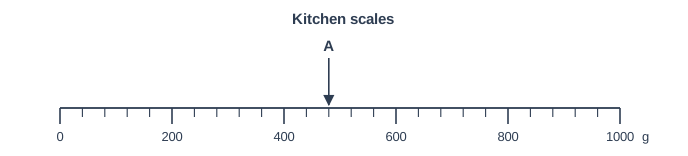
Kofi is weighing flour for a cake. The diagram shows the scale on his kitchen scales, and arrow A shows how much flour is on them. The recipe needs 1 kg of flour.

How much flour is on the scales, and how many more grams does Kofi need?

Kitchen scales. A horizontal scale from 0 to 1000 g, divided into 5 equal parts by long marks, each split into 5 small divisions by short marks. Every long mark is numbered (0, 200, 400, 600, 800 and 1000). An arrow labelled A points to a mark on the scale.

Model answer

Between 400 and 600 there are 5 small spaces, so each one is \(200 \div 5 = 40\) g.
Arrow A is 2 small marks above 400: \(400 + 2 \times 40 = 480\) g.
1 kg = 1,000 g, and \(1{,}000 - 480 = 520\) g.

Answer: Flour on the scales (g): 480 g
More flour needed (g): 520 g

Explanation

Each gap of 200 g is split into 5 spaces, so each small mark is 40 g, an unusual step that is easy to misread. Then change 1 kg to 1,000 g and subtract. A common mistake is to subtract 480 from 1 instead of from 1,000.

Mark scheme
  1. 1 mark

    480 g

    Accept 480. Do not accept 420 (counts each small mark as 10 g) or 500 (divides 200 by the 4 marks instead of the 5 spaces, so counts each mark as 50 g).

  2. 1 mark

    520 g

    Accept 520. Follow through: 1000 − their reading.

Ready to try the rest? Tap your answers and see straight away how you did.

Study Helper Hints first, answers after you try

Stuck on this one? Ask for a hint and I’ll point you in the right direction, without giving the answer away. Once you’ve checked your answer, I’ll show you how the marks are awarded.