Practise 25 questions on Symmetry for 11+ Maths. Tap your answer and find out straight away if you are right, with the Study Helper on hand if you get stuck.
25 questions
1–2 marks each
Instant marking
No sign-up needed
20 questions, marked as you go
Sample questions with model answers
Here are 4 of the questions in this topic, each with a model answer, an explanation of why it earns the marks and the mark scheme.
Question 1
1 mark
How many lines of symmetry does a semicircle have?
Model answer
A semicircle is half a circle: one straight edge (a diameter) and one curved edge. The only fold that makes the two halves match is the line from the middle of the straight edge to the middle of the curved edge. So it has 1 line of symmetry.
Answer: 1
Explanation
Fold a semicircle along the line from the middle of its straight edge to the middle of its curved edge, and the two halves match. No other fold works: the straight edge itself is not a line of symmetry, because the whole shape is on one side of it. A common mistake is to think a semicircle, like a circle, has many lines of symmetry.
Mark scheme
1 mark
1
Accept 1. Do not accept 2 (also counting the straight edge) or 0.
Question 2
1 mark
Which of these shapes has rotational symmetry of order 2 but no lines of symmetry?
Model answer
A parallelogram with no right angles and two side lengths looks the same after a half turn: order 2. But folding it along any line does not make the halves match: no lines of symmetry.
Answer: a parallelogram with no right angles and two different side lengths
Explanation
Turn a parallelogram half way round its centre and it fits its outline again, so its order of rotational symmetry is 2. But it cannot be folded in half to match, because it leans over. Rectangles and rhombuses also have order 2, but each has 2 lines of symmetry as well. A common mistake is to think rotational symmetry needs lines of symmetry.
Mark scheme
1 mark
a parallelogram with no right angles and two different side lengths
Only a parallelogram with no right angles and two different side lengths. a kite: thinks a kite has rotational symmetry, but it only has 1 line of symmetry. an isosceles trapezium: thinks an isosceles trapezium has rotational symmetry, but it has 1 line of symmetry and order 1. a rectangle that is not a square: forgets that a rectangle has 2 lines of symmetry. a rhombus that is not a square: forgets that a rhombus has 2 lines of symmetry, its diagonals.
Question 3
1 mark
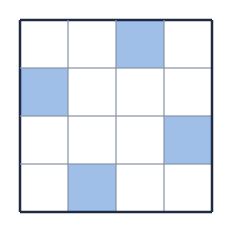
The diagram shows a pattern of four shaded squares on a square grid.
What is the order of rotational symmetry of the pattern, turning it about the centre of the grid?
Model answer
After a quarter turn about the centre, each shaded square moves to where the next one was, so the pattern looks the same. It looks the same after 1, 2, 3 and 4 quarter turns: order 4.
Answer: 4
Explanation
The four squares are placed like the sails of a windmill: a quarter turn moves each one onto the next, so the pattern fits itself 4 times in a full turn. It has no lines of symmetry, which shows that rotational symmetry does not depend on line symmetry. A common mistake is to say order 1 because there are no lines of symmetry.
Mark scheme
1 mark
4
Only 4. 0: thinks a pattern with no lines of symmetry has order 0. 1: thinks a pattern with no lines of symmetry has no rotational symmetry. 2: checks only the half turn. 3: counts the 3 quarter turns that look the same before the full turn, and leaves out the full turn.
Question 4
1 mark
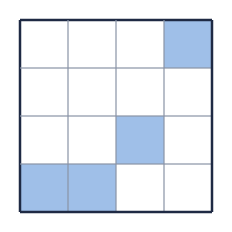
The diagram shows a pattern of shaded squares on a square grid.
What is the smallest number of extra squares that must be shaded so that the pattern looks exactly the same after a half turn about the centre of the grid?
Model answer
A half turn about the centre moves each square to the opposite side. The bottom-left square and the top-right square already swap with each other. The square at column 2, row 1 needs a partner at column 3, row 4, and the square at column 3, row 2 needs a partner at column 2, row 3: 2 extra squares.
Answer: 2
Explanation
To look the same after a half turn (rotational symmetry of order 2), every shaded square needs a partner in the place it moves to after a half turn about the centre. Two shaded squares (the corner squares) are already partners. The other two have no partners, so 2 extra squares are needed. A common mistake is to add a partner for every shaded square, including the ones that already have one.
Mark scheme
1 mark
2
Accept 2. Do not accept 4 (a new partner for every shaded square) or 3.
Ready to try the rest? Tap your answers and see straight away how you did.
Ctrl + Enter to check
Study HelperHints first, answers after you try
Stuck on this one? Ask for a hint and I’ll point you in the right direction, without giving the answer away. Once you’ve checked your answer, I’ll show you how the marks are awarded.