Level:
Correct: 0
Incorrect: 0
Marks: 0/0
Practice
Course:
Topics:
11+ Maths Smart practice A mixed round aimed at your weak spots
Unit 1
Number and place value
Unit 2
Calculation
Unit 3
Factors, multiples and primes
Unit 4
Fractions, decimals and percentages
Unit 5
Ratio and proportion
Unit 6
Algebra
Unit 7
Measures, time and money
Unit 8
Shape and angles
Unit 9
Area, perimeter and volume
Unit 10
Position and direction
Unit 11
Statistics
Unit 12
Probability
Unit 13
Problem solving
Avg
score:
–
Topics
done:
0/71

Rotations and compass directions

Practise 25 questions on Rotations and compass directions for 11+ Maths. Tap your answer and find out straight away if you are right, with the Study Helper on hand if you get stuck.

  • 25 questions
  • 1–2 marks each
  • Instant marking
  • No sign-up needed
20 questions, marked as you go

Sample questions with model answers

Here are 4 of the questions in this topic, each with a model answer, an explanation of why it earns the marks and the mark scheme.

Question 1

1 mark

Tom is facing north. He turns clockwise until he is facing west.

How many right angles has he turned through?

Model answer

Clockwise from north: east (1 right angle), south (2), west (3).

Answer: 3

Explanation

Turning clockwise from north, Tom faces east after one right angle, south after two and west after three. So he turns through 3 right angles, which is a three-quarter turn. A common mistake is to go the short way round, anticlockwise, which is only 1 right angle.

Mark scheme
  1. 1 mark

    3

    Accept 3 only. Do not accept 1 (the anticlockwise turn) or 2 (a half turn).
Question 2

1 mark

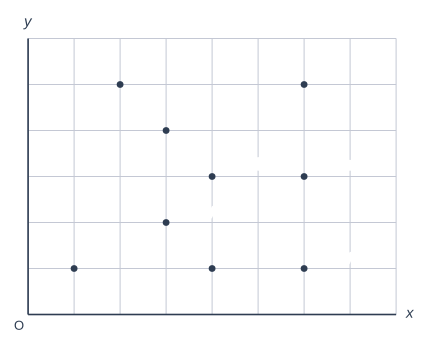
The map shows some places in a town, drawn on a grid. North is straight up the map.

In which direction is the library from the school?

A sketch on a pair of axes (x across, y up) with no scale marked, the axes crossing at the origin O. A point labelled "Park" is marked with a dot at (1, 1). A point labelled "Farm" is marked with a dot at (4, 1). A point labelled "Library" is marked with a dot at (6, 1). A point labelled "Bakery" is marked with a dot at (3, 2). A point labelled "School" is marked with a dot at (4, 3). A point labelled "Museum" is marked with a dot at (6, 3). A point labelled "Cafe" is marked with a dot at (3, 4). A point labelled "Pond" is marked with a dot at (2, 5). A point labelled "Shop" is marked with a dot at (6, 5).

Model answer

From the school to the library is 2 squares to the right (east) and 2 squares down (south).
Equal moves east and south make the direction south-east.

Answer: south-east

Explanation

Start at the school and see how to reach the library: 2 squares right, which is east, and 2 squares down, which is south. The same distance east and south means the library is exactly south-east of the school. A common mistake is to give the direction the other way round, from the library to the school.

Mark scheme
  1. 1 mark

    south-east

    Only south-east. east: notices only the move to the right. north-west: gives the direction of the school from the library. north-east: thinks going down the map is north. south-west: mixes up east and west.

Question 3

1 mark

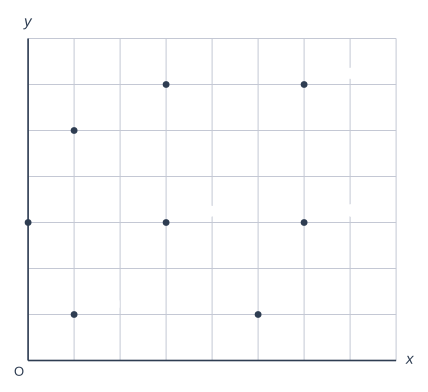
The map shows a park, drawn on a grid. North is straight up the map. Sam walks from the bench to the swings along the grid lines, going only north and east.

How many squares does Sam walk?

A sketch on a pair of axes (x across, y up) with no scale marked, the axes crossing at the origin O. A point labelled "Fountain" is marked with a dot at (3, 3). A point labelled "Tree" is marked with a dot at (3, 6). A point labelled "Swings" is marked with a dot at (6, 6). A point labelled "Bandstand" is marked with a dot at (6, 3). A point labelled "Slide" is marked with a dot at (5, 1). A point labelled "Bench" is marked with a dot at (1, 1). A point labelled "Gate" is marked with a dot at (0, 3). A point labelled "Shed" is marked with a dot at (1, 5).

Model answer

From the bench to the swings: 5 squares east and 5 squares north.
\(5 + 5 = 10\) squares

Answer: 10 squares

Explanation

Walking along the grid lines, Sam has to cover the whole distance east and the whole distance north. The swings are 5 squares east and 5 squares north of the bench, so he walks 5 + 5 = 10 squares, whatever order he takes them in. A common mistake is to count only one of the two directions.

Mark scheme
  1. 1 mark

    10 squares

    Accept 10 only. Do not accept 5 (only one of the two moves) or 12 (counting grid lines including both ends).

Question 4

1 mark

Point P \((4, 1)\) is rotated 90° clockwise about the origin to give point Q. Then Q is rotated 90° clockwise about the origin to give point R.

What are the coordinates of R?

Model answer

P is 4 right and 1 up from the origin.
Quarter turn clockwise: 4 right becomes 4 down, 1 up becomes 1 right, so Q \(= (1, -4)\).
Another quarter turn: 1 right becomes 1 down, 4 down becomes 4 left, so R \(= (-4, -1)\).

Answer: \((-4, -1)\)

Explanation

Two quarter turns clockwise make a half turn, so R is P sent through the origin to the other side: both signs change, and (4, 1) becomes (−4, −1). Doing it step by step gives Q = (1, −4) first, and then R = (−4, −1). A common mistake is to stop at Q.

Mark scheme
  1. 1 mark

    \((-4, -1)\)

    Only \((-4, -1)\). \((1, -4)\): stops after the first rotation, which gives Q. \((4, -1)\): reflects P in the x-axis. \((-1, 4)\): rotates P once anticlockwise instead of twice clockwise. \((-1, -4)\): changes both signs, as for a half turn, but also swaps the numbers, as for a quarter turn.

Ready to try the rest? Tap your answers and see straight away how you did.

Study Helper Hints first, answers after you try

Stuck on this one? Ask for a hint and I’ll point you in the right direction, without giving the answer away. Once you’ve checked your answer, I’ll show you how the marks are awarded.