Practise 30 questions on 3D shapes and nets for 11+ Maths. Tap your answer and find out straight away if you are right, with the Study Helper on hand if you get stuck.
30 questions
1–3 marks each
Instant marking
No sign-up needed
20 questions, marked as you go
Sample questions with model answers
Here are 4 of the questions in this topic, each with a model answer, an explanation of why it earns the marks and the mark scheme.
Question 1
1 mark
A square-based pyramid has a point at the top called the apex.
How many edges meet at the apex?
Model answer
One sloping edge goes from each corner of the square base up to the apex. The square has 4 corners, so 4 edges meet at the apex.
Answer: 4
Explanation
Each corner of the square base is joined to the apex by a sloping edge, so there are 4 of them. The pyramid also has 4 edges round the base, making 8 edges altogether. A common mistake is to give all 8 edges.
Mark scheme
1 mark
4
Accept 4. Do not accept 8 (all the edges) or 5 (the number of vertices).
Question 2
1 mark
Which of these 3D shapes has the same number of faces as vertices?
Model answer
Square-based pyramid: 5 faces (1 square and 4 triangles) and 5 vertices (4 at the base and the apex). Cube and cuboid: 6 faces, 8 vertices. Triangular prism: 5 faces, 6 vertices. Hexagonal prism: 8 faces, 12 vertices.
Answer: a square-based pyramid
Explanation
Count carefully for each shape. A square-based pyramid has a square and 4 triangles, 5 faces, and 4 corners round the base plus the apex, 5 vertices. Every pyramid has the same number of faces as vertices. A common mistake is to count the triangular prism's faces and vertices both as 5, but it has 6 vertices.
Mark scheme
1 mark
a square-based pyramid
Only a square-based pyramid. a cuboid: mixes up its 6 faces and 8 vertices. a triangular prism: counts its 5 faces and thinks it has 5 vertices. a cube: mixes up its 6 faces and 8 vertices. a hexagonal prism: counts the 6 sides of the hexagon for both.
Question 3
1 mark
A cube has edges that are 3 cm long.
What is the total length of all the edges of the cube?
Model answer
A cube has 12 edges. \(12 \times 3 = 36\) cm.
Answer: 36 cm
Explanation
A cube has 12 edges: 4 round the top, 4 round the bottom and 4 upright ones. Each is 3 cm, so the total is 12 × 3 = 36 cm. A common mistake is to use the number of faces (6) or vertices (8) instead of the number of edges.
Mark scheme
1 mark
36 cm
Only 36 cm. 12 cm: counts the edges but does not multiply by 3. 18 cm: uses 6, the number of faces, instead of the number of edges. 24 cm: uses 8, the number of vertices, instead of the number of edges. 27 cm: works out 3 × 3 × 3, which is the volume.
Question 4
2 marks
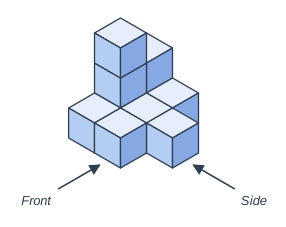
The diagram shows a solid made from cubes. The arrows show the front and the side.
How many squares would you see if you looked at the solid from the front? How many from the side?
Model answer
From the front you see the tallest stack in each column, left to right: 3, 1 and 1: \(3 + 1 + 1 = 5\). From the side you see the tallest stack in each row, back to front: 2, 3 and 1: \(2 + 3 + 1 = 6\).
Answer: Squares seen from the front: 5 Squares seen from the side: 6
Explanation
Looking from one direction, a column of stacks lined up one behind another shows only as tall as its tallest stack, because the others hide behind it. From the front the tallest stacks are 3, 1 and 1 cubes high, giving 5 squares; from the side they are 2, 3 and 1, giving 6. A common mistake is to count every cube.
Mark scheme
1 mark
5
Accept 5. Do not accept 10 (all the cubes).
1 mark
6
Accept 6. Do not accept 10.
Ready to try the rest? Tap your answers and see straight away how you did.
Ctrl + Enter to check
Study HelperHints first, answers after you try
Stuck on this one? Ask for a hint and I’ll point you in the right direction, without giving the answer away. Once you’ve checked your answer, I’ll show you how the marks are awarded.