
Level:
Correct: 0
Incorrect: 0
Marks: 0/0
Exam Practice
Course:
Topics:
Edexcel GCSE Statistics (Higher Paper 1) Smart practice A mixed round aimed at your weak spots
Unit 1
The statistical enquiry cycle
Statistical enquiry cycle stages 1 and 2; (a) Planning: 1a.01, 1a.02, 1a.03
Statistical enquiry cycle: planning and collecting
Statistical enquiry cycle stages 3, 4 and 5
Statistical enquiry cycle: interpreting and evaluating
Unit 2
The collection of data
(b) Types of data: 1b.01, 1b.02, 1b.03
Types of data and variables
(b) Types of data: 1b.04; (d) Collecting data: 1d.01, 1d.02
Primary and secondary data, reliability and validity
(c) Population and sampling: 1c.01, 1c.02, 1c.03
Populations, sampling frames and non-random sampling
(c) Population and sampling: 1c.04, 1c.05
Random and systematic sampling
(c) Population and sampling: 1c.06
Stratified sampling
(d) Collecting data: 1d.05, 1d.06
Problems with collected data and cleaning data
Unit 3
Processing, representing and analysing data
(a) Tabulation, diagrams and representation: 2a.01
Tabulation, tallies, pictograms and two-way tables
(a) Tabulation, diagrams and representation: 2a.01, 2a.02
Pie charts and comparative pie charts
(a) Tabulation, diagrams and representation: 2a.01
Stem and leaf diagrams
(a) Tabulation, diagrams and representation: 2a.02
Population pyramids, choropleth maps and 2D and 3D diagrams
(a) Tabulation, diagrams and representation: 2a.04
Histograms and frequency density
(a) Tabulation, diagrams and representation: 2a.05, 2a.06, 2a.07, 2a.08
Choosing representations and misleading diagrams
(a) Tabulation, diagrams and representation: 2a.09, 2a.10
Skewness
(b) Measures of central tendency: 2b.01, 2b.02, 2b.03
Mode, median and mean
(b) Measures of central tendency: 2b.01
Weighted mean and geometric mean
(c) Measures of dispersion: 2c.01, 2c.06
Standard deviation and standardised scores
(a) Tabulation, diagrams and representation: 2a.03; (c) Measures of dispersion: 2c.02, 2c.03
Box plots and outliers
(b) Measures of central tendency: 2b.03; (c) Measures of dispersion: 2c.04, 2c.05
Comparing distributions
(d) Further summary statistics: 2d.01
Index numbers
(d) Further summary statistics: 2d.02
Rates of change
(e) Scatter diagrams and correlation: 2e.01, 2e.02, 2e.03
Scatter diagrams, correlation and causation
(e) Scatter diagrams and correlation: 2e.04
Lines of best fit and regression lines
(e) Scatter diagrams and correlation: 2e.05, 2e.06, 2e.07, 2e.08
Spearman's rank and product moment correlation coefficients
(f) Time series: 2f.01, 2f.02; (b) 2b.01 mean seasonal variation
Time series, moving averages and seasonal variation
(g) Quality assurance: 2g.01, 2g.02
Quality assurance and control charts
(h) Estimation: 2h.01, 2h.02, 2h.03
Estimation, sample size and capture-recapture
Unit 4
Probability
3. Probability: 3p.01, 3p.02, 3p.03, 3p.04
Probability, expected frequency and risk
3. Probability: 3p.05, 3p.06, 3p.10
Experimental and theoretical probability and bias
3. Probability: 3p.11
Binomial distribution
3. Probability: 3p.12, 3p.13
Normal distribution
Avg
score:
–
Topics
done:
0/40

Two-way tables, sample spaces, tree and Venn diagrams

Practise 17 exam-style questions on Two-way tables, sample spaces, tree and Venn diagrams for Edexcel GCSE Statistics (Higher Paper 1). Write your answer as you would in the exam and get it marked in seconds against the mark scheme, point by point, with the Study Helper on hand if you get stuck.

  • 17 questions
  • 1–5 marks each
  • Instant marking
  • No sign-up needed
17 questions, marked as you go

Sample questions with model answers

Here are 4 of the questions in this topic, each with a model answer, an explanation of why it earns the marks and the mark scheme an examiner would use.

Question 1

1 mark

There are 180 students in Year 11 at a school.
46 of the Year 11 students study French.

A student is chosen at random from the whole school.
E is the event 'the student is in Year 11'.
F is the event 'the student studies French'.

Explain why the events E and F are not mutually exclusive.

Model answer

46 students are in Year 11 and study French, so a student chosen at random can be in E and in F at the same time. So E and F are not mutually exclusive.

Explanation

Mutually exclusive events cannot happen at the same time. Here 46 students belong to both events, so P(E and F) is not 0. Students often confuse mutually exclusive with independent; whether studying French depends on year group is a different question.

Mark scheme
  1. 1 mark

    B1 for a correct explanation, e.g. the events can both happen at the same time because 46 students are in Year 11 and study French

    Accept 'a student can be in Year 11 and also study French (46 of them do)' oe. Must refer to both events happening together (reference to the 46 students is not essential if this is clear). Do not accept answers about independence, e.g. 'being in Year 11 does not affect studying French'. Do not accept 'because not all Year 11 students study French'.

Question 2

2 marks

A cafe offers a meal deal.
The meal deal is one main, one drink and one dessert.

Main: pasta, salad or wrap
Drink: juice or water
Dessert: fruit or yogurt

Ellie chooses each part of her meal deal at random.

By listing all the possible meal deals, or otherwise, work out the probability that Ellie's meal deal includes salad or juice or both.

Model answer

All the meal deals (main, drink, dessert):
P J F, P J Y, P W F, P W Y
S J F, S J Y, S W F, S W Y
W J F, W J Y, W W F, W W Y
(where the first W is wrap and the second W is water)
12 equally likely meal deals.
Including salad or juice: P J F, P J Y, S J F, S J Y, S W F, S W Y, W J F, W J Y = 8
Probability \(= \dfrac{8}{12} = \dfrac{2}{3}\)

Explanation

Listing systematically (fix the main, then the drink, then the dessert) makes sure all \(3 \times 2 \times 2 = 12\) outcomes appear once each. Salad and juice are not mutually exclusive, so the 2 deals with both must be counted once: 4 + 6 - 2 = 8. A quicker route is 1 - P(no salad and no juice).

Mark scheme
  1. 1 mark

    M1 for a systematic list of all 12 meal deals, or 12 as the number of outcomes (\(3 \times 2 \times 2\)) with a count of the deals including salad or juice, or \(1 - \dfrac{2}{3} \times \dfrac{1}{2}\)

    The 8 deals that include salad or juice are: pasta-juice-fruit, pasta-juice-yogurt, salad-juice-fruit, salad-juice-yogurt, salad-water-fruit, salad-water-yogurt, wrap-juice-fruit, wrap-juice-yogurt. Allow a list with one error or omission. Answer-only rule for this question: A correct answer with no working scores full marks.

  2. 1 mark

    A1 for \(\dfrac{8}{12}\) oe

    Accept \(\dfrac{2}{3}\), awrt 0.667 or 0.67, 66.7%. A correct answer with no working scores full marks. \(\dfrac{10}{12}\) (counting the 2 deals with salad and juice twice: 4 + 6) scores M1A0.

Question 3

3 marks

Every member of a gym has exactly one type of membership.
The table shows the probability that a member chosen at random has each type of membership.

Work out the probability that a member chosen at random has an off-peak membership or a student membership.

Table with columns "Type of membership", "Standard", "Off-peak", "Student", "Family". Type of membership: Probability; Standard: 0.42; Off-peak: x; Student: 0.13; Family: 2x.

Model answer

The probabilities add up to 1:
\(0.42 + x + 0.13 + 2x = 1\)
\(3x = 0.45\)
\(x = 0.15\)
Off-peak and student are mutually exclusive, so
P(off-peak or student) \(= 0.15 + 0.13 = 0.28\)

Explanation

The four types of membership are exhaustive (every member has one) and mutually exclusive (no member has two), so their probabilities add up to 1, which gives an equation for x. Then the addition law for mutually exclusive events gives P(off-peak or student) = P(off-peak) + P(student). Using 2x instead of x for off-peak is a common slip.

Mark scheme
  1. 1 mark

    M1 for \(0.42 + x + 0.13 + 2x = 1\) oe

    e.g. \(3x = 0.45\) or \(1 - 0.42 - 0.13 = 0.45\) followed by an attempt to divide by 3. The probabilities add up to 1 because the types of membership are mutually exclusive and exhaustive. Answer-only rule for this question: A correct answer with no working scores full marks.

  2. 1 mark

    A1 for x = 0.15

    oe. May be implied by 0.15 in the off-peak position or 0.3 for family.

  3. 1 mark

    B1ft for 0.28 oe

    ft their x + 0.13, provided 0 < their x < 0.87. Accept 28%, \(\dfrac{7}{25}\). A correct answer with no working scores full marks. 0.0195 (multiplying 0.15 and 0.13) B0. Probabilities must be fractions, decimals or percentages: ratio notation (e.g. 7 : 24) or 'out of' wording (e.g. '7 out of 24') scores A0/B0 for this mark (Pearson's general marking guidance).

Question 4

4 marks

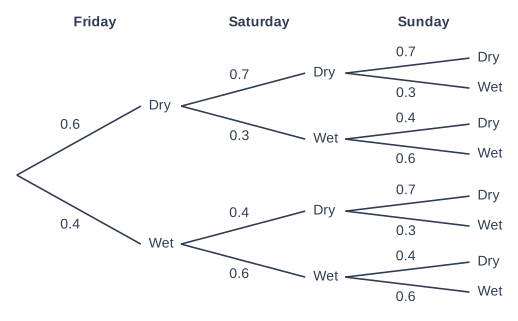
Lily uses a model for the weather in a seaside town in July.

In the model,
- the probability that Friday is dry is 0.6
- if a day is dry, the probability that the next day is dry is 0.7
- if a day is wet, the probability that the next day is dry is 0.4

The tree diagram shows this information for Friday, Saturday and Sunday of one weekend.

Work out the probability that it is dry on Sunday.

A probability tree diagram drawn from left to right with 3 stages of branches, headed "Friday", "Saturday" and "Sunday". Each branch has its outcome written at its end and its probability written beside it. First stage, 2 branches: "Dry" with probability 0.6, "Wet" with probability 0.4. After "Dry", the second stage branches are "Dry" with probability 0.7, "Wet" with probability 0.3. After "Dry" then "Dry", the third stage branches are "Dry" with probability 0.7, "Wet" with probability 0.3. After "Dry" then "Wet", the third stage branches are "Dry" with probability 0.4, "Wet" with probability 0.6. After "Wet", the second stage branches are "Dry" with probability 0.4, "Wet" with probability 0.6. After "Wet" then "Dry", the third stage branches are "Dry" with probability 0.7, "Wet" with probability 0.3. After "Wet" then "Wet", the third stage branches are "Dry" with probability 0.4, "Wet" with probability 0.6.

Model answer

Paths that end with Sunday dry:
Dry, Dry, Dry: \(0.6 \times 0.7 \times 0.7 = 0.294\)
Dry, Wet, Dry: \(0.6 \times 0.3 \times 0.4 = 0.072\)
Wet, Dry, Dry: \(0.4 \times 0.4 \times 0.7 = 0.112\)
Wet, Wet, Dry: \(0.4 \times 0.6 \times 0.4 = 0.096\)
P(Sunday dry) \(= 0.294 + 0.072 + 0.112 + 0.096 = 0.574\)

Explanation

On a three-stage tree diagram, find every path that ends with Sunday dry, multiply along each path, and add the four products, because the paths are mutually exclusive. A shortcut is to find P(Saturday dry) = 0.58 first and use it as the first stage of a two-stage tree. A common error is to use only the path that is dry on all three days.

Mark scheme
  1. 1 mark

    M1 for one correct product for a path ending in dry on Sunday, e.g. \(0.6 \times 0.7 \times 0.7\) (= 0.294)

    The four paths are DDD 0.294, DWD 0.072, WDD 0.112, WWD 0.096. Alternative method: M1 for P(Saturday dry) \(= 0.6 \times 0.7 + 0.4 \times 0.4\) (= 0.58). Answer-only rule for this question: A correct answer with no working scores full marks.

  2. 1 mark

    M1 for all four correct products: \(0.6 \times 0.7 \times 0.7\), \(0.6 \times 0.3 \times 0.4\), \(0.4 \times 0.4 \times 0.7\), \(0.4 \times 0.6 \times 0.4\)

    Alternative method: M1 for their 0.58 \(\times\) 0.7 or (1 - their 0.58) \(\times\) 0.4. Award M0 if any path ending in wet on Sunday is included.

  3. 1 mark

    M1 for adding the four correct products

    e.g. 0.294 + 0.072 + 0.112 + 0.096. Alternative method: M1 for \(0.58 \times 0.7 + 0.42 \times 0.4\).

  4. 1 mark

    A1 for 0.574 oe

    Accept awrt 0.57 or 57.4%. A correct answer with no working scores full marks. 0.294 (dry on all three days) scores M1M0M0A0. 0.7 or 0.55 (averaging) scores 0. Probabilities must be fractions, decimals or percentages: ratio notation (e.g. 7 : 24) or 'out of' wording (e.g. '7 out of 24') scores A0/B0 for this mark (Pearson's general marking guidance).

Ready to try the rest? Every answer you write is marked against the mark scheme, so you can see exactly where the marks are.

Study Helper Hints first, answers after you try

Stuck on this one? Ask for a hint and I’ll point you in the right direction, without giving the answer away. Once you’ve checked your answer, I’ll show you how the marks are awarded.