
Level:
Correct: 0
Incorrect: 0
Marks: 0/0
Exam Practice
Course:
Topics:
Edexcel GCSE Statistics (Higher Paper 1) Smart practice A mixed round aimed at your weak spots
Unit 1
The statistical enquiry cycle
Statistical enquiry cycle stages 1 and 2; (a) Planning: 1a.01, 1a.02, 1a.03
Statistical enquiry cycle: planning and collecting
Statistical enquiry cycle stages 3, 4 and 5
Statistical enquiry cycle: interpreting and evaluating
Unit 2
The collection of data
(b) Types of data: 1b.01, 1b.02, 1b.03
Types of data and variables
(b) Types of data: 1b.04; (d) Collecting data: 1d.01, 1d.02
Primary and secondary data, reliability and validity
(c) Population and sampling: 1c.01, 1c.02, 1c.03
Populations, sampling frames and non-random sampling
(c) Population and sampling: 1c.04, 1c.05
Random and systematic sampling
(c) Population and sampling: 1c.06
Stratified sampling
(d) Collecting data: 1d.05, 1d.06
Problems with collected data and cleaning data
Unit 3
Processing, representing and analysing data
(a) Tabulation, diagrams and representation: 2a.01
Tabulation, tallies, pictograms and two-way tables
(a) Tabulation, diagrams and representation: 2a.01, 2a.02
Pie charts and comparative pie charts
(a) Tabulation, diagrams and representation: 2a.01
Stem and leaf diagrams
(a) Tabulation, diagrams and representation: 2a.02
Population pyramids, choropleth maps and 2D and 3D diagrams
(a) Tabulation, diagrams and representation: 2a.04
Histograms and frequency density
(a) Tabulation, diagrams and representation: 2a.05, 2a.06, 2a.07, 2a.08
Choosing representations and misleading diagrams
(a) Tabulation, diagrams and representation: 2a.09, 2a.10
Skewness
(b) Measures of central tendency: 2b.01, 2b.02, 2b.03
Mode, median and mean
(b) Measures of central tendency: 2b.01
Weighted mean and geometric mean
(c) Measures of dispersion: 2c.01, 2c.06
Standard deviation and standardised scores
(a) Tabulation, diagrams and representation: 2a.03; (c) Measures of dispersion: 2c.02, 2c.03
Box plots and outliers
(b) Measures of central tendency: 2b.03; (c) Measures of dispersion: 2c.04, 2c.05
Comparing distributions
(d) Further summary statistics: 2d.01
Index numbers
(d) Further summary statistics: 2d.02
Rates of change
(e) Scatter diagrams and correlation: 2e.01, 2e.02, 2e.03
Scatter diagrams, correlation and causation
(e) Scatter diagrams and correlation: 2e.04
Lines of best fit and regression lines
(e) Scatter diagrams and correlation: 2e.05, 2e.06, 2e.07, 2e.08
Spearman's rank and product moment correlation coefficients
(f) Time series: 2f.01, 2f.02; (b) 2b.01 mean seasonal variation
Time series, moving averages and seasonal variation
(g) Quality assurance: 2g.01, 2g.02
Quality assurance and control charts
(h) Estimation: 2h.01, 2h.02, 2h.03
Estimation, sample size and capture-recapture
Unit 4
Probability
3. Probability: 3p.01, 3p.02, 3p.03, 3p.04
Probability, expected frequency and risk
3. Probability: 3p.05, 3p.06, 3p.10
Experimental and theoretical probability and bias
3. Probability: 3p.11
Binomial distribution
3. Probability: 3p.12, 3p.13
Normal distribution
Avg
score:
–
Topics
done:
0/40

Experiments, extraneous variables and control groups

Practise 13 exam-style questions on Experiments, extraneous variables and control groups for Edexcel GCSE Statistics (Higher Paper 1). Write your answer as you would in the exam and get it marked in seconds against the mark scheme, point by point, with the Study Helper on hand if you get stuck.

  • 13 questions
  • 1–5 marks each
  • Instant marking
  • No sign-up needed
13 questions, marked as you go

Sample questions with model answers

Here are 4 of the questions in this topic, each with a model answer, an explanation of why it earns the marks and the mark scheme an examiner would use.

Question 1

1 mark

A company has made a new anti-fog coating for swimming goggles. It tests the coating on 40 pairs of goggles of the same type. 20 of the pairs, chosen at random, are given the coating. The other 20 pairs are not coated.

Swimmers wear the goggles, and the company records how long each pair takes to fog up.

Give a reason why the 20 pairs of goggles without the coating are needed in this experiment.

Model answer

The 20 uncoated pairs are a control group. Comparing the two groups shows how much longer the coated goggles stay clear because of the coating, rather than because of things that affect all the goggles, such as the water temperature or how long the swimmers swim.

Explanation

A control group is treated in the same way as the test group except for the one thing being tested. Without it, the company could not tell whether the goggles would have stayed clear just as long anyway. Vague answers such as 'to see if it works' miss the key idea of comparison.

Mark scheme
  1. 1 mark

    B1 for they are a control group: they give something to compare with, so that any difference in the time before the goggles fog up can be put down to the coating (rather than to other factors such as the water temperature or the swimmers)

    oe. Accept 'to compare coated goggles with uncoated goggles' or 'it controls for extraneous variables'. B0 for 'to see if the coating works' with no idea of comparison. B0 for 'to make it a fair test' with no reason.
Question 2

2 marks

A farmer wants to compare the yields of two varieties of wheat, X and Y. She plans to grow variety X in a field next to her farmhouse and variety Y in another field 5 miles away.

Explain why this plan may not give a fair comparison.
Suggest how she could improve her plan.

Model answer

The fields may have different soil, drainage and amounts of sunlight. These extraneous variables could make one field give a bigger yield, so she would not know whether the difference was caused by the variety of wheat.

Improvement: divide one field into small areas, and choose at random which areas grow variety X and which grow variety Y.

Explanation

When two treatments are compared in different places, the place is an extraneous variable that is mixed up with the treatment. Growing both varieties in the same conditions, with random allocation of areas, controls it. Look for whatever else differs between the two groups.

Mark scheme
  1. 1 mark

    B1 for the two fields may be different (e.g. soil, drainage, sunlight, rainfall), so a difference in yield could be caused by the field rather than the variety of wheat

    oe. Must give an example of an extraneous variable or say that the conditions in the two fields may differ. B0 for 'it is not fair' with no reason.

  2. 1 mark

    B1 for grow both varieties in the same field, e.g. split one field into many small areas and choose at random which variety is grown in each / grow them side by side in matched areas with the same soil and conditions

    oe. Accept 'grow both varieties in both fields'. B0 for 'use bigger fields' or 'grow more wheat'.

Question 3

3 marks

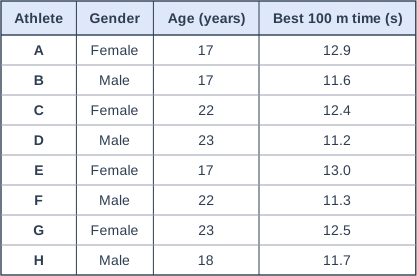
A sports scientist wants to find out whether a new warm-up routine improves sprint times. She has 8 athletes. She will use matched pairs: one athlete in each pair will do the new warm-up and the other will do the usual warm-up.

The table shows information about the athletes.

Write down the athlete who should be paired with athlete A. Give a reason for your answer.
Explain how the scientist should decide which athlete in each pair does the new warm-up.

Table with columns "Athlete", "Gender", "Age (years)", "Best 100 m time (s)". Athlete: A; Gender: Female; Age (years): 17; Best 100 m time (s): 12.9 | Athlete: B; Gender: Male; Age (years): 17; Best 100 m time (s): 11.6 | Athlete: C; Gender: Female; Age (years): 22; Best 100 m time (s): 12.4 | Athlete: D; Gender: Male; Age (years): 23; Best 100 m time (s): 11.2 | Athlete: E; Gender: Female; Age (years): 17; Best 100 m time (s): 13.0 | Athlete: F; Gender: Male; Age (years): 22; Best 100 m time (s): 11.3 | Athlete: G; Gender: Female; Age (years): 23; Best 100 m time (s): 12.5 | Athlete: H; Gender: Male; Age (years): 18; Best 100 m time (s): 11.7.

Model answer

Athlete E should be paired with athlete A. Both are female and aged 17, and their best 100 m times (12.9 s and 13.0 s) are almost the same.

For each pair, the scientist should flip a coin to decide which athlete does the new warm-up; the other athlete does the usual warm-up.

Explanation

Matched pairs are chosen to be as alike as possible on the extraneous variables that could affect the result: here gender, age and sprinting ability. Choosing at random which member of each pair gets the new treatment stops the scientist's own choices from biasing the groups. The other pairs are B with H, C with G and D with F.

Mark scheme
  1. 1 mark

    B1 for E

    cao.

  2. 1 mark

    B1 for a reason: E is the same gender and the same age as A and has a very similar best 100 m time (13.0 s and 12.9 s)

    Dependent on E. Must refer to at least two of gender, age and best time (or to 'all the characteristics').

  3. 1 mark

    B1 for choose at random which athlete in each pair does the new warm-up (e.g. flip a coin for each pair); the other athlete does the usual warm-up

    oe. This mark is independent of the first two. B0 for 'the faster athlete does the new warm-up' or 'let the athletes choose'.

Question 4

4 marks

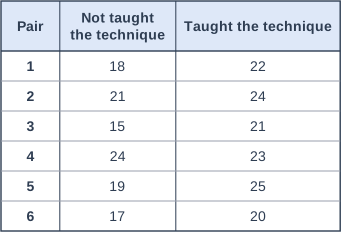
Ms Okafor wants to find out whether a memory technique helps students to remember a list of 30 items. She puts 12 students into 6 matched pairs. In each pair, one student is taught the technique and the other is not. Each student then tries to remember the list.

The table shows the number of items remembered by each student.

Ms Okafor says,
'The technique helps students to remember more items.'

Use calculations to assess Ms Okafor's statement.
Give one reason why your conclusion may not be reliable.

Table with columns "Pair", "Not taught the technique", "Taught the technique". Pair: 1; Not taught the technique: 18; Taught the technique: 22 | Pair: 2; Not taught the technique: 21; Taught the technique: 24 | Pair: 3; Not taught the technique: 15; Taught the technique: 21 | Pair: 4; Not taught the technique: 24; Taught the technique: 23 | Pair: 5; Not taught the technique: 19; Taught the technique: 25 | Pair: 6; Not taught the technique: 17; Taught the technique: 20.

Model answer

Differences (with technique minus without): 4, 3, 6, -1, 6, 3
Mean difference \(= \dfrac{4 + 3 + 6 - 1 + 6 + 3}{6} = \dfrac{21}{6} = 3.5\)
(Or: mean with technique \(= \dfrac{135}{6} = 22.5\), mean without \(= \dfrac{114}{6} = 19\).)

On average, the students taught the technique remembered 3.5 more items than their partners, and they did better in 5 of the 6 pairs. This supports Ms Okafor's statement.

However, the conclusion may not be reliable because only 6 pairs were tested.

Explanation

With matched pairs, compare within each pair: the differences show the effect of the technique with the paired characteristics controlled, and their mean equals the difference between the two group means. A conclusion needs a decision linked to the calculated values. Always consider the size of the experiment: 6 pairs is too few to be sure.

Mark scheme
  1. 1 mark

    M1 for finding the difference for each pair (4, 3, 6, -1, 6, 3), or the total or mean for either group (114 or 19, 135 or 22.5)

    Differences may be found the other way round (technique minus no technique, or no technique minus technique) if consistent.

  2. 1 mark

    A1 for a mean difference of 3.5 items, or both means 19 and 22.5 (or both totals 114 and 135)

    cao.

  3. 1 mark

    B1ft for supports the statement: on average, students taught the technique remembered 3.5 more items (22.5 > 19), and the student with the technique did better in 5 of the 6 pairs

    Dependent on M1. ft their values. Must give a decision and refer to a correct comparison of their values (the mean difference, the two means, or the number of pairs that improved). A conclusion with no calculations scores B0.

  4. 1 mark

    B1 for a reason, e.g. only 6 pairs were tested (small sample) / the pairs may not be perfectly matched / in one pair the student without the technique remembered more / other extraneous variables (e.g. tiredness, interest, how hard each student tried) were not controlled

    oe. This mark is independent of the others. B0 for 'there is no control group' (the students not taught the technique are the control group).

Ready to try the rest? Every answer you write is marked against the mark scheme, so you can see exactly where the marks are.

Study Helper Hints first, answers after you try

Stuck on this one? Ask for a hint and I’ll point you in the right direction, without giving the answer away. Once you’ve checked your answer, I’ll show you how the marks are awarded.