Level:
Correct: 0
Incorrect: 0
Marks: 0/0
Exam Practice
Course:
Topics:
Avg
score:
–
Topics
done:
0/31

Uses and applications of electromagnetic waves

Practise 11 exam-style questions on Uses and applications of electromagnetic waves for AQA GCSE Combined Science (Physics Paper 2). Write your answer as you would in the exam and get it marked in seconds against the mark scheme, point by point, with the Study Helper on hand if you get stuck.

  • 11 questions
  • 1–4 marks each
  • Instant marking
  • No sign-up needed
11 questions, marked as you go

Sample questions with model answers

Here are 4 of the questions in this topic, each with a model answer, an explanation of why it earns the marks and the mark scheme an examiner would use.

Question 1

2 marks

Give one use of microwaves and one use of infrared radiation.

Model answer

Microwaves: cooking food in a microwave oven.
Infrared: electrical heaters.

Explanation

Each type of electromagnetic wave has uses that depend on its properties. Microwaves pass through the atmosphere and are absorbed by water in food; infrared is absorbed by surfaces and heats them, and all warm objects emit it.

Mark scheme
  1. 1 mark

    microwaves: satellite communications / cooking food (microwave ovens)

    allow mobile phone signals

  2. 1 mark

    infrared: electrical heaters / cooking food (grills, toasters) / infrared cameras

    allow remote controls; allow thermal imaging

Question 2

2 marks

Explain why radio waves are suitable for broadcasting radio and television signals.

Model answer

Radio waves can travel long distances through the air without being absorbed, and they pass through walls, so they reach radios and televisions inside homes. They are also easy to produce with oscillating currents in a transmitter, and they induce an alternating current in a receiving aerial.

Explanation

Broadcasting needs waves that spread over a wide area and reach receivers indoors. Radio waves do this, and the transmitter and receiver work using oscillations in electrical circuits.

Mark scheme
  1. 1 mark

    radio waves can travel long distances through the air (they are not absorbed by the atmosphere)

    max 2

  2. 1 mark

    radio waves can pass through walls, so they reach receivers inside buildings

  3. 1 mark

    radio waves are easily produced by oscillations in a transmitter circuit and induce an alternating current in a receiving aerial

  4. 1 mark

    radio waves have long wavelengths so they can spread around hills and buildings

Question 3

3 marks

Rescue teams use infrared cameras to find people trapped in collapsed buildings, even in the dark.

Explain why infrared cameras are suitable for this.

Model answer

All objects emit infrared radiation, and warmer objects emit more. A trapped person's body is warmer than the rubble around them, so it emits more infrared. The camera detects infrared rather than visible light, so it shows the warm person clearly even when it is dark.

Explanation

Infrared cameras form images from the infrared emitted by objects, not from reflected light. Differences in temperature show up as differences in brightness or colour, so people stand out against cooler surroundings.

Mark scheme
  1. 1 mark

    all objects emit infrared radiation

  2. 1 mark

    a person's body is warmer than the surroundings, so it emits more infrared

    allow hotter objects emit more infrared

  3. 1 mark

    the camera detects the infrared and shows the warm person clearly, without needing visible light

    allow works in darkness / smoke

Question 4

3 marks

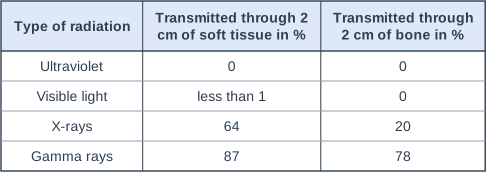
The table shows the percentage of different types of electromagnetic radiation transmitted through 2 cm of soft tissue and through 2 cm of bone.

Use the data to explain why X-rays, rather than the other types, are used to produce images of bones.

Table with columns "Type of radiation", "Transmitted through 2 cm of soft tissue in %", "Transmitted through 2 cm of bone in %". Type of radiation: Ultraviolet; Transmitted through 2 cm of soft tissue in %: 0; Transmitted through 2 cm of bone in %: 0 | Type of radiation: Visible light; Transmitted through 2 cm of soft tissue in %: less than 1; Transmitted through 2 cm of bone in %: 0 | Type of radiation: X-rays; Transmitted through 2 cm of soft tissue in %: 64; Transmitted through 2 cm of bone in %: 20 | Type of radiation: Gamma rays; Transmitted through 2 cm of soft tissue in %: 87; Transmitted through 2 cm of bone in %: 78.

Model answer

Ultraviolet and visible light are almost completely absorbed by soft tissue, so they cannot pass through the body to make an image. X-rays pass through soft tissue (64% transmitted) but most are absorbed by bone (only 20% transmitted), so there is a big difference and the bones show up clearly. Gamma rays pass through soft tissue (87%) and bone (78%) almost equally, so the bones would hardly show up.

Explanation

An image of a bone needs radiation that passes through soft tissue but is absorbed by bone. Different substances absorb and transmit electromagnetic waves in ways that vary with wavelength, and X-rays give the biggest contrast.

Mark scheme
  1. 1 mark

    ultraviolet and visible light are (almost) completely absorbed by soft tissue, so they cannot pass through the body

    allow 0% / less than 1% transmitted

  2. 1 mark

    most X-rays pass through soft tissue (64%) but most are absorbed by bone (only 20% transmitted), so the bones show up clearly

    allow there is a big difference between soft tissue and bone for X-rays

  3. 1 mark

    gamma rays pass through soft tissue and bone almost equally (87% and 78%), so bone would not show up clearly against soft tissue

Ready to try the rest? Every answer you write is marked against the mark scheme, so you can see exactly where the marks are.

Revision notes

Uses and applications of electromagnetic waves

The big idea

Every group of the electromagnetic spectrum has practical uses, from broadcasting radio programmes to treating cancer. Each wave is chosen because its properties suit the job: what it passes through, what absorbs it, and how it is produced and detected. Everyone needs to know the uses; Higher tier students must also explain why each wave is suitable.

Uses of each group

WaveUsesWhat happens
Radio wavesTelevision and radioTransmitters broadcast programmes; aerials on homes and radios receive them
MicrowavesSatellite communications; cooking foodDishes send signals to satellites in orbit and receive them back; a microwave oven heats the food
InfraredElectrical heaters; cooking food; infrared camerasHeaters and grills warm people and food; thermal imaging cameras form images, even in the dark
Visible lightFibre optic communicationsPulses of light carry telephone and internet signals along thin glass fibres
UltravioletEnergy efficient lamps; sun tanningLamps give out visible light for less energy; sunbeds darken the skin
X-raysMedical imaging and treatmentsImages of broken bones; high doses to treat cancer
Gamma raysMedical imaging and treatmentsA gamma-emitting substance in the body shows up on a camera; beams kill cancer cells; sterilising sealed instruments

Some of these uses carry risks. Ultraviolet from sunbeds makes the skin age prematurely and increases the risk of skin cancer, and X-rays and gamma rays are ionising, so medical doses are kept as low as possible and staff are shielded (see also: Properties of electromagnetic waves 2).

Remember

  • Radio: TV and radio. Microwaves: satellites and cooking.
  • Infrared: heaters, cooking, infrared cameras. Visible light: fibre optics.
  • Ultraviolet: energy efficient lamps, sun tanning.
  • X-rays and gamma rays: medical imaging and treatments.

Higher tier only

Why each wave suits its job. Link the use to a property of the wave.

Wave and useWhy it is suitable
Radio waves for broadcastingTravel long distances through the atmosphere without much absorption, spread out around hills and buildings, pass through walls so they can be received indoors, and are easily produced and detected with electrical circuits (aerials)
Microwaves for satellitesPass through the atmosphere and ionosphere (long-wavelength radio waves are reflected by the ionosphere), and a dish can send them in a narrow beam aimed at the satellite
Microwaves for cookingAbsorbed by water molecules in food, passing a few centimetres in; plastic and glass containers transmit them, so the food heats and the container does not
Infrared for heaters and cookingAbsorbed by the surface of skin or food, transferring energy to its thermal energy store; a grill browns the surface first
Infrared camerasAll objects emit infrared, and hotter objects emit more, so warmer objects show up brighter without any visible light
Visible light in optical fibresGlass transmits light with very little absorption, and the light is reflected along the inside of the fibre, even round bends, so signals travel a long way
Ultraviolet in energy efficient lampsMercury vapour in the lamp emits ultraviolet; a coating inside the glass absorbs it and emits visible light, wasting far less energy than heating a filament
Ultraviolet for tanningAbsorbed by the skin, where it makes cells produce more dark pigment
X-rays for imagingPass through (are transmitted by) soft tissue but are absorbed by bone, so bones show as a shadow on the detector
Gamma rays for imaging and treatmentVery penetrating: they escape from inside the body to reach a camera, or reach a tumour deep inside; being ionising, a large dose kills cancer cells (and microorganisms)

Higher tier only

Worked example: an airport luggage scanner. Explain why X-rays can show a metal object hidden inside a closed suitcase, when visible light cannot.

  • X-rays are transmitted by fabric, plastic and the thin case, so most of them reach the detector behind it.
  • Dense materials such as metal absorb X-rays, so fewer X-rays reach the detector behind the metal object. Its outline shows up as a shadow.
  • Visible light is absorbed or reflected by the outside of the case, so it cannot pass through to show what is inside.
  • X-rays are ionising, so the scanner is shielded to protect the staff.

Exam tip: "explain why it is suitable" wants a property, not the use repeated. Say what the wave is transmitted by, absorbed by, emitted by or reflected by, or whether it is ionising.

Common errors: saying bones reflect X-rays (they absorb them); saying a microwave oven heats the container (plastic and glass transmit microwaves); saying an energy efficient lamp sends ultraviolet into the room (the coating turns it into visible light).

Common mistakes

  • Mixing up radio waves and microwaves. Television and radio broadcasts use radio waves; satellite communications use microwaves.
  • Giving fibre optics as a use of radio waves or electricity. Optical fibres carry visible light (or infrared).
  • Saying infrared cameras need light to work. They detect infrared, so they work in the dark.
  • Thinking sun tanning is harmless. Ultraviolet makes the skin age prematurely and increases the risk of skin cancer.
  • Giving one use for "X-rays and gamma rays" without saying what it does. Say medical imaging (such as images of bones) or treatment (killing cancer cells).

Exam tip

Questions often label one group on a drawing of the spectrum and ask for a use. Name the group from its position first, then give a use from the list above, worded precisely: "satellite communications", not just "communication".

Study Helper Hints first, answers after you try

Stuck on this one? Ask for a hint and I’ll point you in the right direction, without giving the answer away. Once you’ve checked your answer, I’ll show you how the marks are awarded.