Level:
Correct: 0
Incorrect: 0
Marks: 0/0
Exam Practice
Course:
Topics:
Avg
score:
–
Topics
done:
0/31

Newton's Third Law

Practise 10 exam-style questions on Newton's Third Law for AQA GCSE Combined Science (Physics Paper 2). Write your answer as you would in the exam and get it marked in seconds against the mark scheme, point by point, with the Study Helper on hand if you get stuck.

  • 10 questions
  • 1–4 marks each
  • Instant marking
  • No sign-up needed
10 questions, marked as you go

Sample questions with model answers

Here are 4 of the questions in this topic, each with a model answer, an explanation of why it earns the marks and the mark scheme an examiner would use.

Question 1

2 marks

State Newton's Third Law.

Model answer

Whenever two objects interact, the forces they exert on each other are equal in size and opposite in direction.

Explanation

The two forces in a Newton's Third Law pair always act on different objects and are always the same type of force (for example both gravitational or both contact forces).

Mark scheme
  1. 1 mark

    whenever two objects interact, the forces they exert on each other are equal (in size)

    allow every action has an equal and opposite reaction for 1 mark only

  2. 1 mark

    and opposite (in direction)

Question 2

2 marks

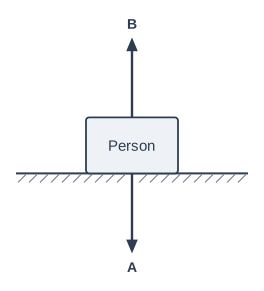
The diagram shows the two forces acting on a person standing still on a floor. Force B is the normal contact force from the floor.

Describe the force that forms a Newton's Third Law pair with force B.

Free body diagram: a box labelled "Person" resting on a horizontal surface with 2 force arrows. An arrow labelled A starts at the object and points downwards; an arrow labelled B starts at the object and points upwards.

Model answer

The partner of force B is the normal contact force exerted by the person on the floor. It is equal in size to force B and acts downwards, on the floor.

Explanation

Force A (the weight) is equal and opposite to force B, but it is not B's Third Law partner: both A and B act on the person, and they are different types of force. B's partner must act on the floor and be a contact force.

Mark scheme
  1. 1 mark

    the (normal contact) force of the person pushing on the floor

    do not accept the weight of the person / force A

  2. 1 mark

    equal in size to B and acting downwards

Question 3

3 marks

A gymnast of weight 520 N stands still on a beam.

Give the size and direction of the force the gymnast exerts on the beam and of the force the beam exerts on the gymnast. Explain your answers.

Model answer

The gymnast pushes down on the beam with a force of 520 N. The beam pushes up on the gymnast with a force of 520 N. These two forces are a Newton's Third Law pair, so they are equal and opposite. The upward force from the beam is also equal to her weight because she is standing still, so the forces on her are balanced.

Explanation

In an equilibrium situation, Newton's Third Law tells us the beam and the gymnast push on each other with equal forces, and Newton's First Law tells us the upward force on the gymnast must balance her weight.

Mark scheme
  1. 1 mark

    the gymnast pushes down on the beam with 520 N

  2. 1 mark

    the beam pushes up on the gymnast with 520 N

  3. 1 mark

    these forces are a Newton's Third Law pair / equal and opposite; and the upward force balances her weight because she is in equilibrium

    allow either explanation

Question 4

4 marks

A lamp hangs at rest from a ceiling by a cable.

A student says, "The weight of the lamp and the tension in the cable are a Newton's Third Law pair."

Explain why the student is wrong.

Model answer

The weight and the tension both act on the same object, the lamp, but the two forces in a Newton's Third Law pair always act on different objects. They are also different types of force: weight is gravitational and tension is a contact force. They are equal and opposite only because the lamp is in equilibrium, so the forces on it are balanced. The real partner of the lamp's weight is the gravitational force with which the lamp pulls the Earth upwards.

Explanation

Balanced forces and Third Law pairs are easy to confuse because both involve equal and opposite forces. Balanced forces act on one object; a Third Law pair acts on two different objects, so the two forces in a pair can never cancel each other out.

Mark scheme
  1. 1 mark

    the weight and the tension both act on the lamp / on the same object

    max 4

  2. 1 mark

    the forces in a Newton's Third Law pair act on different objects

  3. 1 mark

    the weight and tension are different types of force (gravitational and contact)

  4. 1 mark

    they are equal because the lamp is in equilibrium / the resultant force is zero (Newton's First Law)

  5. 1 mark

    the partner of the lamp's weight is the gravitational force of the lamp on the Earth

    allow the partner of the tension is the force of the lamp pulling down on the cable

Ready to try the rest? Every answer you write is marked against the mark scheme, so you can see exactly where the marks are.

Revision notes

Newton's Third Law

The big idea

Forces always come in pairs. Newton's Third Law says that whenever two objects interact, the forces they exert on each other are equal and opposite. The hard part is telling these pairs apart from the balanced forces on a single object, which is what the exam tests most.

Features of a Third Law pair

When object A pushes or pulls on object B, B pushes or pulls on A. The two forces:

  • are equal in size;
  • act in opposite directions;
  • act on two different objects (one on A, one on B);
  • are the same type of force (both contact forces, both gravitational, both magnetic, and so on).

Examples:

  • A footballer's boot pushes the ball forwards; the ball pushes the boot backwards with an equal force.
  • When you jump, your feet push down on the ground and the ground pushes up on you.
  • A bird's wings push air downwards; the air pushes the wings upwards.
  • The Earth pulls the Moon with a gravitational force; the Moon pulls the Earth with an equal gravitational force in the opposite direction.

The pair is equal even when the objects are very different: when a fly hits a car windscreen, the windscreen pushes on the fly with exactly the same size of force as the fly pushes on the windscreen. The fly comes off worse because the same force gives its tiny mass a huge deceleration.

Third Law pairs and equilibrium

An object in equilibrium has a resultant force of zero, so it stays at rest or keeps moving steadily (Newton's First Law). The forces that balance on it are not a Third Law pair.

Balanced forces (equilibrium)Third Law pair
Act onthe same objecttwo different objects
Type of forcecan be different (weight and a contact force)always the same type
Cancel out?yes, the resultant force is zeronever, because they act on different objects
Free body diagram: a box labelled "Bottom box" with 3 force arrows. An arrow labelled "Push of floor 70 N" starts at the object and points upwards; an arrow labelled "Weight 50 N" starts at the object and points downwards; an arrow labelled "Push of top box 20 N" starts at the object and points downwards. Arrow lengths are in proportion to the forces: "Weight 50 N" is about 71% of the length of "Push of floor 70 N"; "Push of top box 20 N" is about 29% of the length of "Push of floor 70 N". Force sizes given: "Push of floor 70 N" = 70, "Weight 50 N" = 50, "Push of top box 20 N" = 20. The forces are balanced: the resultant force is zero.
The forces acting on the bottom box of the stack: 70 N up balances 50 N + 20 N down.

Two boxes stacked on the floor

A box of weight 20 N rests on top of a box of weight 50 N on the floor. Both boxes are at rest. Calculate the force the floor exerts on the bottom box, and give the Third Law partner of each force acting on the bottom box.

The top box is at rest, so the bottom box pushes it up with 20 N, equal to its weight. By the Third Law, the top box pushes down on the bottom box with 20 N.

The bottom box is at rest, so the forces on it balance (equilibrium). Downwards: its weight, 50 N, and the push of the top box, 20 N. So the floor pushes up on it with \(50 + 20 = 70\) N.

Third Law partners (each acts on a different object):

  • floor pushes up on the bottom box, 70 N: the bottom box pushes down on the floor, 70 N;
  • top box pushes down on the bottom box, 20 N: the bottom box pushes up on the top box, 20 N;
  • Earth pulls the bottom box down (its weight), 50 N: the bottom box pulls the Earth up, 50 N.

Common mistakes

  • Calling the weight of a book on a table and the table's upward push a Third Law pair. Both act on the book, so they are balanced forces.
  • Saying the bigger or heavier object exerts the bigger force. The forces in a pair are always equal.
  • Saying Third Law forces cancel out. They act on different objects, so they cannot cancel.
  • Writing only "every action has an equal and opposite reaction". Say that two objects interact and the forces they exert on each other are equal and opposite.

Exam tip

To find the partner of a force, swap the two objects in its description: "the floor pushes the box up" becomes "the box pushes the floor down". The partner always acts on the other object: if both forces you have picked act on the same object, they are balanced forces, not a Third Law pair.

Study Helper Hints first, answers after you try

Stuck on this one? Ask for a hint and I’ll point you in the right direction, without giving the answer away. Once you’ve checked your answer, I’ll show you how the marks are awarded.