Practise 18 exam-style questions on Properties of waves for AQA GCSE Combined Science (Physics Paper 2). Write your answer as you would in the exam and get it marked in seconds against the mark scheme, point by point, with the Study Helper on hand if you get stuck.
18 questions
1–6 marks each
Instant marking
No sign-up needed
18 questions, marked as you go
Sample questions with model answers
Here are 4 of the questions in this topic, each with a model answer, an explanation of why it earns the marks and the mark scheme an examiner would use.
Question 1
1 mark
Write down the equation that links frequency, wave speed and wavelength.
Model answer
wave speed = frequency × wavelength (v = f λ)
Explanation
All waves obey the wave equation. Wave speed is in m/s, frequency in hertz (Hz) and wavelength in metres (m).
Mark scheme
1 mark
wave speed = frequency × wavelength
allow v = f λ; allow any correct rearrangement
Question 2
2 marks
A student uses a ripple tank. She doubles the frequency of the waves. The speed of the waves does not change.
Describe what happens to the wavelength of the waves. Give a reason for your answer.
Model answer
The wavelength halves. Wave speed = frequency × wavelength. The speed stays the same, so if the frequency is doubled the wavelength must be halved.
Explanation
The speed of the ripples depends on the water (its depth), not on the frequency of the dipper. With the speed fixed, frequency and wavelength are inversely proportional.
Mark scheme
1 mark
the wavelength halves
do not accept just 'decreases' for this mark
1 mark
wave speed = frequency × wavelength, and the speed is constant, so if the frequency doubles the wavelength must halve
allow wavelength is inversely proportional to frequency when speed is constant
Question 3
3 marks
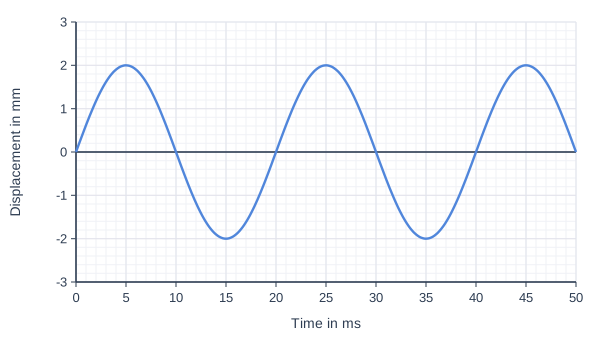
The graph shows how the displacement of one point on a vibrating string changes with time.
The equation linking period and frequency is: period = 1 ÷ frequency
Determine the frequency of the wave.
Model answer
From the graph, one complete oscillation takes 20 ms. T = 20 ms = 0.020 s f = 1 ÷ T = 1 ÷ 0.020 f = 50 Hz
Explanation
On a displacement-time graph, the time for one complete cycle (for example crest to crest) is the period. Convert milliseconds to seconds before using frequency = 1 ÷ period, so that the answer is in hertz.
Mark scheme
1 mark
period = 20 ms
an answer of 50 (Hz) scores 3 marks
1 mark
period = 0.020 s
allow f = 1 ÷ 0.020 for this mark
1 mark
frequency = 50 (Hz)
allow ecf from an incorrect period; an answer of 0.05 scores 2 marks (ms not converted)
Question 4
4 marks
Describe a method that two students could use outdoors to measure the speed of sound in air.
Model answer
The students measure a distance of 200 m across a field with a trundle wheel and stand at each end. One student bangs two wooden blocks together above her head. The other student starts a stopwatch when he sees the blocks hit and stops it when he hears the sound. The speed of sound is calculated using speed = distance ÷ time. They repeat this several times and use the mean time.
Explanation
Light reaches the observer almost instantly, so the time measured is the time taken by the sound. A long distance makes the time longer, so the observer's reaction time causes a smaller percentage error.
Mark scheme
1 mark
the students stand a large measured distance apart (e.g. at least 100 m), measured with a trundle wheel or long tape measure
max 4
1 mark
one student makes a loud sound with a visible action, e.g. banging two wooden blocks together or clashing cymbals
allow a starting pistol
1 mark
the other student starts a stopwatch on seeing the action and stops it on hearing the sound
1 mark
speed = distance ÷ time
1 mark
repeat several times and calculate a mean time
allow swap roles and repeat
Ready to try the rest? Every answer you write is marked against the mark scheme, so you can see exactly where the marks are.
Ctrl + Enter to check
Study HelperHints first, answers after you try
Stuck on this one? Ask for a hint and I’ll point you in the right direction, without giving the answer away. Once you’ve checked your answer, I’ll show you how the marks are awarded.