Level:
Correct: 0
Incorrect: 0
Marks: 0/0
Exam Practice
Course:
Topics:
Avg
score:
–
Topics
done:
0/31

Newton's Second Law

Practise 17 exam-style questions on Newton's Second Law for AQA GCSE Combined Science (Physics Paper 2). Write your answer as you would in the exam and get it marked in seconds against the mark scheme, point by point, with the Study Helper on hand if you get stuck.

  • 17 questions
  • 1–6 marks each
  • Instant marking
  • No sign-up needed
17 questions, marked as you go

Sample questions with model answers

Here are 4 of the questions in this topic, each with a model answer, an explanation of why it earns the marks and the mark scheme an examiner would use.

Question 1

2 marks

Explain what is meant by the inertial mass of an object.

Model answer

Inertial mass is a measure of how difficult it is to change the velocity of an object. It is defined as the ratio of the resultant force on the object to its acceleration: inertial mass = force ÷ acceleration.

Explanation

An object with a large inertial mass needs a large resultant force to give it a particular acceleration. That is why a loaded lorry takes much longer to speed up and to stop than a car.

Mark scheme
  1. 1 mark

    a measure of how difficult it is to change the velocity of the object

    allow how hard it is to accelerate / decelerate the object

  2. 1 mark

    defined as the ratio of force over acceleration / force ÷ acceleration

    allow m = F ÷ a

Question 2

2 marks

In an investigation into the effect of force on acceleration, a trolley on a bench is pulled by a string attached to hanging masses. To increase the force, the student moves slotted masses from the trolley to the hanger, instead of adding new masses to the hanger.

Explain why.

Model answer

The hanging masses accelerate along with the trolley, so the mass being accelerated is the trolley plus all the hanging masses. Moving masses from the trolley to the hanger increases the force while keeping the total mass constant, so the force is the only variable that changes.

Explanation

Acceleration depends on both force and mass. Adding new masses to the hanger would increase the force and the total mass at the same time, so the effect of the force alone could not be found.

Mark scheme
  1. 1 mark

    the hanging masses are accelerated as well as the trolley / the mass being accelerated is the trolley plus the hanging masses

  2. 1 mark

    moving masses keeps the total mass constant, so only the force changes (a fair test)

    allow mass is a control variable

Question 3

3 marks

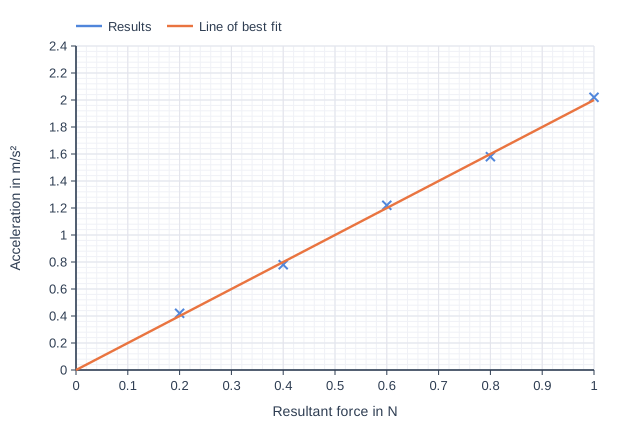
A student investigated how the acceleration of a trolley depends on the resultant force acting on it. The mass of the trolley system was kept constant. The graph shows her results.

Use the line of best fit to determine the mass of the trolley system.

Line graph of acceleration in m/s² (y-axis, 0 to 2.4) against Resultant force in N (x-axis, 0 to 1). "Results" is shown as plotted points only (no line), at (0.2, 0.42), (0.4, 0.78), (0.6, 1.22), (0.8, 1.58), (1, 2.02). "Line of best fit" joins the points (0, 0), (1, 2).

Model answer

From the line of best fit, a force of 1.0 N gives an acceleration of 2.0 m/s².
m = F ÷ a = 1.0 ÷ 2.0 = 0.50 kg

Explanation

Rearranging F = m a gives m = F ÷ a. Using the line of best fit rather than a single result reduces the effect of random errors in the individual results.

Mark scheme
  1. 1 mark

    a pair of values from the line of best fit, e.g. 1.0 N and 2.0 m/s²

    an answer of 0.5 kg scores 3 marks

  2. 1 mark

    m = F ÷ a, e.g. 1.0 ÷ 2.0

    allow ecf from an incorrect reading

  3. 1 mark

    0.50 (kg)

    allow 0.48-0.52 kg

Question 4

4 marks

A car of mass 900 kg accelerates uniformly from rest to 18 m/s in 6.0 s.

Calculate the resultant force on the car.

Model answer

a = Δv ÷ t = (18 − 0) ÷ 6.0 = 3.0 m/s²
F = m × a = 900 × 3.0 = 2700 N

Explanation

This needs two equations: first find the acceleration from the change in velocity and the time, then use Newton's Second Law to find the resultant force.

Mark scheme
  1. 1 mark

    a = 18 ÷ 6.0

    an answer of 2700 N scores 4 marks

  2. 1 mark

    a = 3.0 (m/s²)

  3. 1 mark

    F = 900 × 3.0

    allow ecf from an incorrect acceleration

  4. 1 mark

    2700 (N)

Ready to try the rest? Every answer you write is marked against the mark scheme, so you can see exactly where the marks are.

Revision notes

Newton's Second Law

The big idea

Newton's Second Law tells you how much an object accelerates when a resultant force acts on it. A bigger resultant force gives a bigger acceleration; a bigger mass gives a smaller one. It links forces to motion in one short equation, \(F = ma\), which you will use in many other topics.

The law

The acceleration of an object is directly proportional to the resultant force acting on it, and inversely proportional to its mass. The symbol ∝ means "is proportional to":

  • for a fixed mass, \(a \propto F\): double the resultant force and the acceleration doubles;
  • for a fixed resultant force, \(a \propto \dfrac{1}{m}\): double the mass and the acceleration halves.

As an equation:

\[\text{resultant force} = \text{mass} \times \text{acceleration}\]
\[F = ma\]
  • force, F, in newtons, N
  • mass, m, in kilograms, kg
  • acceleration, a, in metres per second squared, m/s²

You must recall this equation. F is the resultant force: subtract forces that act in opposite directions before you use it. The acceleration is in the direction of the resultant force.

Free body diagram: a box labelled "Go-kart" resting on a horizontal surface with 2 force arrows. An arrow labelled "Driving force 450 N" starts at the object and points to the right; an arrow labelled "Resistive force 90 N" starts at the object and points to the left. Arrow lengths are in proportion to the forces: "Resistive force 90 N" is about 20% of the length of "Driving force 450 N". A separate arrow labelled "Direction of motion" points to the right. Force sizes given: "Driving force 450 N" = 450, "Resistive force 90 N" = 90. The resultant of these sizes is 360 acting horizontally to the right.
The horizontal forces on a go-kart as it pulls away.

How long to reach 12 m/s?

A go-kart and driver have a total mass of 180 kg. The forces on them are shown above. Calculate the time the go-kart takes to reach 12 m/s from rest, assuming the forces stay the same.

Resultant force: \(450 - 90 = 360\) N

\(F = ma\), so \(a = \dfrac{F}{m} = \dfrac{360}{180} = 2.0\) m/s²

\(a = \dfrac{\Delta v}{t}\) (also recalled), so \(t = \dfrac{\Delta v}{a} = \dfrac{12 - 0}{2.0} = 6.0\) s

Estimates and the ~ symbol

You should be able to estimate the speeds, accelerations and forces for everyday road transport. The symbol ~ means "approximately", and estimates are given to 1 or 2 significant figures.

The push from a car seat

A car pulls away hard, reaching 13 m/s (30 mph) in about 4 s. Estimate the resultant force on a passenger of mass ~ 60 kg, and say where it comes from.

\(a = \dfrac{\Delta v}{t} \approx \dfrac{13}{4} \approx 3.3\) m/s²

\(F = ma \approx 60 \times 3.3 \approx 200\) N

The back of the seat pushes the passenger forwards with ~ 200 N, about a third of her weight (about 600 N). That push is why you feel pressed into the seat.

Higher tier only

Inertial mass is a measure of how difficult it is to change the velocity of an object. It is defined as the ratio of force over acceleration:

\[\text{inertial mass} = \dfrac{F}{a}\]

The larger the inertial mass, the smaller the acceleration a given force produces. Applying a known force and measuring the acceleration is a way to find a mass without weighing.

Required practical: Effect of force and mass on acceleration

A trolley is pulled along a bench by a string that runs over a pulley to a hanger of slotted masses. The weight of the hanging masses (\(W = mg\), recalled) is the accelerating force. Light gates and a data logger measure the speed at each gate (card length ÷ time the card blocks the beam) and the time between the gates; then acceleration = change in speed ÷ time.

  • Varying force (mass constant): start with slotted masses on the trolley and move them one at a time to the hanger. This raises the force but keeps the total mass being accelerated (trolley + all masses) the same.
  • Varying mass (force constant): keep the same hanging mass and add masses to the trolley.
  • Release the trolley from the same point each time; repeat each reading and find a mean.
  • Tilt the bench slightly so that the trolley rolls at a steady speed after a gentle push: this compensates for friction.
  • Safety: put a box of padding under the hanging masses and keep feet clear.
  • Typical results: a graph of acceleration against force is a straight line through the origin (\(a \propto F\)); acceleration falls as the mass rises, and acceleration against \(\dfrac{1}{\text{mass}}\) is a straight line through the origin.
Diagram of the apparatus for investigating the acceleration of a trolley. A trolley carrying a vertical card stands on a horizontal bench. A string tied to the front of the trolley runs horizontally over a pulley at the end of the bench to 3 slotted masses hanging on the end. Two light gates are fixed above the bench so that the card passes through each in turn; both are connected to a data logger. Labelled parts: Data logger, Interrupt card, Trolley, Bench, Light gate 2, Pulley, String, Masses, Light gate 1.
Light gates measure the trolley's speed at two points as the falling masses pull it along.

Common mistakes

  • Using the driving force instead of the resultant force in \(F = ma\).
  • Leaving a force in kN or a mass in g. Convert to N and kg first.
  • Writing "acceleration increases with force" when asked for the relationship. Say "directly proportional", and back it up with a straight line through the origin.
  • Adding new masses to the hanger to increase the force. That also increases the mass being accelerated.

Exam tip

In calculations, write \(F = ma\) and show the resultant force on its own line before substituting. In the practical, name the control variable each time: the total mass when force is varied, and the hanging mass (force) when mass is varied.

Study Helper Hints first, answers after you try

Stuck on this one? Ask for a hint and I’ll point you in the right direction, without giving the answer away. Once you’ve checked your answer, I’ll show you how the marks are awarded.