Practise 19 exam-style questions on Forces and elasticity for AQA GCSE Combined Science (Physics Paper 2). Write your answer as you would in the exam and get it marked in seconds against the mark scheme, point by point, with the Study Helper on hand if you get stuck.
19 questions
1–6 marks each
Instant marking
No sign-up needed
19 questions, marked as you go
Sample questions with model answers
Here are 4 of the questions in this topic, each with a model answer, an explanation of why it earns the marks and the mark scheme an examiner would use.
Question 1
2 marks
Describe the difference between elastic deformation and inelastic deformation.
Model answer
An object that has been elastically deformed returns to its original shape and length when the forces on it are removed. An object that has been inelastically deformed does not return to its original shape; it stays permanently stretched or bent.
Explanation
A spring stretched gently deforms elastically. If it is stretched too far it deforms inelastically and stays longer than it was. Only elastic deformation stores energy that can be fully recovered.
Mark scheme
1 mark
elastic: the object returns to its original shape / length when the forces are removed
1 mark
inelastic: the object does not return to its original shape / length when the forces are removed
allow it is permanently deformed
Question 2
2 marks
A student carries out an investigation into the extension of a spring by hanging slotted masses from it on a clamp stand.
Give one hazard in this investigation and describe how the student could reduce the risk.
Model answer
Hazard: the slotted masses could fall off the hanger and land on the student's feet. To reduce the risk, put a tray of sand or a cushion on the floor under the masses and clamp the stand to the bench so that it cannot topple.
Explanation
A hazard is something that could cause harm; a precaution reduces the risk of that harm. Not adding too many masses also keeps the spring below its limit, so it is less likely to be permanently stretched or snap.
Mark scheme
1 mark
hazard: masses could fall (on feet) / the clamp stand could topple / the spring could snap or fly off
1 mark
a precaution linked to the hazard, e.g. clamp the stand to the bench / place a tray or cushion under the masses / stand up while working / wear eye protection
the precaution must match the hazard given
Question 3
3 marks
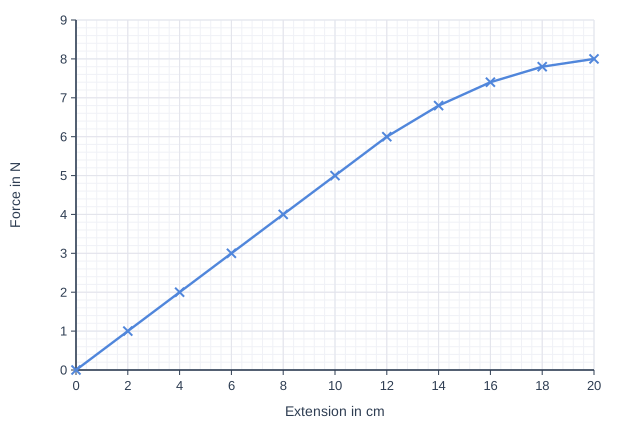
The graph shows how the force on a spring affects its extension.
Describe the relationship between force and extension shown by the graph.
Model answer
Up to a force of about 6 N (an extension of 12 cm), the graph is a straight line through the origin, so the extension is directly proportional to the force. This point is the limit of proportionality. Above 6 N the relationship is non-linear: the graph curves and each extra newton produces a larger extension than before.
Explanation
A linear relationship gives a straight-line graph; a curve shows a non-linear relationship. For a spring, F = k e only applies on the straight part, below the limit of proportionality.
Mark scheme
1 mark
up to 6 N / 12 cm the extension is directly proportional to the force
max 3; allow the graph is a straight line through the origin / linear up to 6 N; allow 5.8-6.2 N
1 mark
above 6 N the relationship is non-linear / the graph curves
1 mark
above 6 N the extension increases by more for each extra newton
allow the spring stretches more easily / the gradient decreases
1 mark
the limit of proportionality is at about 6 N
Question 4
4 marks
Spring A has a spring constant of 20 N/m. Spring B has a spring constant of 80 N/m. The same force of 4.0 N is used to stretch each spring. Neither spring passes its limit of proportionality.
elastic potential energy = 0.5 × spring constant × (extension)²
Determine which spring stores more elastic potential energy. Show your working.
Model answer
Extension of A = F ÷ k = 4.0 ÷ 20 = 0.20 m Extension of B = 4.0 ÷ 80 = 0.050 m Energy stored in A = 0.5 × 20 × 0.20² = 0.40 J Energy stored in B = 0.5 × 80 × 0.050² = 0.10 J Spring A stores more energy: 0.40 J compared with 0.10 J.
Explanation
The stiffer spring B has the larger spring constant, but the same force stretches it much less. Because the energy depends on the extension squared, the less stiff spring A stores four times as much energy for the same force. In both cases the force rises from 0 to 4.0 N, but it moves through a larger distance when stretching spring A, so more work is done on spring A.
Mark scheme
1 mark
extension of A = 4.0 ÷ 20 = 0.20 (m) and extension of B = 4.0 ÷ 80 = 0.050 (m)
a correct conclusion with no working scores 0 marks
1 mark
energy in A = 0.5 × 20 × 0.20² = 0.40 (J)
allow ecf from incorrect extensions
1 mark
energy in B = 0.5 × 80 × 0.050² = 0.10 (J)
1 mark
spring A stores more energy (four times as much)
allow ecf from their energy values
Ready to try the rest? Every answer you write is marked against the mark scheme, so you can see exactly where the marks are.
Ctrl + Enter to check
Study HelperHints first, answers after you try
Stuck on this one? Ask for a hint and I’ll point you in the right direction, without giving the answer away. Once you’ve checked your answer, I’ll show you how the marks are awarded.