Practise 14 exam-style questions on Fleming's left-hand rule (HT only) for AQA GCSE Combined Science (Physics Paper 2). Write your answer as you would in the exam and get it marked in seconds against the mark scheme, point by point, with the Study Helper on hand if you get stuck.
14 questions
1–5 marks each
Instant marking
No sign-up needed
14 questions, marked as you go
Sample questions with model answers
Here are 4 of the questions in this topic, each with a model answer, an explanation of why it earns the marks and the mark scheme an examiner would use.
Question 1
2 marks
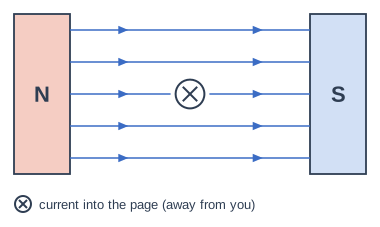
The diagram shows a wire carrying a current between the poles of a magnet. The wire is seen end-on and the current is into the page.
Use Fleming's left-hand rule to determine the direction of the force on the wire.
Model answer
Point the first finger of the left hand to the right, from the N pole to the S pole, along the field. Point the second finger into the page, in the direction of the current. The thumb then points downwards, so the force on the wire is downwards.
Explanation
The field, the current and the force are all at right angles to each other. If the current were out of the page instead, the force would be upwards.
Mark scheme
1 mark
first finger (field) to the right, from N to S, and second finger (current) into the page
allow a correct description of the hand position; an answer of downwards scores 2 marks
1 mark
the force is downwards (towards the bottom of the diagram)
Question 2
2 marks
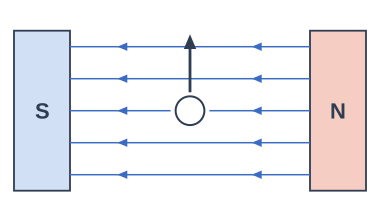
The diagram shows a wire seen end-on between the poles of a magnet. The N pole is on the right and the S pole is on the left. The force on the wire is upwards. The direction of the current is not shown.
Use Fleming's left-hand rule to determine the direction of the current in the wire.
Model answer
The field goes from N to S, which is to the left, so the first finger points left. The force is upwards, so the thumb points up. The second finger then points into the page, so the current is into the page.
Explanation
Fleming's left-hand rule can be used to find any one of the three directions when the other two are known. Keep the thumb, first finger and second finger at right angles to each other.
Mark scheme
1 mark
first finger (field) pointing to the left, from N to S, and thumb (force) pointing up
allow a correct description of the hand position; an answer of into the page scores 2 marks
1 mark
the current is into the page (away from the viewer)
Question 3
3 marks
Fleming's left-hand rule shows the relative directions of the force, the current and the magnetic field for the motor effect.
State what is represented by the first finger, the second finger and the thumb.
Model answer
First finger: the direction of the magnetic field (north to south). Second finger: the direction of the current. Thumb: the direction of the force (motion) on the conductor.
Explanation
Hold the thumb and first two fingers of your left hand at right angles to each other. A common memory aid is First finger = Field, seCond finger = Current, thuMb = Motion.
Mark scheme
1 mark
first finger: the (direction of the) magnetic field
allow field from N to S
1 mark
second finger: the (direction of the conventional) current
1 mark
thumb: the (direction of the) force / motion
allow thrust; ignore any reference to the fingers being at right angles
Question 4
4 marks
A wire carrying a current of 3.0 A is at right angles to a magnetic field. The length of the wire in the field is 4.0 cm. The force on the wire is 18 mN.
The equation linking force, magnetic flux density, current and length is: force = magnetic flux density × current × length
Calculate the magnetic flux density of the field.
Model answer
F = 18 mN = 0.018 N l = 4.0 cm = 0.040 m F = B × I × l 0.018 = B × 3.0 × 0.040 B = 0.018 ÷ 0.12 B = 0.15 T
Explanation
Convert millinewtons to newtons (÷ 1000) and centimetres to metres (÷ 100) before substituting. The unit of magnetic flux density is the tesla (T).
Mark scheme
1 mark
18 mN = 0.018 N
an answer of 0.15 (T) scores 4 marks
1 mark
4.0 cm = 0.040 m
1 mark
0.018 = B × 3.0 × 0.040
allow B = 0.018 ÷ (3.0 × 0.040); allow ecf from incorrect conversions
1 mark
B = 0.15 (T)
allow ecf from incorrect conversions
Ready to try the rest? Every answer you write is marked against the mark scheme, so you can see exactly where the marks are.
Ctrl + Enter to check
Study HelperHints first, answers after you try
Stuck on this one? Ask for a hint and I’ll point you in the right direction, without giving the answer away. Once you’ve checked your answer, I’ll show you how the marks are awarded.