The big idea
Brakes stop a vehicle because the friction force in them does work, which reduces the vehicle's kinetic energy. That energy has to go somewhere, so the brakes get hot. Because kinetic energy rises so steeply with speed, a fast vehicle needs a much bigger braking force to stop in the same distance, and very large decelerations bring their own dangers.
How brakes slow a vehicle
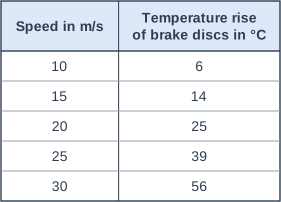
When the driver presses the brake pedal, brake pads are pushed against discs that turn with the wheels. Work done by the friction force between the brakes and the wheel reduces the kinetic energy of the vehicle, and the energy is transferred to the thermal energy store of the brakes, so the temperature of the brakes increases.
Two equations you must recall link these ideas:
\[\text{work done} = \text{force} \times \text{distance}\]
\(W = Fs\): work done, W, in joules, J; force, F, in newtons, N; distance (along the line of action of the force), s, in metres, m.
\[\text{kinetic energy} = 0.5 \times \text{mass} \times (\text{speed})^2\]
\(E_k = \tfrac{1}{2}mv^2\): kinetic energy, Eₖ, in joules, J; mass, m, in kilograms, kg; speed, v, in metres per second, m/s.
If all the kinetic energy is transferred by the brakes, the work done by the braking force equals the kinetic energy lost.
Energy transferred by slowing down
A car of mass 1100 kg slows from 20 m/s to 10 m/s. Calculate the energy transferred by its brakes, assuming all the kinetic energy lost goes to the brakes.
Before: \(E_k = 0.5 \times 1100 \times 20^2 = 220\,000\) J
After: \(E_k = 0.5 \times 1100 \times 10^2 = 55\,000\) J
Energy transferred \(= 220\,000 - 55\,000 = 165\,000\) J
Halving the speed removed three-quarters of the kinetic energy, because kinetic energy depends on speed squared.
Speed, braking force and deceleration
- The greater the speed, the greater the braking force needed to stop in a certain distance. The kinetic energy is greater, and work done = force × distance, so for the same distance the force must be bigger. Doubling the speed gives four times the kinetic energy, so it needs four times the braking force.
- The greater the braking force, the greater the deceleration of the vehicle. For a fixed mass, \(F = ma\) (recalled) shows that doubling the braking force doubles the deceleration.
Why large decelerations are dangerous
- Brakes overheating: a lot of kinetic energy is transferred to the brakes in a short time. Very hot brakes work less well (brake fade), so the vehicle may not stop when needed.
- Loss of control: if the braking force needed is bigger than the friction between the tyres and the road, the wheels lock and the vehicle skids. A skidding vehicle cannot be steered.
- Injury to passengers: to decelerate with the vehicle, each person needs a large force on them (\(F = ma\)), from a seat belt or from hitting the inside of the vehicle.
Higher tier only
Estimating braking forces. You should be able to estimate the forces involved when road vehicles decelerate in typical situations. Use typical values (car ~ 1500 kg, bus ~ 12 000 kg, town speed ~ 13 m/s), then either:
- divide the kinetic energy by the braking distance (\(F = \dfrac{E_k}{s}\)), or
- find the deceleration, from \(a = \dfrac{\Delta v}{t}\) (recalled) or \(v^2 - u^2 = 2as\) (given on the equation sheet), and use \(F = ma\).
Worked example: so that standing passengers stay safe, a bus driver keeps the deceleration to about 1.5 m/s². Estimate the braking force on the bus (~ 12 000 kg), and how far before a bus stop the driver must start braking from 13 m/s.
\(F = ma \approx 12\,000 \times 1.5 \approx 18\,000\) N
\(v^2 - u^2 = 2as\): \(0 - 13^2 = 2 \times (-1.5) \times s\), so \(s = \dfrac{169}{3} \approx 56\) m
Check with energy: \(F \times s \approx 18\,000 \times 56 \approx 1\,000\,000\) J, the same as the bus's kinetic energy, \(0.5 \times 12\,000 \times 13^2 \approx 1\,000\,000\) J. Even this gentle stop needs a force of about \(70 \times 1.5 \approx 100\) N on a standing passenger (~ 70 kg), which is why passengers hold on to a rail.
Common mistakes
- Saying the brakes "use up" or "destroy" the kinetic energy. It is transferred to the thermal energy store of the brakes.
- Forgetting to square the speed in \(E_k = \tfrac{1}{2}mv^2\).
- Saying twice the speed needs twice the braking force for the same distance. It needs four times the force.
- Saying large decelerations are dangerous without saying why: name overheating brakes, skidding and loss of control, or large forces on passengers.
Exam tip
In 6-mark braking answers, link the steps in order: friction force → work done → kinetic energy reduced → brakes heat up; then use \(E_k = \tfrac{1}{2}mv^2\) and \(W = Fs\) to explain why higher speeds need larger forces, and finish with two specific dangers.