Level:
Correct: 0
Incorrect: 0
Marks: 0/0
Exam Practice
Course:
Topics:
Avg
score:
–
Topics
done:
0/31

Properties of electromagnetic waves 1

Practise 15 exam-style questions on Properties of electromagnetic waves 1 for AQA GCSE Combined Science (Physics Paper 2). Write your answer as you would in the exam and get it marked in seconds against the mark scheme, point by point, with the Study Helper on hand if you get stuck.

  • 15 questions
  • 1–6 marks each
  • Instant marking
  • No sign-up needed
15 questions, marked as you go

Sample questions with model answers

Here are 4 of the questions in this topic, each with a model answer, an explanation of why it earns the marks and the mark scheme an examiner would use.

Question 1

2 marks

When electromagnetic waves reach a different substance, some of the waves may be absorbed.

Name three other things that can happen to electromagnetic waves when they reach a different substance.

Model answer

They may be transmitted, reflected or refracted.

Explanation

A substance can absorb, transmit, reflect or refract electromagnetic waves, and what happens depends on the wavelength. For example, glass transmits visible light, while the metal walls of a microwave oven reflect microwaves.

Mark scheme
  1. 2 marks

    transmitted; reflected; refracted

    all three for 2 marks; any two for 1 mark; allow 'pass through' for transmitted; do not accept absorbed

Question 2

2 marks

At the end of a marathon, runners are often given shiny, silver-coloured blankets to wrap around themselves.

Explain why the blankets are shiny and silver.

Model answer

Shiny silver surfaces are very poor emitters of infrared radiation, and they reflect infrared back towards the body. So much less energy is transferred from the runner's body to the surroundings by infrared radiation, which stops the runner cooling down too quickly.

Explanation

The surface of an object affects how much infrared radiation it emits and absorbs. Matt black is the best emitter and shiny silver the worst, so a shiny silver blanket keeps energy in.

Mark scheme
  1. 1 mark

    shiny silver surfaces are poor emitters of infrared radiation

    allow good reflectors of infrared radiation (back towards the body)

  2. 1 mark

    so less energy is transferred away from the runner's body by infrared radiation, keeping the runner warm

    allow so the runner does not cool down too quickly

Question 3

3 marks

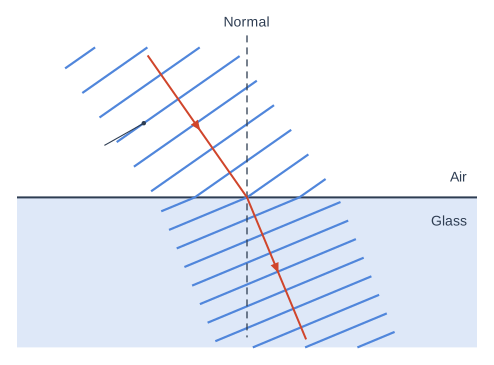
The diagram shows wavefronts of light passing from air into glass. The frequency of the light does not change when it enters the glass.

Explain what the diagram shows about the speed of light in glass compared with in air.

Wave-front diagram of refraction: a beam of straight, parallel wavefronts (lines) travels from the top left towards a horizontal boundary between "Air" (above) and "Glass" (below, shaded). Each wavefront meets the boundary at an angle, so one end crosses first; below the boundary the wavefronts are closer together (0.67 times the spacing above) and each one has a kink where it crosses the boundary. The direction of travel changes, bending towards the dashed line drawn at 90° to the boundary. An arrowed line through the middle of the beam, at right angles to the wavefronts, shows the direction of travel. The angle between the arrowed line above the boundary and the dashed line is 35°. The angle between the arrowed line below the boundary and the dashed line is 22.6°. The dashed line at 90° to the boundary is labelled "Normal". One of the lines is labelled "Wavefront".

Model answer

The wavefronts are closer together in the glass, so the wavelength is shorter in glass. Wave speed = frequency × wavelength. The frequency does not change, so a shorter wavelength means the light travels more slowly in glass than in air.

Explanation

The spacing of wavefronts is the wavelength. Because the frequency is fixed by the source, any change in wavelength at a boundary shows a change in speed, and this change in speed is what causes refraction.

Mark scheme
  1. 1 mark

    the wavefronts are closer together in the glass, so the wavelength is shorter in glass

  2. 1 mark

    wave speed = frequency × wavelength

    allow v = f λ

  3. 1 mark

    the frequency is the same, so the speed of light is lower in glass than in air

    allow light slows down when it enters glass

Question 4

4 marks

Describe how a student could compare how well a matt black surface and a shiny silver surface absorb infrared radiation.

Model answer

Take two identical metal plates. Paint one matt black and the other shiny silver. Stand them at the same distance on either side of a radiant heater, with the surfaces facing the heater. Stick a drawing pin to the back of each plate with a small blob of wax. Switch on the heater and time how long it takes for each pin to fall as the wax melts. The plate whose pin falls first has heated up faster, so its surface is the better absorber of infrared radiation.

Explanation

A fair test changes only the surface. A good absorber gains energy faster, so its temperature rises faster; you would find the matt black plate absorbs infrared much better than the shiny silver plate.

Mark scheme
  1. 1 mark

    use two identical metal plates, one painted matt black and one shiny silver

    max 4

  2. 1 mark

    place the plates at the same distance from (either side of) an infrared source such as a radiant heater

  3. 1 mark

    measure the temperature of each plate after the same time / attach a drawing pin to the back of each with wax and time how long each takes to fall

    allow a thermometer or temperature sensor on each plate

  4. 1 mark

    the plate whose temperature rises faster (or whose pin falls first) is the better absorber

  5. 1 mark

    both plates start at the same temperature / are the same size, thickness and material

Ready to try the rest? Every answer you write is marked against the mark scheme, so you can see exactly where the marks are.

Revision notes

Properties of electromagnetic waves 1

The big idea

When electromagnetic waves meet a substance, they can be absorbed, transmitted, refracted or reflected. This topic covers refraction (the change in direction of a wave as it passes into a new medium) and a required practical on how the nature of a surface affects the infrared radiation it absorbs or emits.

Refraction ray diagrams

Refraction is the change in direction of a wave when it crosses the boundary between two different media at an angle. Light is refracted when it passes from air into glass, water or Perspex, and again when it comes back out.

Ray diagram of refraction through a rectangular glass block in air. A ray of light hits the top surface of the block, changes direction inside the block (it bends towards the normal), then leaves through the bottom surface and travels on parallel to the original ray. Dashed lines are drawn at 90° to the surfaces where the ray enters and leaves. The dashed line at 90° to the surface is labelled "Normal". The incoming ray is labelled "Incident ray". The ray inside the block is labelled "Refracted ray". The ray leaving the bottom of the block is labelled "Emergent ray". The block is labelled "Glass block". The surrounding region is labelled "Air". The angle between the incoming ray and the dashed line is marked i and is 45° (i is the angle of incidence). The angle between the refracted ray and the dashed line inside the block is marked r and is 28.1° (r is the angle of refraction). (Drawn with refractive index n = 1.5 for the glass: sin(angle in air) = n × sin(angle in the glass), sin 45° = 1.5 × sin 28.1°. Entering the glass the light slows down and bends towards the normal.)
Entering the glass, the ray bends towards the normal; leaving it, the ray bends away from the normal.
  • The normal is a line at 90° to the boundary where the ray meets it. Measure the angle of incidence, i, and the angle of refraction, r, from the normal.
  • From air into glass (or water or Perspex), the ray bends towards the normal, so the angle of refraction is smaller than the angle of incidence.
  • From glass into air, the ray bends away from the normal, so the angle of refraction is bigger.
  • A ray that meets the boundary along the normal (angle of incidence 0°) goes straight on without changing direction.
  • With a rectangular block, the ray bends one way going in and by the same amount the other way coming out, so the emergent ray is parallel to the incident ray, shifted sideways.

To construct one, use a ruler and protractor: the boundary, a dashed normal, the incident ray at the given angle with an arrow, then the refracted ray bent towards or away from the normal.

Higher tier only

Why refraction happens. Refraction is due to the difference in the velocity of the waves in different substances. Light travels more slowly in glass than in air.

Wave-front diagram of refraction: a beam of straight, parallel wavefronts (lines) travels from the top left towards a horizontal boundary between "Air" (above) and "Glass" (below, shaded). Each wavefront meets the boundary at an angle, so one end crosses first; below the boundary the wavefronts are closer together (0.67 times the spacing above) and each one has a kink where it crosses the boundary. The direction of travel changes, bending towards the dashed line drawn at 90° to the boundary. An arrowed line through the middle of the beam, at right angles to the wavefronts, shows the direction of travel. The angle between the arrowed line above the boundary and the dashed line is 40° (the angle of incidence). The angle between the arrowed line below the boundary and the dashed line is 25.5° (the angle of refraction). The dashed line at 90° to the boundary is labelled "Normal". One of the lines is labelled "Wavefront". (The waves travel slower below the boundary: speed ratio 0.67, so the wavelength is 0.67 times as long while the frequency stays the same. The end of each wavefront that reaches the boundary first slows down first, so the wave changes direction: 40° to the normal above, 25.5° below.)
The wavefronts slow down and get closer together in the glass, so the waves turn towards the normal.

A wavefront is a line joining the same point (such as the crest) on neighbouring parts of a wave. When a wavefront meets the boundary at an angle, one end reaches the boundary first and slows down first, while the other end is still moving faster in the air. So the wavefront turns, and the wave bends towards the normal. Going into a faster medium, the opposite happens and the wave bends away from the normal.

  • The frequency stays the same, because it is set by the source. With a lower speed, \(v = f\lambda\) means a shorter wavelength, so the wavefronts are closer together.
  • Along the normal the whole wavefront slows down at the same moment: the speed changes but the direction does not.
  • Water waves refract in the same way when they pass from deep water into shallow water, where they are slower.

Higher tier only

Different substances, different wavelengths. Substances may absorb, transmit, refract or reflect electromagnetic waves in ways that vary with wavelength:

SubstanceWhat it does
GlassTransmits visible light and short-wavelength infrared, but absorbs long-wavelength infrared (which keeps a greenhouse warm)
The atmosphereTransmits most radio waves and visible light; absorbs most ultraviolet and all X-rays and gamma rays, so X-ray telescopes go on satellites
The ionosphereReflects long-wavelength radio waves but transmits microwaves, so microwaves are used to reach satellites
The bodySoft tissue transmits most X-rays but bone absorbs them, so bones show up on an X-ray image
A microwave ovenThe metal walls reflect microwaves, a glass bowl transmits them and the water in food absorbs them

Required practical: Radiation and absorption

Emission: fill a Leslie cube (a hollow metal cube with four different faces: matt black, shiny black, matt white and shiny silver) with hot water. Point an infrared detector at one face from a measured distance, such as 10 cm, and record the reading. Turn the cube so each face in turn faces the detector at the same distance, and take the readings quickly.

  • Independent variable: the type of surface. Dependent variable: the detector reading.
  • Control variables: the distance to the detector and the temperature of the water (take readings quickly, before the water cools).
  • Typical results: matt black emits the most, shiny silver the least; matt surfaces emit more than shiny surfaces of the same colour.
  • Absorption: put the same volume of cold water in a matt black can and a shiny silver can, place them the same distance from a radiant heater, and compare their temperature rises after the same time. Matt black absorbs the most.
  • Safety: the hot water and cube can scald, so pour carefully and stand the cube on a heatproof mat.

Spotting a flaw in a plan

To compare how well two surfaces absorb infrared, a student fills a matt black can and a shiny silver can with the same volume of cold water. The black can is 20 cm from a radiant heater and the silver can is 40 cm away. After 10 minutes the black can is 8 °C warmer and the silver can 2 °C warmer. Explain why her conclusion that matt black is the better absorber is not valid.

  • Two variables changed: the surface and the distance from the heater.
  • The nearer can receives more infrared, so it would warm up more whatever its surface.
  • Improvement: put both cans the same distance from the heater (for example one on each side), with the same starting temperature, and repeat.

Common mistakes

  • Measuring angles from the surface of the block. Angles of incidence and refraction are measured from the normal.
  • Drawing a ray along the normal bending. At 0° the ray goes straight on.
  • Drawing the emergent ray at a new angle. For a rectangular block it is parallel to the incident ray.
  • Writing "black surfaces" are the best emitters. Say matt black: shiny black emits less.
  • Taking the Leslie cube readings slowly. The water cools, so later faces are at a lower temperature and emit less.

Exam tip

In refraction diagrams, always draw the normal, put arrows on every ray and compare the angles: "the angle of refraction is smaller than the angle of incidence" is clearer than "it bends a bit".

Study Helper Hints first, answers after you try

Stuck on this one? Ask for a hint and I’ll point you in the right direction, without giving the answer away. Once you’ve checked your answer, I’ll show you how the marks are awarded.