Level:
Correct: 0
Incorrect: 0
Marks: 0/0
Exam Practice
Course:
Topics:
Avg
score:
–
Topics
done:
0/31

Speed

Practise 18 exam-style questions on Speed for AQA GCSE Combined Science (Physics Paper 2). Write your answer as you would in the exam and get it marked in seconds against the mark scheme, point by point, with the Study Helper on hand if you get stuck.

  • 18 questions
  • 1–6 marks each
  • Instant marking
  • No sign-up needed
18 questions, marked as you go

Sample questions with model answers

Here are 4 of the questions in this topic, each with a model answer, an explanation of why it earns the marks and the mark scheme an examiner would use.

Question 1

2 marks

During a storm, a boy hears the thunder 3.0 s after he sees the lightning flash. The light reaches him almost instantly.

speed of sound in air = 330 m/s

Calculate the distance between the boy and the lightning.

Model answer

s = v × t
s = 330 × 3.0
s = 990 m

Explanation

Light travels so fast that the flash is seen almost immediately, so the delay is the time the sound takes to travel. The speed of sound in air varies, for example with temperature, so 330 m/s is a typical value.

Mark scheme
  1. 1 mark

    s = 330 × 3.0

    an answer of 990 m scores 2 marks

  2. 1 mark

    990 (m)

Question 2

2 marks

Some students measure the speed of a toy car using a metre rule and a stopwatch.

Suggest why using two light gates connected to a data logger would give a more accurate value for the speed.

Model answer

With a stopwatch, the student has to react to the car passing each line, so the time includes errors from their reaction time when starting and stopping. Light gates start and stop the timing automatically as the car passes, so there is no reaction time error and the time is more accurate.

Explanation

Human reaction times are typically 0.2-0.9 s, which is a large fraction of the short times measured in a lab. Light gates remove this source of error.

Mark scheme
  1. 1 mark

    the stopwatch timing includes the student's reaction time (when starting and stopping it)

    allow human error in timing

  2. 1 mark

    light gates measure the time automatically, so there is no reaction time error

    allow light gates are more precise / measure to 0.01 s or better

Question 3

3 marks

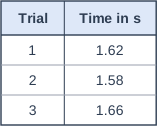
A student measures the time a toy car takes to travel between two lines 2.00 m apart. She repeats the measurement three times. The table shows her results.

Calculate the mean speed of the car.
Give your answer to 3 significant figures.

Table with columns "Trial", "Time in s". Trial: 1; Time in s: 1.62 | Trial: 2; Time in s: 1.58 | Trial: 3; Time in s: 1.66.

Model answer

Mean time = (1.62 + 1.58 + 1.66) ÷ 3 = 4.86 ÷ 3 = 1.62 s
Speed = distance ÷ time = 2.00 ÷ 1.62 = 1.234... m/s
Speed = 1.23 m/s (3 s.f.)

Explanation

Repeating the timing and calculating a mean reduces the effect of random errors, such as variations in the student's reaction time. Then use speed = distance ÷ time.

Mark scheme
  1. 1 mark

    mean time = (1.62 + 1.58 + 1.66) ÷ 3 = 1.62 (s)

    an answer of 1.23 m/s scores 3 marks

  2. 1 mark

    speed = 2.00 ÷ 1.62

    allow ecf from an incorrect mean time

  3. 1 mark

    1.23 (m/s)

Question 4

4 marks

A car journey has three parts:

12 km in 15 minutes
a stop at traffic lights and road works lasting 5 minutes
18 km in 10 minutes

Calculate the average speed of the car for the whole journey in m/s.
Give your answer to 3 significant figures.

Model answer

Total distance = 12 + 18 = 30 km = 30 000 m
Total time = 15 + 5 + 10 = 30 minutes = 1800 s
Average speed = total distance ÷ total time = 30 000 ÷ 1800 = 16.666... m/s
Average speed = 16.7 m/s (3 s.f.)

Explanation

For non-uniform motion, average speed = total distance ÷ total time, including any time spent stopped. Do not average the speeds of the separate parts: the parts take different times.

Mark scheme
  1. 1 mark

    total distance = 30 km = 30 000 m

    an answer of 16.7 m/s scores 4 marks

  2. 1 mark

    total time = 30 minutes = 1800 s

    the 5-minute stop must be included

  3. 1 mark

    average speed = 30 000 ÷ 1800

    allow ecf from an incorrect total distance or time

  4. 1 mark

    16.7 (m/s)

    allow ecf: their answer correctly given to 3 significant figures

Ready to try the rest? Every answer you write is marked against the mark scheme, so you can see exactly where the marks are.

Revision notes

Speed

The big idea

Speed tells you how fast something is moving: the distance it travels each second. Speed does not involve direction, so it is a scalar quantity. In the exam you need to calculate speeds, distances and times, convert units, and know typical speeds well enough to make sensible estimates.

Speed is rarely constant

Real speeds keep changing. A person walking to school slows down at road crossings and on hills and speeds up when late. The speed at which a person can walk, run or cycle depends on many factors, including age, terrain, fitness and the distance travelled (people tire). It is not only moving objects that vary: the speed of sound and the speed of the wind also change, for example sound travels a little faster in warmer air.

Learn these typical values (the symbol ~ means "approximately"):

Moving thingTypical speed
Person walking~ 1.5 m/s
Person running~ 3 m/s
Person cycling~ 6 m/s
Car in a town (30 mph)~ 13 m/s
Car on a motorway (70 mph)~ 31 m/s
Fast passenger train~ 50-90 m/s
Passenger aircraft cruising~ 250 m/s
Sound in air~ 330 m/s

The speed equation

For an object moving at constant speed:

\[\text{distance travelled} = \text{speed} \times \text{time}\]
\[s = vt\]
  • distance, s, in metres, m
  • speed, v, in metres per second, m/s
  • time, t, in seconds, s

You must recall this equation; it is not on the equation sheet. Rearranged, \(v = \dfrac{s}{t}\) and \(t = \dfrac{s}{v}\).

Before you substitute, put every value into these units:

  • km to m: multiply by 1000.
  • minutes to s: multiply by 60 (hours: multiply by 3600).
  • km/h to m/s: divide by 3.6 (because 1 km/h is 1000 m in 3600 s).

Distance on an e-scooter

An e-scooter travels at a steady 18 km/h for 12 minutes. Calculate the distance it travels.

Convert the speed: \(18 \div 3.6 = 5.0\) m/s

Convert the time: \(12 \times 60 = 720\) s

\(s = vt = 5.0 \times 720 = 3600\) m (3.6 km)

Average speed

When the speed changes (non-uniform motion), use the same equation with totals:

\[\text{average speed} = \dfrac{\text{total distance travelled}}{\text{total time taken}}\]

The total time includes any time spent stopped. Never just average the separate speeds: the object spends longer at the slower speed.

Making up lost time

A coach must travel 90 km in 1.5 hours. Traffic means the first 30 km takes 40 minutes. Calculate the average speed, in m/s, it needs for the rest of the journey.

Distance left: \(90 - 30 = 60\) km \(= 60\,000\) m

Time left: \(90 - 40 = 50\) minutes \(= 50 \times 60 = 3000\) s

\(v = \dfrac{s}{t} = \dfrac{60\,000}{3000} = 20\) m/s

Measuring speed

To find a speed, measure a distance and a time, then divide.

  • Distance: a metre rule or tape measure for short distances, a trundle wheel for long ones.
  • Time: a stopwatch includes your reaction time (about 0.2-0.9 s) when starting and stopping it. This error matters less if the time is long, so time over a long distance and repeat to find a mean.
  • Light gates time automatically, so there is no reaction time error. With one gate, \(\text{speed} = \dfrac{\text{length of the card}}{\text{time the card blocks the beam}}\).

A speedometer shows the speed at one moment; the average speed for a journey can be quite different.

Remember

  • Speed is a scalar: it has size only.
  • \(s = vt\) must be recalled; work in m, s and m/s.
  • Average speed = total distance ÷ total time, including stops.
  • Walking ~ 1.5 m/s, running ~ 3 m/s, cycling ~ 6 m/s, sound in air ~ 330 m/s.

Common mistakes

  • Leaving the time in minutes or the distance in km, giving answers 60 or 1000 times too big or small.
  • Averaging two speeds instead of dividing total distance by total time.
  • Leaving out time spent stopped when calculating an average speed.
  • Forgetting that an echo travels there and back, so the sound covers twice the distance to the wall.
  • Giving a typical value with no unit, such as "1.5". The unit is needed for the mark.

Exam tip

Check every answer against the typical speeds: a cyclist at 60 m/s or a car at 0.5 m/s means a unit has not been converted. In "estimate" questions, state the typical value you are using before you calculate.

Study Helper Hints first, answers after you try

Stuck on this one? Ask for a hint and I’ll point you in the right direction, without giving the answer away. Once you’ve checked your answer, I’ll show you how the marks are awarded.