Level:
Correct: 0
Incorrect: 0
Marks: 0/0
Exam Practice
Course:
Topics:
Avg
score:
–
Topics
done:
0/31

Momentum is a property of moving objects (HT only)

Practise 10 exam-style questions on Momentum is a property of moving objects (HT only) for AQA GCSE Combined Science (Physics Paper 2). Write your answer as you would in the exam and get it marked in seconds against the mark scheme, point by point, with the Study Helper on hand if you get stuck.

  • 10 questions
  • 1–4 marks each
  • Instant marking
  • No sign-up needed
10 questions, marked as you go

Sample questions with model answers

Here are 4 of the questions in this topic, each with a model answer, an explanation of why it earns the marks and the mark scheme an examiner would use.

Question 1

1 mark

Give the unit of momentum.

Model answer

kg m/s (kilogram metres per second)

Explanation

Momentum = mass × velocity, so its unit is the unit of mass (kg) multiplied by the unit of velocity (m/s), giving kg m/s.

Mark scheme
  1. 1 mark

    kg m/s

    allow kilogram metres per second; allow kg m s⁻¹; allow N s

Question 2

2 marks

Two identical cars are each travelling at 20 m/s along a straight road. One car is travelling north and the other is travelling south.

A student says: 'The two cars have the same momentum.'

Explain why the student is wrong.

Model answer

Momentum = mass × velocity, and velocity has a direction, so momentum is a vector. The two cars have momentum of the same size, but one is north and the other is south, so their momenta are in opposite directions and are not the same.

Explanation

Speed has no direction but velocity does, so momentum is a vector quantity. Two objects only have the same momentum if the size and the direction are both the same.

Mark scheme
  1. 1 mark

    momentum has direction / is a vector (because velocity has direction)

  2. 1 mark

    the momenta are the same size but in opposite directions

    allow one momentum is positive and the other negative

Question 3

3 marks

A tennis ball of mass 58 g is served at a velocity of 50 m/s.

Calculate the momentum of the tennis ball.

Model answer

m = 58 g = 0.058 kg
p = m × v = 0.058 × 50
p = 2.9 kg m/s

Explanation

Momentum must be calculated with the mass in kilograms, so divide grams by 1000 first. Forgetting the conversion gives an answer 1000 times too big.

Mark scheme
  1. 1 mark

    58 g = 0.058 kg

    an answer of 2.9 (kg m/s) scores 3 marks

  2. 1 mark

    p = 0.058 × 50

    allow ecf from an incorrect conversion

  3. 1 mark

    p = 2.9 (kg m/s)

    an answer of 2900 scores 2 marks (mass not converted to kg)

Question 4

3 marks

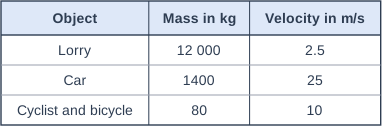
The table gives the mass and velocity of three moving objects.

A student says: 'The object with the greatest mass always has the greatest momentum.'

Use data from the table to evaluate the student's statement.

Table with columns "Object", "Mass in kg", "Velocity in m/s". Object: Lorry; Mass in kg: 12 000; Velocity in m/s: 2.5 | Object: Car; Mass in kg: 1400; Velocity in m/s: 25 | Object: Cyclist and bicycle; Mass in kg: 80; Velocity in m/s: 10.

Model answer

Momentum of the lorry = 12 000 × 2.5 = 30 000 kg m/s
Momentum of the car = 1400 × 25 = 35 000 kg m/s
The car has a smaller mass than the lorry but a greater momentum, so the student is wrong. Momentum = mass × velocity, so it depends on velocity as well as mass.

Explanation

To test a claim, calculate the quantity for each object and look for a counter-example. The lorry is about nine times heavier than the car, but the car moves ten times faster, so the car has more momentum.

Mark scheme
  1. 1 mark

    momentum of the lorry = 12 000 × 2.5 = 30 000 (kg m/s)

  2. 1 mark

    momentum of the car = 1400 × 25 = 35 000 (kg m/s)

    allow cyclist = 800 kg m/s if lorry and car are also calculated

  3. 1 mark

    the car has more momentum than the lorry even though it has a smaller mass, so the statement is wrong because momentum also depends on velocity

    allow ecf from incorrect momentum values if the conclusion follows

Ready to try the rest? Every answer you write is marked against the mark scheme, so you can see exactly where the marks are.

Revision notes

Momentum is a property of moving objects (HT only)

The big idea

Every moving object has momentum: a measure of how much motion it carries, which depends on both its mass and its velocity. A slow, heavy lorry can have far more momentum than a fast, light tennis ball.

The momentum equation

\[\text{momentum} = \text{mass} \times \text{velocity}\]
\[p = mv\]
  • momentum, p, in kilograms metre per second, kg m/s
  • mass, m, in kilograms, kg
  • velocity, v, in metres per second, m/s

You must recall this equation; it is not on the equation sheet. Rearranged, \(m = \dfrac{p}{v}\) and \(v = \dfrac{p}{m}\). Convert grams to kilograms, tonnes to kilograms (1 tonne = 1000 kg) and km/h to m/s first.

An object that is not moving has zero momentum, however large its mass.

Momentum is a vector

Mass is a scalar but velocity is a vector, so momentum is a vector quantity: it has a size and a direction, the same direction as the velocity. Along a line, choose one direction as positive; momentum the other way is negative. An object moving in a circle at a steady speed has changing momentum, because its direction keeps changing.

A charging rhinoceros

A rhinoceros of mass 2.4 tonnes charges at 45 km/h. Calculate its momentum.

Mass: \(2.4 \times 1000 = 2400\) kg

Velocity: \(45 \div 3.6 = 12.5\) m/s

\(p = mv = 2400 \times 12.5 = 30\,000\) kg m/s

Total momentum of two dancers

Two ice dancers glide towards each other. Dancer A (55 kg) moves at 3.0 m/s to the right; dancer B (70 kg) moves at 2.0 m/s to the left. Calculate their total momentum.

Take right as positive.

A: \(p = 55 \times 3.0 = +165\) kg m/s

B: \(p = 70 \times (-2.0) = -140\) kg m/s

Total momentum \(= 165 + (-140) = +25\) kg m/s, which is 25 kg m/s to the right.

Common mistakes

  • Using a mass in grams: a 60 g ball has a mass of 0.060 kg, not 60 kg.
  • Writing the unit as kg/m/s or kg m/s². The unit is kg m/s.
  • Adding the sizes of momenta in opposite directions. Give one direction a minus sign first.
  • Thinking the faster object always has more momentum. A horse walking at 2 m/s has far more momentum than an arrow flying at 60 m/s, because the horse's mass is so much greater.

Exam tip

When directions are involved, say which way is positive at the start of your working, and give a direction (or sign) with your final answer.

Study Helper Hints first, answers after you try

Stuck on this one? Ask for a hint and I’ll point you in the right direction, without giving the answer away. Once you’ve checked your answer, I’ll show you how the marks are awarded.