Practise 14 exam-style questions on Poles of a magnet for AQA GCSE Combined Science (Physics Paper 2). Write your answer as you would in the exam and get it marked in seconds against the mark scheme, point by point, with the Study Helper on hand if you get stuck.
14 questions
1–6 marks each
Instant marking
No sign-up needed
14 questions, marked as you go
Sample questions with model answers
Here are 4 of the questions in this topic, each with a model answer, an explanation of why it earns the marks and the mark scheme an examiner would use.
Question 1
2 marks
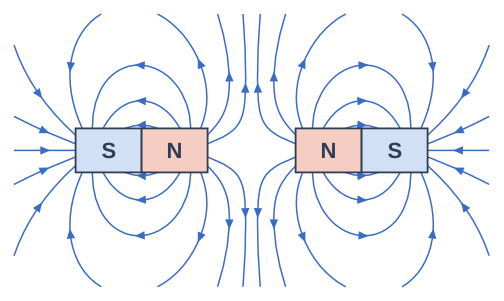
The diagram shows two bar magnets with a small gap between them, and the magnetic field around them.
State whether the magnets attract or repel each other. Give a reason for your answer.
Model answer
The magnets repel each other, because two north poles are facing each other and like poles repel.
Explanation
Like poles (N and N, or S and S) repel and unlike poles (N and S) attract. In the field pattern for repelling magnets, the lines from the two poles push away from each other and there is a point in the middle where the field is zero.
Mark scheme
1 mark
repel
1 mark
two like poles (two north poles) are facing each other, and like poles repel
allow the field lines turn away from each other in the gap
Question 2
2 marks
A bar magnet hangs from a thread so that it can turn freely. The north pole of a second magnet is brought near one end of the hanging magnet. That end of the hanging magnet moves away.
State the type of pole at that end of the hanging magnet. Give a reason for your answer.
Model answer
It is a north pole, because it was repelled by the north pole of the second magnet and like poles repel.
Explanation
Repulsion only happens between two like poles. If that end had been attracted instead, it could have been a south pole or just a piece of magnetic material.
Mark scheme
1 mark
north (pole)
1 mark
like poles repel
allow it was repelled by a north pole, so it must also be north
Question 3
3 marks
A chain of steel paper clips hangs from one end of a bar magnet. Each clip holds up the clip below it. When the magnet is lifted away from the top clip, the chain falls apart.
Explain these observations.
Model answer
Each paper clip is in the magnetic field of the magnet, so it becomes an induced magnet. Induced magnetism always causes a force of attraction, so each clip attracts the clip below it and the chain hangs together. When the magnet is removed, the clips are no longer in a magnetic field, so they lose most of their magnetism quickly and stop attracting each other, and the chain falls apart.
Explanation
Paper clips are not permanent magnets: they only behave as magnets while they are in a magnetic field. That is the key difference between induced and permanent magnets.
Mark scheme
1 mark
the paper clips become induced magnets when they are in the magnet's field
allow the clips are magnetised by the magnet
1 mark
induced magnetism always causes attraction, so each clip attracts the next one
1 mark
when the magnet is removed the clips lose (most of) their magnetism quickly, so they no longer attract each other
Question 4
4 marks
Compare permanent magnets and induced magnets.
Model answer
Both permanent and induced magnets have north and south poles and can attract magnetic materials. A permanent magnet produces its own magnetic field all the time, but an induced magnet is only a magnet while it is in a magnetic field, and it loses most or all of its magnetism quickly when removed. A permanent magnet can attract or repel another magnet, but induced magnetism always causes a force of attraction.
Explanation
A comparison should include similarities and differences, ideally with 'whereas' or 'but'. The two key differences are where the field comes from and whether the force can be repulsive.
Mark scheme
1 mark
a permanent magnet produces its own magnetic field; an induced magnet only becomes a magnet when placed in a magnetic field
max 4
1 mark
a permanent magnet keeps its magnetism; an induced magnet loses most or all of its magnetism quickly when removed from the field
1 mark
a permanent magnet can attract or repel another magnet
1 mark
induced magnetism always causes a force of attraction
1 mark
both have north and south poles / both can attract magnetic materials such as iron, steel, cobalt and nickel
Ready to try the rest? Every answer you write is marked against the mark scheme, so you can see exactly where the marks are.
Ctrl + Enter to check
Study HelperHints first, answers after you try
Stuck on this one? Ask for a hint and I’ll point you in the right direction, without giving the answer away. Once you’ve checked your answer, I’ll show you how the marks are awarded.