Practise 15 exam-style questions on Resultant forces for AQA GCSE Combined Science (Physics Paper 2). Write your answer as you would in the exam and get it marked in seconds against the mark scheme, point by point, with the Study Helper on hand if you get stuck.
15 questions
1–6 marks each
Instant marking
No sign-up needed
15 questions, marked as you go
Sample questions with model answers
Here are 4 of the questions in this topic, each with a model answer, an explanation of why it earns the marks and the mark scheme an examiner would use.
Question 1
2 marks
In a tug-of-war, team A pulls the rope to the left with a force of 2300 N. Team B pulls the rope to the right with a force of 2150 N.
Determine the resultant force on the rope.
Model answer
Resultant force = 2300 − 2150 = 150 N, to the left (towards team A).
Explanation
When two forces act in opposite directions along the same line, the resultant is the difference between them and acts in the direction of the larger force. A resultant force always needs a direction as well as a size because force is a vector.
Mark scheme
1 mark
2300 − 2150 = 150 (N)
an answer of 150 N to the left scores 2 marks
1 mark
to the left / towards team A
Question 2
2 marks
A student says, "The resultant force on a parked car is zero, so there are no forces acting on the car."
Explain why the student is wrong.
Model answer
There are forces acting on the parked car: its weight acts downwards and the normal contact force from the road acts upwards. These forces are equal in size and opposite in direction, so they cancel out and the resultant force is zero.
Explanation
A zero resultant force means the forces are balanced, not that there are no forces. On Earth every object has weight, so a stationary object must have another force balancing it.
Mark scheme
1 mark
forces do act on the car, e.g. its weight (downwards) and the normal contact force (upwards)
1 mark
these forces are equal in size and opposite in direction / balanced, so the resultant is zero
Question 3
3 marks
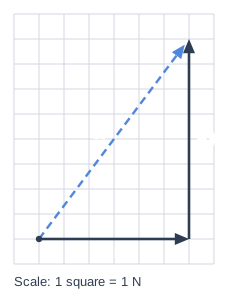
The diagram is a scale drawing of two forces, 6 N and 8 N, acting on the same object at right angles. The forces are drawn tip to tail and the resultant force is labelled R.
Use the diagram to determine the magnitude of R and its angle above the horizontal.
Model answer
R is 10 squares long and the scale is 1 square = 1 N, so R = 10 N. Measuring the angle between R and the 6 N force with a protractor gives 53° above the horizontal.
Explanation
In a tip-to-tail vector diagram the resultant goes from the start of the first arrow to the tip of the last arrow. Its length, converted with the scale, gives the magnitude, and a protractor gives its direction.
Mark scheme
1 mark
R is 10 squares long
allow use of Pythagoras: √(6² + 8²); an answer of 10 N at 53° scores 3 marks
1 mark
magnitude of R = 10 N
allow 9.8-10.2 N
1 mark
angle = 53° above the horizontal
allow 51-55°
Question 4
4 marks
Two forces act on the same point at right angles to each other: 30 N towards the east and 40 N towards the north.
Describe how a scale drawing can be used to determine the magnitude and direction of the resultant force.
Model answer
Choose a scale, for example 1 cm represents 5 N. Draw a 6.0 cm arrow pointing east for the 30 N force. From the tip of this arrow, draw an 8.0 cm arrow pointing north for the 40 N force. Draw the resultant from the start of the first arrow to the tip of the second. Measure its length (10.0 cm) and use the scale to convert it to a force (50 N). Use a protractor to measure the angle between the resultant and the east direction (about 53°, north of east).
Explanation
A scale drawing gives both parts of a vector: the length of the resultant gives its magnitude and its angle gives its direction. A larger scale makes the drawing more accurate because lengths and angles can be measured with a smaller percentage uncertainty.
Mark scheme
1 mark
choose a suitable scale, e.g. 1 cm represents 5 N
1 mark
draw an arrow to scale for the 30 N force pointing east, then from its tip draw an arrow to scale for the 40 N force pointing north
allow draw both arrows from one point and complete a parallelogram (rectangle)
1 mark
draw the resultant from the start of the first arrow to the tip of the second, measure its length and convert it using the scale
1 mark
measure the angle (between the resultant and the east direction) with a protractor
allow measure the angle from north
Ready to try the rest? Every answer you write is marked against the mark scheme, so you can see exactly where the marks are.
Ctrl + Enter to check
Study HelperHints first, answers after you try
Stuck on this one? Ask for a hint and I’ll point you in the right direction, without giving the answer away. Once you’ve checked your answer, I’ll show you how the marks are awarded.