Level:
Correct: 0
Incorrect: 0
Marks: 0/0
Exam Practice
Course:
Topics:
Avg
score:
–
Topics
done:
0/31

Gravity

Practise 14 exam-style questions on Gravity for AQA GCSE Combined Science (Physics Paper 2). Write your answer as you would in the exam and get it marked in seconds against the mark scheme, point by point, with the Study Helper on hand if you get stuck.

  • 14 questions
  • 1–6 marks each
  • Instant marking
  • No sign-up needed
14 questions, marked as you go

Sample questions with model answers

Here are 4 of the questions in this topic, each with a model answer, an explanation of why it earns the marks and the mark scheme an examiner would use.

Question 1

1 mark

Name the measuring instrument used to measure the weight of an object.

Model answer

A newtonmeter (a calibrated spring balance).

Explanation

A newtonmeter contains a spring that stretches when an object hangs from it; the scale is calibrated in newtons. A top-pan balance is used to measure mass, not weight.

Mark scheme
  1. 1 mark

    newtonmeter

    allow (calibrated) spring balance / force meter; do not accept (top-pan) balance or scales

Question 2

2 marks

Explain why an object close to the Earth has weight.

Model answer

The Earth has a gravitational field around it. Any object in this field has a force exerted on it, pulling it towards the centre of the Earth; this force is the object's weight.

Explanation

Weight is a non-contact force caused by the gravitational field around the Earth. The size of the weight depends on the object's mass and on the gravitational field strength at the place where the object is.

Mark scheme
  1. 1 mark

    the Earth has a gravitational field (around it)

  2. 1 mark

    the field exerts a force on the object (towards the Earth / the centre of the Earth)

    allow the object is pulled towards the Earth

Question 3

3 marks

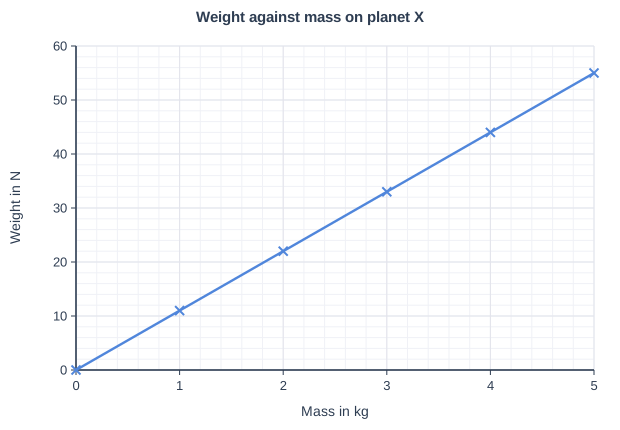
The graph shows how the weight of an object varies with its mass on the surface of planet X.

Use the graph to determine the gravitational field strength on planet X.

Weight against mass on planet X. Line graph of Weight in N (y-axis, 0 to 60) against mass in kg (x-axis, 0 to 5). The line joins the points (0, 0), (1, 11), (2, 22), (3, 33), (4, 44), (5, 55).

Model answer

From the graph, a mass of 5 kg has a weight of 55 N.
g = W ÷ m = 55 ÷ 5 = 11 N/kg

Explanation

Rearranging W = m g gives g = W ÷ m, which is the gradient of a graph of weight against mass. Reading a large pair of values from the line gives the most accurate value.

Mark scheme
  1. 1 mark

    correct pair of values read from the graph, e.g. 5 kg and 55 N

    any correct pair from the line; an answer of 11 N/kg scores 3 marks

  2. 1 mark

    g = W ÷ m, e.g. 55 ÷ 5

    allow ecf from an incorrect reading

  3. 1 mark

    11 (N/kg)

    allow 10.8-11.2

Question 4

4 marks

A robot vehicle on the surface of Mars has a weight of 3330 N.

gravitational field strength on Mars = 3.7 N/kg
gravitational field strength on Earth = 9.8 N/kg

Calculate the weight of the vehicle on Earth.

Model answer

On Mars: W = m × g
3330 = m × 3.7
m = 3330 ÷ 3.7 = 900 kg
On Earth: W = 900 × 9.8 = 8820 N

Explanation

The mass of the vehicle is the same everywhere, so find the mass from its weight on Mars and then use the Earth's gravitational field strength. Weight changes from place to place because it depends on the gravitational field strength where the object is.

Mark scheme
  1. 1 mark

    3330 = m × 3.7

    an answer of 8820 N scores 4 marks

  2. 1 mark

    m = 3330 ÷ 3.7 = 900 (kg)

  3. 1 mark

    W = 900 × 9.8

    allow ecf from an incorrect mass

  4. 1 mark

    8820 (N)

    allow 8800 (N)

Ready to try the rest? Every answer you write is marked against the mark scheme, so you can see exactly where the marks are.

Revision notes

Gravity

The big idea

Weight is the force acting on an object due to gravity. Close to the Earth, this force is caused by the Earth's gravitational field. Weight is not the same as mass: an object's mass is the same everywhere, but its weight depends on the gravitational field strength where it is. You need to calculate weight, explain why it changes from place to place, and know where it acts and how it is measured.

Mass and weight

MassWeight
What it isThe amount of matter in an objectThe force on an object due to gravity
Unitkilogram (kg)newton (N)
Scalar or vector?ScalarVector (acts towards the centre of the Earth)
Measured withA balanceA calibrated spring-balance (a newtonmeter)
Taken to the MoonStays the sameDecreases, because the Moon's field is weaker

The weight of an object depends on the gravitational field strength at the point where the object is. Near the Earth's surface it is 9.8 N/kg, which means each kilogram has a weight of 9.8 N. On the Moon it is about 1.6 N/kg. The Earth's field also gets weaker further from the Earth, so you weigh very slightly less at the top of a mountain. Even astronauts in orbit still have a large weight: there is gravity in space.

Calculating weight

You must recall this equation (it is not on the equation sheet):

\[\text{weight} = \text{mass} \times \text{gravitational field strength}\]
\[W = mg\]
  • weight, \(W\), in newtons, N
  • mass, \(m\), in kilograms, kg
  • gravitational field strength, \(g\), in newtons per kilogram, N/kg

In any calculation the value of \(g\) is given (AQA questions use 9.8 N/kg on Earth). Rearranged: \(m = \dfrac{W}{g}\) and \(g = \dfrac{W}{m}\).

Can the crane lift the beam?

A crane's cable can safely hold a force of up to 40 kN. A steel beam has a mass of 3.6 tonnes (1 tonne = 1000 kg). Gravitational field strength = 9.8 N/kg. Can the crane lift the beam safely?

Convert the mass: \(3.6\text{ tonnes} = 3600\text{ kg}\)

\(W = mg = 3600 \times 9.8 = 35\,280\text{ N}\), which is about 35 kN.

35 kN is less than 40 kN, so yes: the cable can lift the beam safely.

Weight is proportional to mass

The weight of an object is directly proportional to its mass: double the mass and the weight doubles. A graph of weight against mass is a straight line through the origin, and its gradient is the gravitational field strength.

Line graph of Weight in N (y-axis, 0 to 50) against mass in kg (x-axis, 0 to 5). "On the Earth (g = 9.8 N/kg)" joins the points (0, 0), (5, 49). "On the Moon (g = 1.6 N/kg)" (dashed) joins the points (0, 0), (5, 8).
Both lines are straight and pass through the origin; the Earth's line is steeper because its gravitational field strength is greater.

Centre of mass and measuring weight

Gravity pulls on every part of an object, but its weight may be considered to act at a single point called its centre of mass. For a uniform, symmetrical object, such as a metre rule, it is at the centre. For a flat, irregular shape it can be found by hanging the shape from a pin with a plumb line, marking the vertical line, repeating from a second hole and seeing where the lines cross.

Weight is measured with a newtonmeter: a spring stretches by an amount that depends on the force, against a scale marked in newtons. Check it reads zero before you start (to avoid a zero error), and choose one whose range covers the weight but whose scale divisions are as small as possible.

Remember

  • Weight is a force, in newtons; mass is the amount of matter, in kilograms.
  • \(W = mg\) must be recalled; \(g\) on Earth is 9.8 N/kg.
  • Mass never changes from place to place; weight changes with the gravitational field strength.
  • Weight acts at the centre of mass.

Common mistakes

  • Giving a weight in kilograms. Weight is a force, so its unit is the newton.
  • Using grams in \(W = mg\). Convert to kilograms first: 250 g = 0.250 kg.
  • Saying the mass of an object is smaller on the Moon. Only its weight is smaller.
  • Saying there is no gravity in space or on a space station. The field is weaker there, but still strong.
  • Describing the centre of mass as "the middle". It is the point where the weight may be considered to act.

Exam tip

In "compare" or "explain the differences" answers, write matched pairs ("mass is measured in kilograms, but weight is measured in newtons") rather than describing each quantity separately. Whenever a weight changes from place to place, give the reason: the gravitational field strength is different there.

Study Helper Hints first, answers after you try

Stuck on this one? Ask for a hint and I’ll point you in the right direction, without giving the answer away. Once you’ve checked your answer, I’ll show you how the marks are awarded.