Level:
Correct: 0
Incorrect: 0
Marks: 0/0
Exam Practice
Course:
Topics:
Avg
score:
–
Topics
done:
0/31

Magnetic fields

Practise 16 exam-style questions on Magnetic fields for AQA GCSE Combined Science (Physics Paper 2). Write your answer as you would in the exam and get it marked in seconds against the mark scheme, point by point, with the Study Helper on hand if you get stuck.

  • 16 questions
  • 1–6 marks each
  • Instant marking
  • No sign-up needed
16 questions, marked as you go

Sample questions with model answers

Here are 4 of the questions in this topic, each with a model answer, an explanation of why it earns the marks and the mark scheme an examiner would use.

Question 1

2 marks

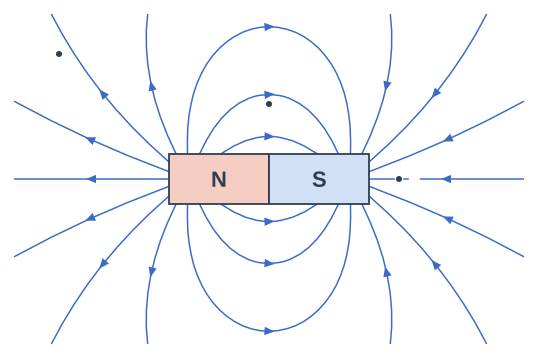
The diagram shows the magnetic field around a bar magnet. Three points, A, B and C, are marked.

At which point is the magnetic field strongest?
Give a reason for your answer.

A bar magnet lies horizontally, its left end labelled N and its right end labelled S. Curved magnetic field lines loop around the outside of the magnet from one end to the other, closest together near the ends; arrows on the lines point away from the left end and towards the right end. Lines leaving the middle of each end go straight out along the axis. Point A is close to the magnet, beyond its right end (labelled S), on its axis. Point B is above the middle of the magnet, a short distance from it. Point C is far from the magnet, beyond its left end (labelled N), above the axis.

Model answer

A. It is closest to a pole of the magnet, where the field lines are closest together, so the field is strongest there.

Explanation

The strength of a magnetic field depends on the distance from the magnet and is greatest at the poles. On a field diagram, the closer together the lines are, the stronger the field.

Mark scheme
  1. 1 mark

    A

  2. 1 mark

    A is closest to a pole of the magnet / the field lines are closest together at A

    allow the field is strongest at the poles and gets weaker with distance

Question 2

2 marks

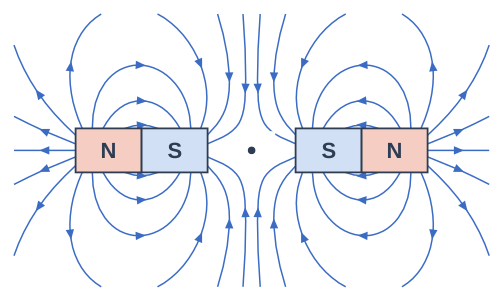
The diagram shows the magnetic field between two bar magnets with their south poles facing each other. Point X is in the middle of the gap.

A small plotting compass is placed at X. Explain why the compass needle does not point in any particular direction.

Two bar magnets in a line with a gap between them. The left magnet's ends are labelled N (left) and S (right); the right magnet's ends are labelled S (left) and N (right). The poles facing each other across the gap are S and S. Field lines from the facing ends do not cross the gap: they bend away from each other and leave the gap upwards and downwards, leaving a point in the middle of the gap with no field lines; arrows point towards both facing ends. A dot marks the centre of the gap, labelled X.

Model answer

X is the same distance from two like poles, so the magnetic fields of the two magnets at X are equal in strength but in opposite directions. They cancel out, so there is no magnetic field at X and no force to turn the compass needle in any particular direction.

Explanation

A point where the fields of two magnets cancel is called a neutral point; no field lines pass through it. It occurs between like poles, where the magnets repel.

Mark scheme
  1. 1 mark

    the magnetic fields of the two magnets at X are equal in strength and opposite in direction

    allow X is the same distance from two like poles

  2. 1 mark

    so they cancel and there is no (resultant) magnetic field at X / no force on the needle

    allow X is a neutral point

Question 3

3 marks

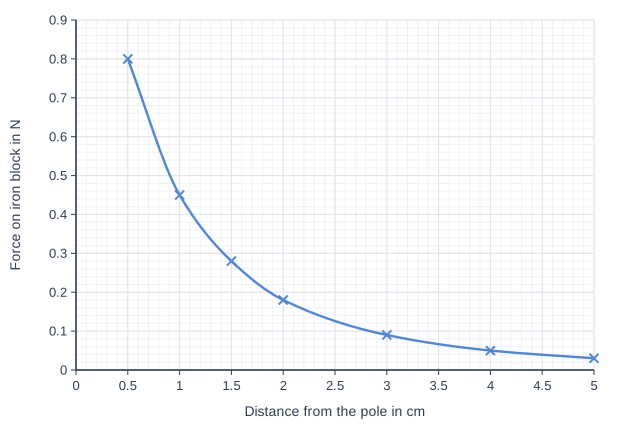
A student measured the force of attraction between a bar magnet and a small iron block at different distances from one pole of the magnet. The graph shows her results.

Describe the pattern shown by the graph, and state what it shows about the strength of the magnetic field.

Line graph of Force on iron block in N (y-axis, 0 to 0.9) against distance from the pole in cm (x-axis, 0 to 5). The line is a smooth curve through (0.5, 0.8), (1, 0.45), (1.5, 0.28), (2, 0.18), (3, 0.09), (4, 0.05), (5, 0.03).

Model answer

As the distance from the pole increases, the force on the iron block decreases. It decreases rapidly at first, from 0.80 N at 0.5 cm to 0.18 N at 2 cm, and then more slowly, falling only from 0.09 N at 3 cm to 0.03 N at 5 cm. This shows that the magnetic field is strongest close to the pole and gets weaker further away from the magnet.

Explanation

The force on a magnetic material shows how strong the field is. The strength of a magnetic field depends on the distance from the magnet, and the field is strongest at the poles.

Mark scheme
  1. 1 mark

    the force decreases as the distance from the pole increases

  2. 1 mark

    the force decreases quickly at first and then more slowly / not linearly, e.g. from 0.80 N at 0.5 cm to 0.18 N at 2 cm, but only from 0.09 N to 0.03 N between 3 cm and 5 cm

    allow any correct use of data showing the decrease gets smaller (allow ±0.02 N)

  3. 1 mark

    the magnetic field is strongest close to the pole and gets weaker with distance from the magnet

    allow the strength of the field depends on the distance from the magnet

Question 4

4 marks

Explain how the magnetic field lines drawn around a bar magnet show both the direction and the strength of the magnetic field at different points.

Model answer

The arrows on the field lines show the direction of the field at each point: the direction of the force on a north pole, which is from the north pole of the magnet to its south pole. The spacing of the lines shows the strength: the closer together the lines, the stronger the field. The lines are closest together at the poles, where the field is strongest, and spread further apart away from the magnet, where the field is weaker.

Explanation

A field diagram carries two kinds of information: arrows give the direction, and line spacing gives the strength. The field changes in both strength and direction from one point to another around a bar magnet.

Mark scheme
  1. 1 mark

    the arrows on the field lines show the direction of the field

  2. 1 mark

    the direction is that of the force on a north pole, so the lines point from the north pole to the south pole

    allow the direction a compass needle would point

  3. 1 mark

    the closer together the field lines, the stronger the field

  4. 1 mark

    the lines are closest together at the poles, so the field is strongest there, and spread out further away where the field is weaker

Ready to try the rest? Every answer you write is marked against the mark scheme, so you can see exactly where the marks are.

Revision notes

Magnetic fields

The big idea

A magnetic field is the region around a magnet where a force acts on another magnet or on a magnetic material. We draw it with field lines, which show both the direction of the field and how strong it is. A compass needle lines up with the field, so it can be used to plot field patterns, and compasses show that the Earth itself has a magnetic core.

What a magnetic field is

  • The magnetic field is the region around a magnet where a force acts on another magnet or on a magnetic material: iron, steel, cobalt and nickel.
  • The force between a magnet and a magnetic material is always attraction.
  • The strength of the field depends on the distance from the magnet. It is strongest at the poles and gets weaker further away.
  • The direction of the field at any point is the direction of the force that would act on a north pole placed at that point. A north pole is pushed away from a north pole and pulled towards a south pole, so field lines run from the north (seeking) pole to the south (seeking) pole.

The field pattern of a bar magnet

A bar magnet lies horizontally, its left end labelled N and its right end labelled S. Curved magnetic field lines loop around the outside of the magnet from one end to the other, closest together near the ends; arrows on the lines point away from the left end and towards the right end. Lines leaving the middle of each end go straight out along the axis. (Field lines run from N to S outside the magnet; the field is strongest at the poles, where the lines are closest.) A plotting compass (1) is a short distance from the magnet, beyond its left end (labelled N), on its axis; its needle's north end points to the left. A plotting compass (2) is above the middle of the magnet, a short distance from it; its needle's north end points to the right. A plotting compass (3) is a short distance from the magnet, beyond its right end (labelled S), on its axis; its needle's north end points to the left. A plotting compass (4) is a short distance from the magnet, beyond its right end (labelled S), above the axis; its needle's north end points downwards. A plotting compass (5) is a short distance from the magnet, beyond its left end (labelled N), below the axis; its needle's north end points downwards. A plotting compass (6) is below the middle of the magnet, far from it; its needle's north end points to the right.
Each compass needle's north end points along the field line, away from N and towards S. The lines are closest together at the poles, where the field is strongest.

When you draw or describe the pattern:

  • the lines leave the north pole and loop round the outside of the magnet to the south pole, with arrows from N to S;
  • the lines are closest together at the poles, where the field is strongest, and spread out further away, where it is weaker;
  • the lines never cross, because the field can only have one direction at any point;
  • the direction changes from point to point: straight out of the N pole along the axis, parallel to the magnet beside its middle, and straight into the S pole.

Iron filings show the shape of the pattern quickly, because each filing becomes a tiny induced magnet and lines up with the field, but they do not show its direction. A plotting compass does.

Plotting a field pattern with a compass

  1. Put the magnet in the middle of a sheet of paper and draw round it.
  2. Place a small plotting compass next to the north pole. Mark a dot where the north end of the needle points.
  3. Move the compass so that the south end of the needle is over the dot, then mark a new dot at the north end.
  4. Repeat until you reach the south pole. Join the dots with a smooth curve and add an arrow in the direction the needle's north end pointed.
  5. Start from several different points around the magnet to build up the whole pattern. Keep other magnets and iron or steel objects away.

Compasses and the Earth's magnetic field

A magnetic compass contains a small bar magnet, the needle, which is free to turn. The Earth has a magnetic field, and away from other magnets the compass needle points in the direction of the Earth's magnetic field, towards the north.

This behaviour is evidence that the core of the Earth must be magnetic:

  • wherever a compass is taken on the Earth, away from other magnets, its needle settles pointing roughly north;
  • so there must be a magnetic field all over the Earth, shaped like the field of a giant bar magnet;
  • a field covering the whole planet must come from inside it, so the Earth's core must be magnetic.

The north (seeking) end of a compass needle is attracted towards the geographic North Pole. Unlike poles attract, so the magnetic pole near the geographic North Pole is really a magnetic south pole.

Two compasses side by side

A student puts two plotting compasses right next to each other on a bench, far from any magnet. Neither needle points north. Explain why, and what happens as she moves the compasses apart.

  • Each needle is a small magnet, so each produces its own magnetic field.
  • Close together, the field of each needle at the other compass is stronger than the Earth's field, so each needle lines up with the combined field instead of pointing north.
  • Field strength depends on distance from a magnet. As the compasses move apart, each needle's field at the other gets weaker, until the Earth's field is stronger and both needles point north.

Remember

  • Field lines go from the north pole to the south pole, and never cross.
  • The closer together the field lines, the stronger the field.
  • The field direction is the direction of the force on a north pole: the way a compass needle's north end points.
  • The magnetic materials are iron, steel, cobalt and nickel.

Common mistakes

  • Drawing field lines from S to N, or without arrows. Outside a magnet they always point from N to S.
  • Drawing field lines that cross or touch. They never cross.
  • Saying iron filings show the direction of a field. Only a compass shows the direction.
  • Defining the field direction as the force on a south pole. It is the direction of the force on a north pole.

Exam tip

When you draw a field pattern, the marks are for: lines that start and finish on the poles, arrows from N to S, lines closer together at the poles than further away, and no crossing lines. For the Earth's core question, link each step to the next rather than just stating that the core is magnetic.

Study Helper Hints first, answers after you try

Stuck on this one? Ask for a hint and I’ll point you in the right direction, without giving the answer away. Once you’ve checked your answer, I’ll show you how the marks are awarded.