Practise 22 questions on Measuring and classifying angles for Year 5 Maths. Tap your answer and find out straight away if you are right, with the Study Helper on hand if you get stuck.
22 questions
1–4 marks each
Instant marking
No sign-up needed
20 questions, marked as you go
Sample questions with model answers
Here are 4 of the questions in this topic, each with a model answer, an explanation of why it earns the marks and the mark scheme.
Question 1
1 mark
Which of these angles is acute?
Model answer
9°
Explanation
An acute angle is less than a right angle, so it is less than 90°. Only 9° is less than 90°. A common mistake is to choose 90°, but 90° is exactly a right angle, so it is not acute.
Mark scheme
1 mark
9°
9° only. Do not accept 90° (a right angle is not acute), 99° (obtuse) or 190° (reflex).
Question 2
2 marks
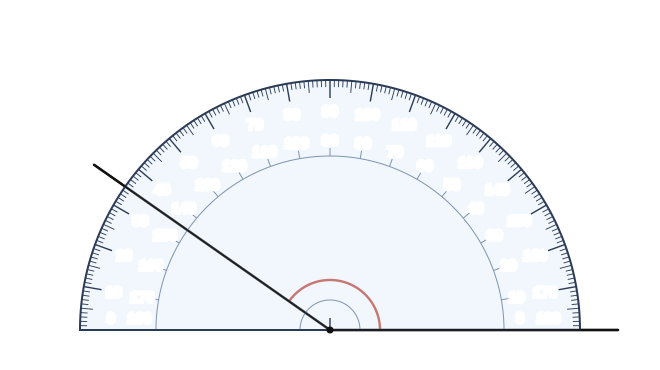
The diagram shows a protractor measuring the angle marked with an arc.
What is the size of the angle?
What type of angle is it?
Model answer
The arm on the base line goes through 0 on the inner scale. On the inner scale the other arm is at 145. The angle is 145°. It is an obtuse angle.
Explanation
One arm goes through 0 on the inner scale, so count up the inner scale to the other arm. It is halfway between 140 and 150, at 145. The angle is wider than a right angle but less than a straight line, so it is obtuse. A common mistake is to read 35 from the outer scale: always check that your answer fits the look of the angle.
Mark scheme
1 mark
145°
Accept 145 with or without the degree sign. Do not accept 35 (read from the wrong scale).
1 mark
obtuse
Obtuse only. Mark this on its own: the angle is wider than a right angle, so 'acute' scores 0 even with a reading of 35.
Question 3
2 marks
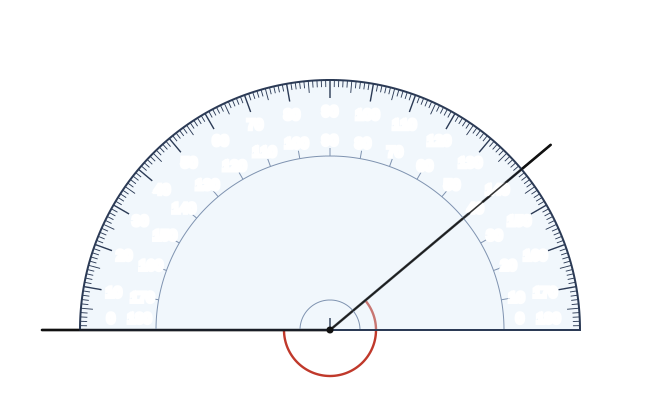
The diagram shows a protractor on two arms. The arc marks the reflex angle between the arms.
Work out the size of the reflex angle.
Model answer
The arm on the base line points left, through 0 on the outer scale. The angle between the arms is 140°. Reflex angle: \(360 - 140 = 220\) 220°
Explanation
A protractor only measures up to 180°, so first measure the smaller angle between the arms. The arm along the base line is at 0 on the outer scale, and the outer scale reaches 140 at the other arm. The two angles round the point make a full turn, so the reflex angle is \(360 - 140 = 220\)°. A common mistake is to give 140°, which is the other angle.
Mark scheme
1 mark
The angle between the arms read correctly as 140°, or \(360 - 140\); or the correct answer 220° with no working
1 mark
220°
Accept 220 with or without the degree sign. Do not accept 140 (the obtuse angle, not the reflex angle) or 320 (360 − 40, using the wrong scale). A correct answer with no working scores full marks.
Question 4
4 marks
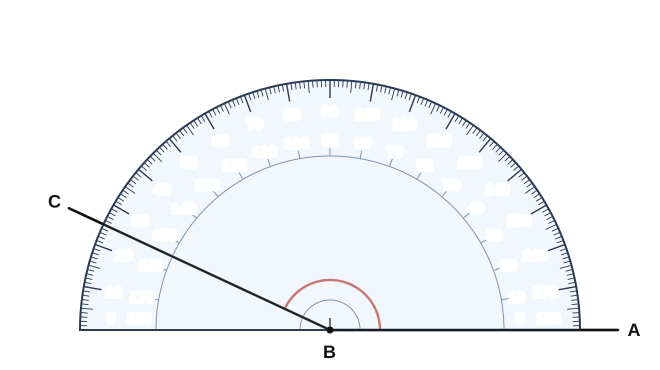
The diagram shows a protractor measuring angle ABC.
What is the size of angle ABC?
What type of angle is it?
How many more degrees would make it a straight angle?
What is the size of the reflex angle at B?
Model answer
BA lies along the base line through 0 on the inner scale. Angle ABC = 155° It is obtuse. \(180 - 155 = 25\), so 25° more Reflex angle: \(360 - 155 = 205\)°
Explanation
BA lies along the base line through 0 on the inner scale, so read the inner scale where BC crosses it: 155°. That is between 90° and 180°, so it is obtuse. A straight angle is 180°, so it needs \(180 - 155 = 25\)° more, and the reflex angle at B is the rest of the full turn: \(360 - 155 = 205\)°. A common mistake is to read 25 from the outer scale as the angle.
Mark scheme
1 mark
Angle ABC = 155°
Do not accept 25 (read from the wrong scale).
1 mark
obtuse
Mark on its own: the angle is wider than a right angle.
1 mark
25° more
Follow through: 180 − their angle ABC, if their angle is less than 180°.
1 mark
Reflex angle 205°
Follow through: 360 − their angle ABC. Accept every answer with or without the degree sign.
Ready to try the rest? Tap your answers and see straight away how you did.
Ctrl + Enter to check
Study HelperHints first, answers after you try
Stuck on this one? Ask for a hint and I’ll point you in the right direction, without giving the answer away. Once you’ve checked your answer, I’ll show you how the marks are awarded.