Level:
Correct: 0
Incorrect: 0
Marks: 0/0
Practice
Course:
Topics:
Year 5 Maths Smart practice A mixed round aimed at your weak spots
Unit 1
Place value
Number and place value
Numbers up to one million
Quick practice6 skills
Rounding whole numbers
Quick practice6 skills
Negative numbers
Quick practice6 skills
Roman numerals
Quick practice5 skills
Unit 2
Addition and subtraction
Unit 3
Multiplication and division
Unit 4
Fractions
Unit 5
Decimals and percentages
Unit 6
Measurement
Measurement
Converting metric units
Quick practice6 skills
Imperial units
Quick practice5 skills
Time
Quick practice5 skills
Money and measure problems
Quick practice4 skills
Perimeter
Quick practice5 skills
Area
Quick practice6 skills
Volume and capacity
Quick practice5 skills
Unit 7
Shape and angles
Unit 8
Position and direction
Geometry: position and direction
Coordinates
Quick practice5 skills
Reflection
Quick practice5 skills
Translation
Quick practice5 skills
Unit 9
Statistics
Statistics
Tables, timetables and charts
Quick practice5 skills
Line graphs
Quick practice5 skills
Avg
score:
–
Topics
done:
0/47

Multiplication and division facts

Practise 25 questions on Multiplication and division facts for Year 5 Maths. Tap your answer and find out straight away if you are right, with the Study Helper on hand if you get stuck.

  • 25 questions
  • 1–4 marks each
  • Instant marking
  • No sign-up needed
20 questions, marked as you go

Sample questions with model answers

Here are 4 of the questions in this topic, each with a model answer, an explanation of why it earns the marks and the mark scheme.

Question 1

1 mark

What is the missing number?

\(8 \times \square = 96\)

Model answer

\(96 \div 8 = 12\)
Check: \(8 \times 12 = 96\)
Answer: 12

Explanation

The missing number is how many 8s make 96, so divide: \(96 \div 8 = 12\). Then check by multiplying. A common mistake is to subtract 8 from 96 instead of dividing.

Mark scheme
  1. 1 mark

    12

    A correct answer with no working scores full marks.

Question 2

2 marks

Which are the four facts in the fact family for 7, 12 and 84? Tap all of them.

Model answer

\(7 \times 12 = 84\)
\(12 \times 7 = 84\)
\(84 \div 7 = 12\)
\(84 \div 12 = 7\)

Explanation

A fact family is two multiplications and two divisions made from the same three numbers. You can multiply the two smaller numbers in either order to get 84. To divide, always start with the biggest number, 84. A common mistake is to write a division the wrong way round, such as \(7 \div 84 = 12\).

Mark scheme
  1. 2 marks

    All four facts: \(7 \times 12 = 84\), \(12 \times 7 = 84\), \(84 \div 7 = 12\), \(84 \div 12 = 7\)

    Award 1 mark for two or three correct facts. A wrong fact such as \(7 \div 84 = 12\) or \(12 \div 7 = 84\) does not count. The facts may be in any order and may use x and / for the signs.

Question 3

2 marks

What is the missing number in each calculation?

\(2 \times \square \times 3 = 42\)

\(\square \times 5 \times 4 = 120\)

Model answer

First: \(2 \times 3 = 6\), and \(6 \times 7 = 42\), so the missing number is 7.
Second: \(5 \times 4 = 20\), and \(20 \times 6 = 120\), so the missing number is 6.
Answers: 7 and 6

Explanation

Multiply the two numbers you know first, because you can multiply in any order. Then ask what that answer must be multiplied by to make the total: \(6 \times 7 = 42\) and \(20 \times 6 = 120\). A common mistake is to divide by only one of the numbers, such as \(42 \div 2 = 21\).

Mark scheme
  1. 1 mark

    First calculation: 7

  2. 1 mark

    Second calculation: 6

    The two answers may be given in order without labels. A correct answer with no working scores full marks.

Question 4

4 marks

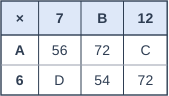
The table is part of a multiplication grid. Each number inside the grid is the number at the start of its row multiplied by the number at the top of its column.

Work out the values of A, B, C and D.

Table with columns "×", "7", "B", "12". ×: A; 7: 56; B: 72; 12: C | ×: 6; 7: D; B: 54; 12: 72.

Model answer

A: \(A \times 7 = 56\), so \(A = 8\)
B: \(6 \times B = 54\), so \(B = 9\) (check: \(8 \times 9 = 72\))
C: \(8 \times 12 = 96\)
D: \(6 \times 7 = 42\)
Answer: A = 8, B = 9, C = 96, D = 42

Explanation

Some letters are numbers inside the grid, so multiply to find them. Others are numbers on the edge, so divide: 56 is in the column for 7, so the row number A is \(56 \div 7 = 8\). Check that every number in the grid works with your answers. A common mistake is to add instead of multiplying.

Mark scheme
  1. 1 mark

    A = 8

    \(56 \div 7\)

  2. 1 mark

    B = 9

    \(54 \div 6\), or \(72 \div 8\)

  3. 1 mark

    C = 96

    \(8 \times 12\). Follow through: their A × 12.

  4. 1 mark

    D = 42

    \(6 \times 7\). A correct answer with no working scores full marks.

Ready to try the rest? Tap your answers and see straight away how you did.

Topic notes

Multiplication and division facts

The big idea

Knowing your times tables up to \(12 \times 12\) by heart makes almost every other calculation quicker. Each multiplication fact also gives you division facts, and one fact you know can help you work out lots of others.

Fact families

Multiplication and division are inverses: one undoes the other. So three numbers such as 7, 9 and 63 make a fact family of two multiplications and two divisions:

\(7 \times 9 = 63 \qquad 9 \times 7 = 63 \qquad 63 \div 7 = 9 \qquad 63 \div 9 = 7\)

You can multiply in either order and get the same answer. A division always starts with the biggest number, 63.

Using facts you know

Make one number 10 times as big, and the answer becomes 10 times as big as well.

  • \(4 \times 9 = 36\), so \(40 \times 9 = 360\) and \(400 \times 9 = 3{,}600\).
  • The fact family still works: \(360 \div 9 = 40\) and \(360 \div 40 = 9\).

You can also split a number into parts you know. This is called partitioning.

Work out \(8 \times 13\) using facts you know.

13 is the same as 10 and 3.

\(8 \times 10 = 80\), and \(8 \times 3 = 24\).

Add the two parts: \(80 + 24 = 104\). So \(8 \times 13 = 104\).

Multiplying by 0 and 1

  • Multiply a number by 1 and it does not change: \(9 \times 1 = 9\). Dividing by 1 does not change it either.
  • Multiply a number by 0 and you get 0: \(9 \times 0 = 0\). Nine empty boxes hold nothing at all.

Doubling and halving

Doubling means multiplying by 2, and halving means dividing by 2. Doubling again and again lets you multiply by 4 or 8:

  • to multiply by 4, double twice;
  • to multiply by 8, double three times;
  • to divide by 4, halve twice.

Work out \(8 \times 35\) by doubling.

Double 35 to get 70. That is 2 lots of 35.

Double 70 to get 140. That is 4 lots of 35.

Double 140 to get 280. That is 8 lots of 35.

So \(8 \times 35 = 280\).

To halve a number, split it into parts you can halve easily. Half of 74 is half of 70 (35) and half of 4 (2), which is 37.

Multiplying three numbers

With three numbers to multiply, the order does not matter. Pick the pair that is easiest to start with.

3 friends each do 25 star jumps a day for 4 days. How many star jumps do they do altogether?

Work out \(3 \times 25 \times 4\).

Start with the easy pair, the 25 and the 4: four 25s make 100.

Then 3 lots of 100 make 300.

They do 300 star jumps altogether.

Missing numbers

Use the inverse to find a missing number.

  • In \(\square \times 6 = 42\), divide: \(42 \div 6 = 7\).
  • In \(\square \div 4 = 12\), multiply 12 by 4 to get 48.

Then check by putting your number back in: \(7 \times 6 = 42\).

Remember

  • Every multiplication fact gives two division facts.
  • Swapping the order of a multiplication does not change the answer.
  • A number times 1 stays the same. A number times 0 is 0.
  • Double twice to multiply by 4, and three times to multiply by 8.

Common mistakes

  • Turning a division back to front. \(9 \div 63\) is not 7: start with the biggest number, \(63 \div 9 = 7\).
  • Thinking that multiplying by 0 leaves a number the same. \(9 \times 0 = 0\), not 9.
  • Adding too many zeros: \(40 \times 9 = 360\), not 3,600.
  • Halving each digit on its own when a digit is odd. Half of 74 is 37, not 32.

Top tip

Learn facts in families. When you practise \(7 \times 8 = 56\), say the other three facts as well: \(8 \times 7 = 56\), \(56 \div 7 = 8\) and \(56 \div 8 = 7\).

Study Helper Hints first, answers after you try

Stuck on this one? Ask for a hint and I’ll point you in the right direction, without giving the answer away. Once you’ve checked your answer, I’ll show you how the marks are awarded.