Level:
Correct: 0
Incorrect: 0
Marks: 0/0
Practice
Course:
Topics:
Year 5 Maths Smart practice A mixed round aimed at your weak spots
Unit 1
Place value
Number and place value
Numbers up to one million
Quick practice6 skills
Rounding whole numbers
Quick practice6 skills
Negative numbers
Quick practice6 skills
Roman numerals
Quick practice5 skills
Unit 2
Addition and subtraction
Unit 3
Multiplication and division
Unit 4
Fractions
Unit 5
Decimals and percentages
Unit 6
Measurement
Measurement
Converting metric units
Quick practice6 skills
Imperial units
Quick practice5 skills
Time
Quick practice5 skills
Money and measure problems
Quick practice4 skills
Perimeter
Quick practice5 skills
Area
Quick practice6 skills
Volume and capacity
Quick practice5 skills
Unit 7
Shape and angles
Unit 8
Position and direction
Geometry: position and direction
Coordinates
Quick practice5 skills
Reflection
Quick practice5 skills
Translation
Quick practice5 skills
Unit 9
Statistics
Statistics
Tables, timetables and charts
Quick practice5 skills
Line graphs
Quick practice5 skills
Avg
score:
–
Topics
done:
0/47

Column addition and subtraction

Practise 22 questions on Column addition and subtraction for Year 5 Maths. Tap your answer and find out straight away if you are right, with the Study Helper on hand if you get stuck.

  • 22 questions
  • 1–4 marks each
  • Instant marking
  • No sign-up needed
20 questions, marked as you go

Sample questions with model answers

Here are 4 of the questions in this topic, each with a model answer, an explanation of why it earns the marks and the mark scheme.

Question 1

1 mark

Work out \(25{,}618 + 43{,}795\)

Model answer

Ones: \(8 + 5 = 13\), write 3, carry 1
Tens: \(1 + 9 + 1 = 11\), write 1, carry 1
Hundreds: \(6 + 7 + 1 = 14\), write 4, carry 1
Thousands: \(5 + 3 + 1 = 9\)
Ten thousands: \(2 + 4 = 6\)
Answer: 69,413

Explanation

Add the columns from the right. When a column makes 10 or more, write the ones digit and carry the 1 into the next column. A common mistake is to forget to add a carried 1 into the next column. An estimate checks the answer: \(26{,}000 + 44{,}000 = 70{,}000\).

Mark scheme
  1. 1 mark

    69,413

    Accept 69413. A correct answer with no working scores full marks.

Question 2

2 marks

What is the missing number in each calculation?

\(\square - 24{,}675 = 38{,}549\)

\(45{,}308 - \square = 17{,}926\)

Model answer

First: the missing number is the whole, so add: \(38{,}549 + 24{,}675 = 63{,}224\)
Second: the missing number is the part taken away, so subtract: \(45{,}308 - 17{,}926 = 27{,}382\)
Answers: 63,224 and 27,382

Explanation

In the first calculation, taking 24,675 away leaves 38,549, so the missing number is the two parts added together. In the second, the missing number is what was taken away, so subtract the answer from 45,308. A common mistake is to add in the second one as well. Check by putting your numbers back into the calculations.

Mark scheme
  1. 1 mark

    First calculation: 63,224

    Accept 63224.

  2. 1 mark

    Second calculation: 27,382

    Accept 27382. The two answers may be given in order without labels. A correct answer with no working scores full marks.

Question 3

2 marks

Ben works out \(4{,}675 + 2{,}849\). He gets 6,414.

What mistake has Ben made? Then work out the correct answer.

Model answer

Ben forgot to carry. For example, \(5 + 9 = 14\): he wrote the 4 but did not carry the 1 into the tens.
Ones: \(5 + 9 = 14\), write 4, carry 1
Tens: \(7 + 4 + 1 = 12\), write 2, carry 1
Hundreds: \(6 + 8 + 1 = 15\), write 5, carry 1
Thousands: \(4 + 2 + 1 = 7\)
Answer: 7,524

Explanation

When a column adds up to 10 or more, write the ones digit and carry the ten into the next column as 1. Ben wrote 4, 1 and 4 in the first three columns but never carried, so his answer is too small. An estimate shows this as well: \(5{,}000 + 3{,}000 = 8{,}000\), and 6,414 is a long way from that.

Mark scheme
  1. 1 mark

    A correct explanation: Ben did not carry. When a column made 10 or more, he wrote only the ones digit and did not carry 1 into the next column.

    Accept 'he forgot to carry', 'he did not carry the 1s over', 'he wrote 14 as 4 and lost the ten'. Do not accept 'he added wrong' or 'he made a mistake' alone.

  2. 1 mark

    7,524

    Accept 7524. Award this mark even if the explanation is missing or wrong.

Question 4

4 marks

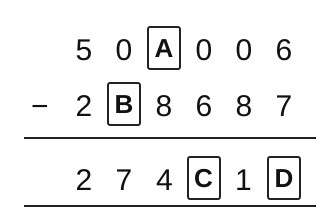
The diagram shows a column subtraction with four missing digits, A, B, C and D.

What digits are A, B, C and D?

A column subtraction. The top number has the digits 5, 0, a box marked A, 0, 0 and 6. Below it are a minus sign and the digits 2, a box marked B, 8, 6, 8 and 7. Under the line, the answer has the digits 2, 7, 4, a box marked C, 1 and a box marked D.

Model answer

Use the inverse: add the answer and the number taken away to make the top number.
Ones: \(D + 7\) ends in 6, so it is 16 and \(D = 9\), carry 1
Tens: \(1 + 8 + 1 = 10\), write 0, carry 1
Hundreds: \(C + 6 + 1\) ends in 0, so it is 10 and \(C = 3\), carry 1
Thousands: \(4 + 8 + 1 = 13\), so \(A = 3\), carry 1
Ten thousands: \(7 + B + 1\) ends in 0, so it is 10 and \(B = 2\), carry 1
Hundred thousands: \(2 + 2 + 1 = 5\), which matches.
Answer: A = 3, B = 2, C = 3, D = 9

Explanation

It is easiest to use the inverse: the answer plus the number taken away must make the top number. Add column by column from the ones, and use the digits you know to find each missing one. In the hundreds, C + 6 + 1 must end in 0, so C = 3. A common mistake is to forget the carried 1s, which makes most of the missing digits 1 out. Check: \(503{,}006 - 228{,}687 = 274{,}319\).

Mark scheme
  1. 1 mark

    A = 3

    Accept the top number written in full as 503,006.

  2. 1 mark

    B = 2

    Accept the number being taken away written in full as 228,687.

  3. 1 mark

    C = 3

    Accept the answer written in full as 274,319 for C and D.

  4. 1 mark

    D = 9

    A correct answer with no working scores full marks.

Ready to try the rest? Tap your answers and see straight away how you did.

Topic notes

Column addition and subtraction

The big idea

When numbers are too big to work with in your head, use a written method. In column addition and column subtraction you write the numbers one under the other and deal with a single column at a time, beginning with the ones.

Column addition

  1. Write the numbers with the ones lined up, so every digit sits in its own column. Take care with a shorter number: its first digit starts further to the right.
  2. Add the ones column first, then move left one column at a time.
  3. If a column's total is 10 or more, only its last digit goes in the answer. The ten moves into the next column on the left: this is called carrying. Write the carried digit small, under the answer line.

When you add several numbers, a column's total can reach 20 or more. Then you carry 2, or even more.

Four small villages have 1,286, 948, 1,375 and 869 people living in them. How many people live in the four villages altogether?

\[ \begin{array}{ccccc} & 1 & 2 & 8 & 6 \\ & & 9 & 4 & 8 \\ & 1 & 3 & 7 & 5 \\ + & & 8 & 6 & 9 \\ \hline & 4 & 4 & 7 & 8 \\ & {\scriptsize 2} & {\scriptsize 2} & {\scriptsize 2} & \end{array} \]

Ones: \(6 + 8 + 5 + 9 = 28\). Write 8 and carry 2 into the tens.

Tens: \(8 + 4 + 7 + 6 = 25\), and the carried 2 makes 27. Write 7 and carry 2.

Hundreds: \(2 + 9 + 3 + 8 = 22\), and the carried 2 makes 24. Write 4 and carry 2.

Thousands: \(1 + 1 = 2\), and the carried 2 makes 4.

Altogether, 4,478 people live in the four villages.

Column subtraction

  1. Write the bigger number on top, with the ones lined up.
  2. Start with the ones. Always take the bottom digit away from the top digit.
  3. If the bottom digit is bigger than the top digit, exchange: take 1 from the column on its left, which gives your column 10 more.
  4. If the column on the left holds 0, it has nothing to give. Keep moving left to the first digit that is not 0. Every 0 you pass becomes 9. For example, in \(50{,}000 - 17{,}386\) the 5 becomes 4, the three middle zeros turn into 9s, and the ones column gets 10.

The Moon is about 384,400 km from Earth. A spacecraft flying to the Moon has gone 156,875 km so far. How much further does it have to go?

Work out \(384{,}400 - 156{,}875\).

\[ \begin{array}{ccccccc} & & {\scriptsize 7} & {\scriptsize 3} & {\scriptsize 3} & {\scriptsize 9} & \\ & 3 & \cancel{8} & {}^{1}\cancel{4} & {}^{1}\cancel{4} & \cancel{0} & {}^{1}0 \\ - & 1 & 5 & 6 & 8 & 7 & 5 \\ \hline & 2 & 2 & 7 & 5 & 2 & 5 \end{array} \]

Ones: you cannot take 5 from 0, and the tens hold 0 too. So exchange from the hundreds: the 4 hundreds become 3, the 0 tens become 9, and the ones get 10. Then \(10 - 5 = 5\).

In the tens column, \(9 - 7 = 2\).

Hundreds: you cannot take 8 from 3, so exchange from the thousands. The thousands become 3, and the hundreds become 13. Then \(13 - 8 = 5\).

Thousands: you cannot take 6 from 3, so the ten thousands give 1. The 8 becomes 7, and the thousands become 13. Then \(13 - 6 = 7\).

Ten thousands: \(7 - 5 = 2\). Hundred thousands: \(3 - 1 = 2\).

The spacecraft has 227,525 km further to go.

Checking with the inverse

Addition and subtraction undo each other: they are inverse operations. To check a subtraction, add your answer to the number you took away. You should get the top number again. For the spacecraft, \(227{,}525 + 156{,}875 = 384{,}400\), so the answer is right.

To check an addition, take one of the numbers away from the total. You should be left with the other numbers.

Missing digits

The inverse helps with missing digits too. In \(6\square 3 - 248 = 385\), adding 385 and 248 gets you back to the top number: \(385 + 248 = 633\). So the missing digit is 3.

Common mistakes

  • Lining the numbers up by their first digits. The 948 in the villages example goes under the last three digits of 1,286.
  • Forgetting a carried digit, or carrying only 1 when a column's total is 20 or more.
  • Swapping the digits round when the bottom one is bigger. In \(61 - 28\), the ones are \(11 - 8\) after exchanging, not \(8 - 1\).
  • Making a 0 you exchange across into 10 and leaving it there. Once it has given 1 to its right, it is 9.

Top tip

Write each digit in its own square in a squared maths book, or draw faint lines between the columns. Then every digit stays in the right column.

Study Helper Hints first, answers after you try

Stuck on this one? Ask for a hint and I’ll point you in the right direction, without giving the answer away. Once you’ve checked your answer, I’ll show you how the marks are awarded.