Level:
Correct: 0
Incorrect: 0
Marks: 0/0
Practice
Course:
Topics:
Year 5 Maths Smart practice A mixed round aimed at your weak spots
Unit 1
Place value
Unit 2
Addition and subtraction
Unit 3
Multiplication and division
Unit 4
Fractions
Unit 5
Decimals and percentages
Unit 6
Measurement
Measurement
Converting metric units
Quick practice6 skills
Imperial units
Quick practice5 skills
Time
Quick practice5 skills
Money and measure problems
Quick practice4 skills
Perimeter
Quick practice5 skills
Area
Quick practice6 skills
Volume and capacity
Quick practice5 skills
Unit 7
Shape and angles
Unit 8
Position and direction
Geometry: position and direction
Coordinates
Quick practice5 skills
Reflection
Quick practice5 skills
Translation
Quick practice5 skills
Unit 9
Statistics
Statistics
Tables, timetables and charts
Quick practice5 skills
Line graphs
Quick practice5 skills
Avg
score:
–
Topics
done:
0/47

Rounding whole numbers

Practise 22 questions on Rounding whole numbers for Year 5 Maths. Tap your answer and find out straight away if you are right, with the Study Helper on hand if you get stuck.

  • 22 questions
  • 1–4 marks each
  • Instant marking
  • No sign-up needed
20 questions, marked as you go

Sample questions with model answers

Here are 4 of the questions in this topic, each with a model answer, an explanation of why it earns the marks and the mark scheme.

Question 1

1 mark

Round 8,615 to the nearest 1,000.

Model answer

8,615 is between 8,000 and 9,000.
The hundreds digit is 6, so round up.
9,000

Explanation

8,615 is between 8,000 and 9,000. To round to the nearest 1,000, look at the hundreds digit. It is 6, which is 5 or more, so round up to 9,000. A common mistake is to just drop the last three digits and write 8,000, without checking the hundreds digit first.

Mark scheme
  1. 1 mark

    9,000

    Accept 9000. Do not accept 8,000, 8,600 or 8,620.

Question 2

2 marks

A theme park had 712,486 visitors last year.

Round this number to the nearest 10.

Round it to the nearest 10,000.

Model answer

Nearest 10: the ones digit is 6, so round up: 712,490
Nearest 10,000: the thousands digit is 2, so round down: 710,000

Explanation

For the nearest 10, look at the ones digit: 6 means round up, so 712,486 becomes 712,490. For the nearest 10,000, look at the thousands digit: 2 means round down, so the answer is 710,000. A common mistake is to keep some of the old digits, such as 712,000.

Mark scheme
  1. 1 mark

    712,490

    Accept 712490. Do not accept 712,480 or 712,500.

  2. 1 mark

    710,000

    Accept 710000. Do not accept 712,000, 720,000 or 700,000.

Question 3

2 marks

Ivy says, "78,350 rounded to the nearest 1,000 is 79,000, because the 5 means you round up."

Is Ivy right? How do you know?

Model answer

No. To round to the nearest 1,000 you look at the hundreds digit. It is 3, so you round down. 78,350 rounds to 78,000. The 5 is in the tens column, so it does not matter.

Explanation

78,350 is between 78,000 and 79,000, and the halfway point is 78,500. 78,350 is below halfway, so it rounds down to 78,000. The digit to look at is the one just to the right of the column you are rounding to, which here is the hundreds digit. Ivy looked at the tens digit by mistake.

Mark scheme
  1. 1 mark

    No, with a reason that is relevant but incomplete, e.g. 'it should be 78,000' with no reason, or 'she looked at the wrong digit'

    'No' on its own scores 0. Any answer that says Ivy is right scores 0.

  2. 1 mark

    A complete reason: to round to the nearest 1,000 you look at the hundreds digit, which is 3, so it rounds down to 78,000; or 78,350 is nearer to 78,000 than to 79,000 (it is 350 away from 78,000 and 650 away from 79,000)

    Accept '78,350 is less than 78,500, so it rounds down to 78,000'. A complete correct reason on its own scores both marks.

Question 4

4 marks

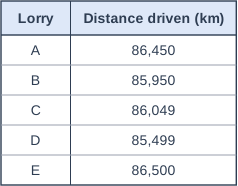
The table shows how far five lorries drove last year.

Which lorries drove 86,000 km, to the nearest 1,000 km? Tap all of them.

Which lorry drove 87,000 km, to the nearest 1,000 km?

Round the distance that lorry D drove to the nearest 10,000 km.

Table with columns "Lorry", "Distance driven (km)". Lorry: A; Distance driven (km): 86,450 | Lorry: B; Distance driven (km): 85,950 | Lorry: C; Distance driven (km): 86,049 | Lorry: D; Distance driven (km): 85,499 | Lorry: E; Distance driven (km): 86,500.

Model answer

A: 86,450 rounds to 86,000
B: 85,950 rounds to 86,000
C: 86,049 rounds to 86,000
D: 85,499 rounds to 85,000
E: 86,500 rounds to 87,000
So A, B and C drove 86,000 km, and E drove 87,000 km.
D to the nearest 10,000: the thousands digit is 5, so 90,000 km.

Explanation

To round to the nearest 1,000, look at the hundreds digit of each distance. Lorry B, with 85,950 km, rounds up to 86,000, but lorry E, with 86,500 km, is exactly halfway, so it rounds up to 87,000. For the nearest 10,000, look at the thousands digit of 85,499: it is 5, so round up to 90,000. A common mistake is to write 80,000 by just keeping the first digit.

Mark scheme
  1. 1 mark

    Two of A, B and C and no wrong lorry; or all three with one wrong lorry

    Also award this mark for the fully correct answer A, B and C.

  2. 1 mark

    A, B and C, and no others

    D (85,499 km) rounds to 85,000 km and E (86,500 km) rounds to 87,000 km.

  3. 1 mark

    E

    Accept 86,500 km.

  4. 1 mark

    90,000 km

    The unit is not needed. Do not accept 80,000, 85,000 or 86,000.

Ready to try the rest? Tap your answers and see straight away how you did.

Topic notes

Rounding whole numbers

The big idea

Rounding means swapping a number for a nearby number that is easier to use. If 635,000 people visit a museum in a year, you might say "about 600,000". A rounded number is close to the real number, but it is not exact.

Rounding on a number line

To round 635,000 to the nearest 100,000, find the two multiples of 100,000 either side of it. (Multiples of 100,000 are the numbers in its times table: 100,000, 200,000, 300,000 and so on.) The number rounds to whichever one is closer.

A horizontal scale from 600000 to 700000, divided into 2 equal parts by long marks, each split into 10 small divisions by short marks. The marks are not numbered. Long marks are every 50000 and each small division is 5000. Words under the scale: "600,000" at 600000, "halfway" at 650000 and "700,000" at 700000. Arrow A points to 635000.
Arrow A points to 635,000. It has not reached the halfway point, 650,000, so it is closer to 600,000 and rounds down to 600,000.

The number exactly in the middle is the halfway point. A number at halfway always rounds up, so 650,000 rounds to 700,000.

The rounding rule

You do not need to draw a number line every time.

  1. Find your rounding column. For the nearest 1,000, it is the thousands column.
  2. Look at the next digit: the digit straight after your rounding column.
  3. If the next digit is 5 or more, round up: the digit in your column goes up by 1. If it is 4 or less, round down: that digit stays the same.
  4. Every digit to the right of your column becomes 0.

For 48,267 to the nearest 1,000, the next digit is the 2 in the hundreds column. 2 is 4 or less, so 48,267 rounds down to 48,000.

If the digit you round up is a 9, it becomes 0 and the column on its left goes up by 1. So 596,800 to the nearest 10,000 is 600,000.

A charity bike ride raised £63,718. A poster says it raised "about £64,000". Which rounding did the poster use?

Try each rounding in turn.

  • Nearest 10: the next digit, 8, says up. That gives £63,720.
  • Nearest 100: the next digit, 1, says down. That gives £63,700.
  • Nearest 1,000: the next digit, 7, says up. That gives £64,000.
  • Nearest 10,000: the next digit, 3, says down. That gives £60,000.

The poster rounded to the nearest £1,000.

Rounding in real life

We round crowds, distances and amounts of money when the exact number does not matter. Words like "about", "roughly" and "approximately" tell you a number has been rounded. Rounding to a bigger column gives a simpler number, but it is further from the real one: £60,000 is simpler than £63,720, but less exact.

Leo's number is \(3\square{,}482\). One digit is missing. Rounded to the nearest 10,000, his number is 40,000. Which digits could be missing?

Leo's number is between 30,000 and 40,000. It rounds to 40,000, so it must be 35,000 or more.

The missing digit is in the thousands column, which is the next digit when you round to the nearest 10,000. It must be 5 or more.

The missing digit could be any digit from 5 to 9.

Stretch: the smallest and largest numbers

Lots of whole numbers round to the same answer. To the nearest 100, every whole number from 2,350 up to 2,449 rounds to 2,400.

  • The smallest, 2,350, is the halfway point below 2,400. It rounds up to 2,400.
  • The largest is 2,449. One more, 2,450, is the halfway point above 2,400, and it rounds up to 2,500.

So start half a step below the rounded number, and stop one whole number before half a step above it.

Common mistakes

  • Looking at the wrong digit. For the nearest 1,000, check the hundreds digit, not the thousands digit.
  • Rounding a halfway number down. 650,000 to the nearest 100,000 is 700,000.
  • Leaving off the zeros: 48,267 to the nearest 1,000 is 48,000, not 48.
  • Rounding in steps. 7,463 to the nearest 1,000 is 7,000. Going to 7,500 first and then to 8,000 is wrong.
  • Giving the halfway point above as the largest number. To the nearest 100, 2,450 rounds to 2,500, not 2,400.

Top tip

Before you round, write down the two numbers your answer could be, one each side. For 48,267 to the nearest 1,000, it must be 48,000 or 49,000. Then pick the closer one.

Study Helper Hints first, answers after you try

Stuck on this one? Ask for a hint and I’ll point you in the right direction, without giving the answer away. Once you’ve checked your answer, I’ll show you how the marks are awarded.