Level:
Correct: 0
Incorrect: 0
Marks: 0/0
Practice
Course:
Topics:
Year 5 Maths Smart practice A mixed round aimed at your weak spots
Unit 1
Place value
Number and place value
Numbers up to one million
Quick practice6 skills
Rounding whole numbers
Quick practice6 skills
Negative numbers
Quick practice6 skills
Roman numerals
Quick practice5 skills
Unit 2
Addition and subtraction
Unit 3
Multiplication and division
Unit 4
Fractions
Unit 5
Decimals and percentages
Unit 6
Measurement
Unit 7
Shape and angles
Unit 8
Position and direction
Geometry: position and direction
Coordinates
Quick practice5 skills
Reflection
Quick practice5 skills
Translation
Quick practice5 skills
Unit 9
Statistics
Statistics
Tables, timetables and charts
Quick practice5 skills
Line graphs
Quick practice5 skills
Avg
score:
–
Topics
done:
0/47

Time

Practise 22 questions on Time for Year 5 Maths. Tap your answer and find out straight away if you are right, with the Study Helper on hand if you get stuck.

  • 22 questions
  • 1–5 marks each
  • Instant marking
  • No sign-up needed
20 questions, marked as you go

Sample questions with model answers

Here are 4 of the questions in this topic, each with a model answer, an explanation of why it earns the marks and the mark scheme.

Question 1

1 mark

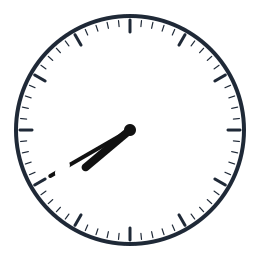
The picture shows a clock. It shows the time Zac goes to bed one evening.

What is this time on the 24-hour clock?

A round clock face with the numbers 1 to 12 and a small mark for every minute. The short hour hand is between the 7 and the 8, nearer to the 8. The long minute hand points exactly at the 8.

Model answer

The clock shows 20 minutes to 8, which is 7:40.
It is the evening, so it is 7:40 pm.
\(7 + 12 = 19\)
19:40

Explanation

The minute hand points at the 8, which means 40 minutes past the hour. The hour hand has gone past the 7 but has not reached the 8, so the time is 7:40. In the evening you add 12 to the hour for the 24-hour clock: \(7 + 12 = 19\), so the time is 19:40. A common mistake is to read the hour as 8 because the hour hand is close to the 8.

Mark scheme
  1. 1 mark

    19:40

    Accept 1940, 19.40 or 19 40. Do not accept 7:40, 07:40 or 7:40 pm (07:40 is 7:40 in the morning; the question asks for the 24-hour clock), 17:40, 20:40 or 19:08.

Question 2

2 marks

Kim practised the piano for 150 minutes this week.

What is this time in hours and minutes?

Model answer

60 minutes = 1 hour, so 120 minutes = 2 hours.
\(150 - 120 = 30\)
150 minutes = 2 hours 30 minutes

Explanation

Take away as many hours as you can. Two hours is \(2 \times 60 = 120\) minutes, and \(150 - 120 = 30\) minutes are left over. So 150 minutes is 2 hours 30 minutes. A common mistake is to write 1 hour 50 minutes, as if there were 100 minutes in an hour.

Mark scheme
  1. 1 mark

    120 minutes = 2 hours (or 60 minutes = 1 hour used to count up); or the correct answer 2 hours 30 minutes with no working

    2.5 hours as a final answer scores this mark only (the question asks for hours and minutes).

  2. 1 mark

    2 hours 30 minutes

    Accept 2 h 30 min, 2 hours and 30 minutes or 2 and a half hours. Do not accept 1 hour 50 minutes (from 150 รท 100) or 2.3 hours. A correct answer with no working scores full marks.

Question 3

2 marks

Ravi goes on holiday. He is away every day from 25 July to 5 August, including both of those days.

How many days is Ravi away?

Model answer

July has 31 days.
25, 26, 27, 28, 29, 30, 31 July = 7 days
1, 2, 3, 4, 5 August = 5 days
7 + 5 = 12 days

Explanation

July has 31 days, so the days in July are the 25th to the 31st: that is 7 days. Then there are 5 days in August, from the 1st to the 5th. So Ravi is away for \(7 + 5 = 12\) days. A common mistake is to forget that July has 31 days, or to leave out the first or last day.

Mark scheme
  1. 1 mark

    July has 31 days, or 7 days in July (25 to 31 July), or 5 days in August; or the correct answer 12 days with no working

  2. 1 mark

    12 days

    Accept 12. Do not accept 11 (not counting both of the end days, or using 30 days in July) or 10. A correct answer with no working scores full marks.

Question 4

4 marks

Jack's family arrive at the zoo at 10:05. They stay at the zoo for 195 minutes. Then they catch the next bus home to Riverside.

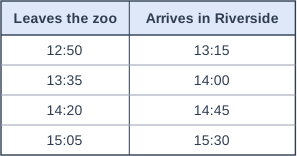
The table shows the buses from the zoo to Riverside.

At what time do Jack's family arrive in Riverside?

Table with columns "Leaves the zoo", "Arrives in Riverside". Leaves the zoo: 12:50; Arrives in Riverside: 13:15 | Leaves the zoo: 13:35; Arrives in Riverside: 14:00 | Leaves the zoo: 14:20; Arrives in Riverside: 14:45 | Leaves the zoo: 15:05; Arrives in Riverside: 15:30.

Model answer

195 minutes = 180 minutes + 15 minutes = 3 hours 15 minutes
10:05 + 3 hours = 13:05
13:05 + 15 minutes = 13:20
The next bus leaves the zoo at 13:35.
It arrives in Riverside at 14:00.

Explanation

First change 195 minutes into hours and minutes: 180 minutes is 3 hours, so 195 minutes is 3 hours 15 minutes. The family leave the zoo at 10:05 + 3 hours 15 minutes = 13:20. The 12:50 bus has already gone, so they catch the 13:35 bus, which arrives in Riverside at 14:00. A common mistake is to give the time the bus leaves instead of the time it arrives.

Mark scheme
  1. 1 mark

    195 minutes = 3 hours 15 minutes; or the correct answer 14:00 with no working

  2. 1 mark

    They leave the zoo at 13:20 (1:20 pm)

    Follow through: 10:05 plus their time at the zoo.

  3. 1 mark

    They catch the bus that leaves the zoo at 13:35

    Follow through: the first bus after their time from the second mark.

  4. 1 mark

    14:00

    Accept 14.00, 1400, 2:00 pm, 2.00 pm, 02:00 pm, 2 pm, 2:00 or 2 o'clock. Do not accept 2:00 am, 13:15 (a bus that has already gone) or 13:35 (the time the bus leaves the zoo). A correct answer with no working scores full marks.

Ready to try the rest? Tap your answers and see straight away how you did.

Topic notes

Time

The big idea

Time is measured in seconds, minutes, hours, days, weeks, months and years. It does not go up in tens like most measures: an hour has 60 minutes and a day has 24 hours. So when you change units, or work out how long something lasts, take care to count in 60s, 24s and 7s.

Units of time

UnitIs the same as
1 minute60 seconds
1 hour60 minutes
1 day24 hours
1 week7 days
1 year12 months, or 365 days

To change into a smaller unit, multiply: 4 days is \(4 \times 24 = 96\) hours. To change into a bigger unit, take away as many whole lots as you can. What is left over stays in the smaller unit.

A ready meal says "heat for 460 seconds". The microwave timer is set in minutes and seconds. What should Ben set it to?

7 minutes is \(7 \times 60 = 420\) seconds. 8 minutes would be 480 seconds: too much.

\(460 - 420 = 40\) seconds are left over.

So Ben sets the timer to 7 minutes 40 seconds, not 4 minutes 60 seconds: a minute is 60 seconds, not 100.

Months and leap years

Four months have 30 days: April, June, September and November. February has 28 days, but a leap year gives it 29. Every other month has 31 days.

A leap year has 366 days. One comes every 4 years, and the year's number is a multiple of 4, such as 2024 and 2028. (Some years ending in 00, such as 2100, are not leap years.)

12-hour and 24-hour clocks

The 12-hour clock uses am for times from midnight to noon and pm for times after noon. The 24-hour clock numbers the hours from 00 to 23 and always uses four digits, so it needs no am or pm.

  • Morning times keep their hour: 7:05 am is 07:05.
  • From 1 pm, add 12 to the hour: 3:40 pm is 15:40.
  • To go back, take 12 away from hours 13 to 23 and write pm: 23:10 is 11:10 pm.
  • Noon is 12:00 and midnight is 00:00.

Ana's phone shows 00:45. She says, "It is quarter to one in the afternoon." Is she right?

The hour 00 is the hour just after midnight, so 00:45 is 12:45 am.

That is quarter to one in the morning, so Ana is not right. Quarter to one in the afternoon is 12:45.

How long does it last?

The time something takes is its duration. To find a duration, draw a time line and count on in jumps: first to the next o'clock, then in whole hours, then the minutes that are left.

Sunrise to sunset. Flow chart of 4 boxes joined by arrows, read from left to right. The first box is "06:52", which leads (along an arrow labelled "+ 8 minutes") to "07:00", which leads (along an arrow labelled "+ 12 hours") to "19:00", which leads (along an arrow labelled "+ 37 minutes") to "19:37".
The jumps make 12 hours and 8 + 37 = 45 minutes: 12 hours 45 minutes.

One spring day, the sun rose at 06:52 and set at 19:37. Was it light for longer than it was dark that day? By how much?

The time line shows it was light for 12 hours 45 minutes.

A day is 24 hours, so count on from 12 hours 45 minutes to 24 hours: 15 minutes makes 13 hours, then 11 more hours. It was dark for 11 hours 15 minutes.

12 hours 45 minutes is longer, so it was light for longer, by 1 hour 30 minutes.

Timetables

A timetable lists the times buses or trains reach each stop. Each column is one bus.

StopFirst busSecond busThird bus
Station Road09:4810:1310:38
High Street09:5510:2010:45
Museum10:1610:4111:06

Jo must be at the Museum by 11:00. What is the latest bus she can catch from Station Road?

Look along the Museum row for the latest time that is not after 11:00. The second bus arrives at 10:41. The third bus arrives at 11:06, which is too late.

Read up the second bus's column to Station Road: 10:13.

The latest bus Jo can catch leaves Station Road at 10:13.

Remember

  • 60 seconds = 1 minute, 60 minutes = 1 hour, 24 hours = 1 day, 7 days = 1 week.
  • A year is 365 days, or 366 in a leap year.
  • From 1 pm on the 24-hour clock, add 12 to the hour.

Common mistakes

  • Taking times away like ordinary numbers. From 9:50 to 10:15 is 25 minutes, not 65.
  • Thinking 2.5 hours is 2 hours 50 minutes. Half an hour is 30 minutes, so 2.5 hours is 2 hours 30 minutes.
  • Adding 10 instead of 12 for pm times. 5:20 pm is 17:20, not 15:20.

Top tip

On a timetable, keep your finger on the right column as you read down, so you do not read a time from the wrong bus.

Study Helper Hints first, answers after you try

Stuck on this one? Ask for a hint and I’ll point you in the right direction, without giving the answer away. Once you’ve checked your answer, I’ll show you how the marks are awarded.