Level:
Correct: 0
Incorrect: 0
Marks: 0/0
Practice
Course:
Topics:
Year 5 Maths Smart practice A mixed round aimed at your weak spots
Unit 1
Place value
Number and place value
Numbers up to one million
Quick practice6 skills
Rounding whole numbers
Quick practice6 skills
Negative numbers
Quick practice6 skills
Roman numerals
Quick practice5 skills
Unit 2
Addition and subtraction
Unit 3
Multiplication and division
Unit 4
Fractions
Unit 5
Decimals and percentages
Unit 6
Measurement
Measurement
Converting metric units
Quick practice6 skills
Imperial units
Quick practice5 skills
Time
Quick practice5 skills
Money and measure problems
Quick practice4 skills
Perimeter
Quick practice5 skills
Area
Quick practice6 skills
Volume and capacity
Quick practice5 skills
Unit 7
Shape and angles
Unit 8
Position and direction
Unit 9
Statistics
Statistics
Tables, timetables and charts
Quick practice5 skills
Line graphs
Quick practice5 skills
Avg
score:
–
Topics
done:
0/47

Translation

Practise 18 questions on Translation for Year 5 Maths. Tap your answer and find out straight away if you are right, with the Study Helper on hand if you get stuck.

  • 18 questions
  • 1–4 marks each
  • Instant marking
  • No sign-up needed
18 questions, marked as you go

Sample questions with model answers

Here are 4 of the questions in this topic, each with a model answer, an explanation of why it earns the marks and the mark scheme.

Question 1

1 mark

Rosie translates a triangle 3 squares to the right.

What changes when she does this?

Model answer

its position

Explanation

A translation slides a shape to a new place. Its size and shape stay the same, and it does not turn or flip, so it still faces the same way. Only its position on the grid changes. A common mistake is to think a shape gets bigger or turns round when it moves.

Mark scheme
  1. 1 mark

    its position

    Do not accept more than one choice.

Question 2

2 marks

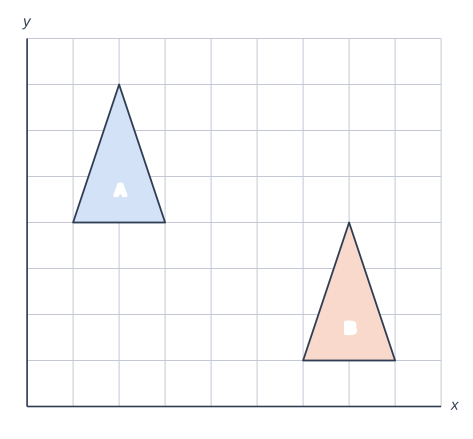
The diagram shows triangle A and triangle B.

Triangle A is translated onto triangle B.

Describe the translation.

A coordinate grid with x from 0 to 9 and y from 0 to 8; each grid square is 1 unit across, and the axes cross at the origin O. Shape A is a shaded triangle with vertices (1, 4), (3, 4) and (2, 7). Shape B is a shaded triangle with vertices (6, 1), (8, 1) and (7, 4).

Model answer

The top corner of A is at \((2, 7)\). The top corner of B is at \((7, 4)\).
\(7 - 2 = 5\) and \(7 - 4 = 3\)
5 squares to the right and 3 squares down

Explanation

Choose one corner of A and find the same corner on B, then count the squares across and the squares down. In a translation every corner moves the same way, so one corner is enough. A common mistake is to count the gap between the two triangles instead of how far one corner moves.

Mark scheme
  1. 1 mark

    5 squares to the right

    Accept '5 right' or 'right 5'.

  2. 1 mark

    3 squares down

    Accept '3 down' or 'down 3'. The two parts can be in either order. Do not accept the move from B back to A (5 left and 3 up) for either mark.

Question 3

3 marks

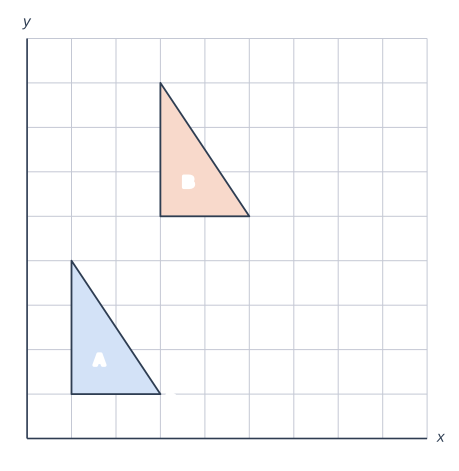
Ben was asked to translate triangle A 4 squares to the right and 2 squares up. He drew triangle B, but he made a mistake.

The diagram shows triangle A and triangle B.

Describe the translation that Ben used.

Then what are the coordinates of the point where corner P should have moved to?

A coordinate grid with x from 0 to 9 and y from 0 to 9; each grid square is 1 unit across, and the axes cross at the origin O. Shape A is a shaded triangle with vertices (1, 1), P(3, 1) and (1, 4). Shape B is a shaded triangle with vertices (3, 5), (5, 5) and (3, 8).

Model answer

P is at \((3, 1)\). On triangle B the same corner is at \((5, 5)\).
Ben used 2 squares to the right and 4 squares up. He swapped the two numbers.
P should move to \((3 + 4, 1 + 2) = (7, 3)\).

Explanation

Compare one corner of A with the same corner of B: P moves from \((3, 1)\) to \((5, 5)\), which is 2 right and 4 up. Ben swapped the numbers, so he moved 2 right instead of 4, and 4 up instead of 2. The correct move takes P to \((7, 3)\). Always check that the move across and the move up are the right way round.

Mark scheme
  1. 1 mark

    Ben used: 2 squares to the right

    Accept '2 right'.

  2. 1 mark

    Ben used: 4 squares up

    Accept '4 up'. The two parts can be in either order. Do not accept the move from B back to A (2 left and 4 down).

  3. 1 mark

    P should have moved to \((7, 3)\)

    Accept 7, 3 without brackets. P is at \((3, 1)\), and 4 right and 2 up gives \((7, 3)\). Do not accept \((5, 5)\), where Ben moved P.

Question 4

4 marks

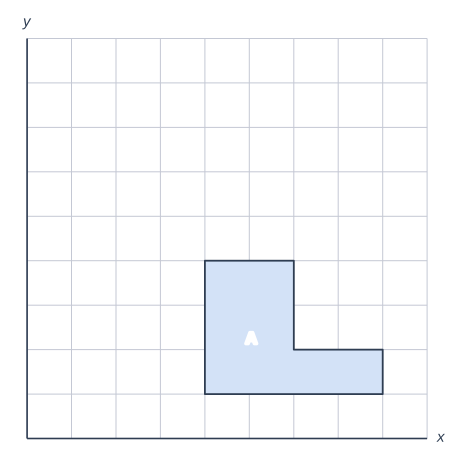
The diagram shows shape A on a grid of 1 cm squares.

Shape A is translated 3 squares to the left and 4 squares up to make shape B.

Plot the six corners of shape B on the grid.

What is the area of shape B? How do you know?

A coordinate grid with x from 0 to 9 and y from 0 to 9; each grid square is 1 unit across, and the axes cross at the origin O. Shape A is a shaded hexagon with vertices (4, 1), (8, 1), (8, 2), (6, 2), (6, 4) and (4, 4).

Model answer

Take 3 from each first number and add 4 to each second number:
\((4, 1)\) to \((1, 5)\), \((8, 1)\) to \((5, 5)\), \((8, 2)\) to \((5, 6)\),
\((6, 2)\) to \((3, 6)\), \((6, 4)\) to \((3, 8)\), \((4, 4)\) to \((1, 8)\)
Shape A covers \(4 + 4 = 8\) squares. A translation does not change the size of a shape, so the area of B is also 8 cm².

Explanation

Move every corner the same way: left takes away from the first coordinate and up adds to the second. To find the area, count the squares in shape A: 4 in the bottom row and 4 in the part above. A translation slides a shape without changing its size, so B covers exactly the same number of squares. A common mistake is to work out the area of the whole rectangle around the shape.

Mark scheme
  1. 1 mark

    At least three of the corners of B correct: \((1, 5)\), \((5, 5)\), \((5, 6)\), \((3, 6)\), \((3, 8)\), \((1, 8)\)

  2. 1 mark

    All six corners of B correct: \((1, 5)\), \((5, 5)\), \((5, 6)\), \((3, 6)\), \((3, 8)\), \((1, 8)\)

    Accept the corners in any order and without brackets.

  3. 1 mark

    8 cm²

    Accept 8 or 8 squares. Do not accept 12 (the area of the 4 by 3 rectangle around the shape).

  4. 1 mark

    A correct reason: a translation does not change the size of a shape, so B has the same area as A (8 squares); or B's squares counted (4 in the bottom part and 4 in the top part)

    'It is the same shape' alone is not enough: the pupil must say B is the same size as A, or show how the 8 was counted.

Ready to try the rest? Tap your answers and see straight away how you did.

Topic notes

Translation

The big idea

Slide a book across a table without turning it: that is a translation. The shape ends up somewhere new, yet it never spins round, turns over, grows or shrinks. Every corner makes exactly the same journey, so the new shape, the image, is an exact copy of the original that still points the same way.

Describing a translation

On a grid, give a translation in two parts: the number of squares it moves left or right, then the number of squares it moves up or down. "6 squares right and 5 squares up" is one example.

When you are shown a shape and its image, pick one corner, find its partner on the image, and count the squares across and then up or down. One corner is enough, because all the corners make the same journey.

A coordinate grid with x from 0 to 13 and y from 0 to 10; each grid square is 1 unit across, and the axes cross at the origin O. Shape A is a shaded heptagon with vertices (2, 1), (5, 1), (6, 2), (4, 2), (4, 5), (2, 2) and (1, 2). (Heptagon; area 7 square units.) Shape B is a shaded heptagon with vertices (8, 6), (11, 6), (12, 7), (10, 7), (10, 10), (8, 7) and (7, 7). (Heptagon; area 7 square units.) A point labelled "6 right" is marked at (8, 0.5). A point labelled "5 up" is marked at (11.5, 3.5). An arrow goes from (5, 1) to (11, 1). (As a column vector with top 6 and bottom 0: 6 right and 0 up.) An arrow goes from (11, 1) to (11, 6). (As a column vector with top 0 and bottom 5: 0 right and 5 up.) (Shape B is the image of shape A under a translation by the column vector (6, 5) (6 right, 5 up).)
Boat A is translated 6 squares right and 5 squares up to make boat B. The arrows follow one corner; every other corner makes the same journey.

Coordinates after a translation

  • Moving right increases the first number (the x-coordinate). Moving left decreases it.
  • Moving up increases the second number (the y-coordinate). Moving down decreases it.

In the picture, the bottom-right corner of A is at \((5, 1)\). After 6 right and 5 up it is at \((5 + 6, 1 + 5) = (11, 6)\), the bottom-right corner of B.

What stays the same

A translation changes only the position. Every side keeps its length, every angle keeps its size, and the shape still points the same way. A sail that points up before a translation still points up after it.

A bee flies in a straight line from its hive at \((1, 1)\) to a flower at \((10, 6)\). Describe the translation. Then describe the translation that takes it home again.

Across: from 1 to 10 is \(10 - 1 = 9\), and 10 is bigger, so it went 9 squares right.

Up or down: from 1 to 6 is \(6 - 1 = 5\), and 6 is bigger, so it went 5 squares up.

The trip home undoes the trip out, so the directions swap: 9 squares left and 5 squares down. Check: 9 squares left of 10 is 1, and 5 squares down from 6 is 1, so the bee is back at the hive.

The grid goes from 0 to 10 across and from 0 to 8 up. How far left can the shape be translated and still be on the grid? How far up?

A coordinate grid with x from 0 to 10 and y from 0 to 8; each grid square is 1 unit across, and the axes cross at the origin O. Shape S is a shaded quadrilateral with vertices (3, 2), (6, 2), (6, 4) and (4, 5). (Quadrilateral; area 6.5 square units.)
Shape S has corners at (3, 2), (6, 2), (6, 4) and (4, 5).

Left: the corner furthest left has x-coordinate 3. Moving left makes the x-coordinates smaller, and they cannot go below 0. So the shape can move at most 3 squares left, which puts that corner on the y-axis.

Up: the highest corner has y-coordinate 5, and the grid stops at 8. Counting on from 5 to 8 is 3 squares, so it can move at most 3 squares up.

The shape moves all in one piece, so you only need to check the corner closest to that edge of the grid.

The corners of a square are \((2, 1)\), \((6, 1)\), \((6, 5)\) and \((2, 5)\). It is translated 3 squares right. Does the image overlap the square? How far right must the square move so that the two squares just touch along a side?

The square is 4 squares wide: its left side is at 2 and its right side is at 6.

After 3 right, the image's left side has moved from 2 to 5, and its right side from 6 to 9. The strip between 5 and 6 is inside both squares, so yes, they overlap.

To just touch, the image's left side must land on the square's right-hand side, at 6. Moving from 2 to 6 is 4 squares, so the square must move 4 squares right: exactly its own width.

Common mistakes

  • Using the wrong number for the move. Left and right belong to the first number; up and down belong to the second.
  • Turning or flipping the shape as you move it. A translated shape always faces the same way.
  • Giving where a point ends up instead of how far it moved: from \((2, 3)\) to \((2, 8)\) is 5 squares up, not 8.
  • Repeating the move when asked where a shape started. Undo it with the opposite move.

Top tip

Always describe a translation in two parts, across first and then up or down, even when one part is 0 squares.

Study Helper Hints first, answers after you try

Stuck on this one? Ask for a hint and I’ll point you in the right direction, without giving the answer away. Once you’ve checked your answer, I’ll show you how the marks are awarded.