Level:
Correct: 0
Incorrect: 0
Marks: 0/0
Practice
Course:
Topics:
Year 5 Maths Smart practice A mixed round aimed at your weak spots
Unit 1
Place value
Number and place value
Numbers up to one million
Quick practice6 skills
Rounding whole numbers
Quick practice6 skills
Negative numbers
Quick practice6 skills
Roman numerals
Quick practice5 skills
Unit 2
Addition and subtraction
Unit 3
Multiplication and division
Unit 4
Fractions
Unit 5
Decimals and percentages
Unit 6
Measurement
Measurement
Converting metric units
Quick practice6 skills
Imperial units
Quick practice5 skills
Time
Quick practice5 skills
Money and measure problems
Quick practice4 skills
Perimeter
Quick practice5 skills
Area
Quick practice6 skills
Volume and capacity
Quick practice5 skills
Unit 7
Shape and angles
Unit 8
Position and direction
Geometry: position and direction
Coordinates
Quick practice5 skills
Reflection
Quick practice5 skills
Translation
Quick practice5 skills
Unit 9
Statistics
Statistics
Tables, timetables and charts
Quick practice5 skills
Line graphs
Quick practice5 skills
Avg
score:
–
Topics
done:
0/47

Tenths, hundredths and thousandths

Practise 22 questions on Tenths, hundredths and thousandths for Year 5 Maths. Tap your answer and find out straight away if you are right, with the Study Helper on hand if you get stuck.

  • 22 questions
  • 1–5 marks each
  • Instant marking
  • No sign-up needed
20 questions, marked as you go

Sample questions with model answers

Here are 4 of the questions in this topic, each with a model answer, an explanation of why it earns the marks and the mark scheme.

Question 1

1 mark

What is the value of the digit 5 in 2.856?

Model answer

2.856: 2 ones, 8 tenths, 5 hundredths, 6 thousandths.
The 5 is worth 5 hundredths, which is 0.05.

Explanation

After the decimal point the places are tenths, then hundredths, then thousandths. The 5 is the second digit after the point, so it is in the hundredths place and is worth 0.05. A common mistake is to say just '5', but the value of a digit depends on its place.

Mark scheme
  1. 1 mark

    5 hundredths

    Accept 0.05 or 5/100. Do not accept 5, 'hundredths' alone, 0.5 or 5 tenths.

Question 2

2 marks

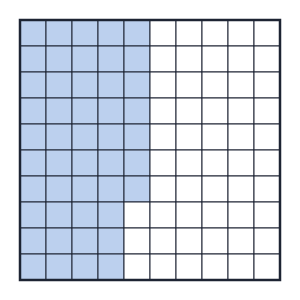
The diagram shows a large square split into 100 equal small squares. Some of the small squares are shaded.

What is the shaded part of the large square as a fraction and as a decimal?

A large square made of 10 rows and 10 columns of equal small squares. The first 4 columns on the left are fully shaded, and the top 7 squares of the 5th column are shaded. The rest are white.

Model answer

4 full columns of 10 = 40 squares, and 7 more = 47 squares shaded.
Fraction: \(\dfrac{47}{100}\)
Decimal: 0.47

Explanation

Each small square is one hundredth of the large square. Count the shaded squares in tens: 4 full columns make 40, and 7 more make 47. So 47 hundredths are shaded, which is \(\dfrac{47}{100}\) or 0.47. Each full column is one tenth, so you can also see 4 tenths and 7 hundredths.

Mark scheme
  1. 1 mark

    \(\dfrac{47}{100}\)

    Accept 470/1000.

  2. 1 mark

    0.47

    Accept 0.470. If the two answers are not labelled, accept them in either order. Do not accept 47 or 4.7.

Question 3

2 marks

What are the two missing numbers?

\(5.374 = 5 + \square + 0.07 + \square\)

Model answer

5.374 = 5 ones, 3 tenths, 7 hundredths, 4 thousandths
\(5.374 = 5 + 0.3 + 0.07 + 0.004\)

Explanation

Split the number into the value of each digit. The 3 is in the tenths place, so it is worth 0.3. The 4 is in the thousandths place, so it is worth 0.004. A common mistake is to write just the digits 3 and 4, but each box needs the value of the digit.

Mark scheme
  1. 1 mark

    0.3 (in the first box)

    Accept 3/10, 0.30 or '3 tenths'. Do not accept 3.

  2. 1 mark

    0.004 (in the second box)

    Accept 4/1000 or '4 thousandths'. Do not accept 4 or 0.04. If the boxes are not labelled, accept 0.3 then 0.004 in that order.

Question 4

4 marks

Mia has 4 place-value counters. Each counter is a 0.1 counter or a 0.01 counter. She can use any mix of the two kinds.

Find all the different numbers Mia could make with all 4 counters.

Model answer

4 tenths: 0.4
3 tenths, 1 hundredth: 0.31
2 tenths, 2 hundredths: 0.22
1 tenth, 3 hundredths: 0.13
4 hundredths: 0.04

Explanation

Work in order so you do not miss any: start with all 4 counters as tenths, then swap one tenth for a hundredth each time. That gives 4, 3, 2, 1 and 0 tenths, with 0, 1, 2, 3 and 4 hundredths. So there are five numbers: 0.4, 0.31, 0.22, 0.13 and 0.04. A common mistake is to forget the two ends, where all the counters are the same kind.

Mark scheme
  1. 1 mark

    Two correct numbers from 0.4, 0.31, 0.22, 0.13, 0.04

    Accept 0.40 for 0.4.

  2. 1 mark

    Three correct numbers

  3. 1 mark

    Four correct numbers

  4. 1 mark

    All five correct numbers (0.4, 0.31, 0.22, 0.13, 0.04), and no wrong numbers

    There are exactly five numbers. A list with a wrong number (for example 0.5 or 0.0004) loses this mark but can still score the first three marks.

Ready to try the rest? Tap your answers and see straight away how you did.

Topic notes

Tenths, hundredths and thousandths

The big idea

Decimals are a way of writing parts of a whole. The decimal point goes after the ones, and the digits after it are worth less than 1. Straight after the point come the tenths, then the hundredths, then the thousandths. Every decimal can also be written as a fraction.

Splitting into 10 again and again

Split one whole into 10 equal parts and each part is one tenth. Split a tenth into 10 and each part is one hundredth. Split a hundredth into 10 and each part is one thousandth.

NameFractionDecimal
one tenth\(\dfrac{1}{10}\)0.1
one hundredth\(\dfrac{1}{100}\)0.01
one thousandth\(\dfrac{1}{1000}\)0.001

Putting the parts back together works the other way: 1 whole is 10 tenths, 1 tenth is 10 hundredths, and 1 hundredth is 10 thousandths. This means that if you ever have 10 or more in a column, you can exchange 10 of them for 1 in the column to the left.

The value of each digit

A digit's column tells you what it is worth. Here is 9.416 in a place-value grid:

OnesTenthsHundredthsThousandths
9416

The 9 is worth 9, the 4 is worth 0.4, the 1 is worth 0.01 and the 6 is worth 0.006. Splitting a number up like this is called partitioning:

\[ 9.416 = 9 + 0.4 + 0.01 + 0.006 \]

A 0 in a decimal is a place holder. It keeps the other digits in the right columns. 0.8, 0.08 and 0.008 are very different numbers: 8 tenths, 8 hundredths and 8 thousandths.

Write \(5 + 0.08 + 0.003\) as one decimal. Then change it into a mixed number.

There are 5 ones, no tenths, 8 hundredths and 3 thousandths.

Put a 0 in the tenths column to hold the place: 5.083.

The last digit is in the thousandths column, so the decimal part is 83 thousandths.

\(5.083 = 5\dfrac{83}{1000}\)

Decimals and fractions

Find the column where the decimal ends. That column decides the denominator, which is the fraction's bottom number:

  • last digit in the tenths: \(0.8 = \dfrac{8}{10}\)
  • last digit in the hundredths: \(0.61 = \dfrac{61}{100}\)
  • last digit in the thousandths: \(0.347 = \dfrac{347}{1000}\)

Zeros on the end do not change a decimal. 0.6, 0.60 and 0.600 are all the same, because 6 tenths = 60 hundredths = 600 thousandths.

Decimals on a number line

Between any two tenths there are 10 hundredths, and between any two hundredths there are 10 thousandths. To read a number line, start by finding the value of one small step.

A horizontal scale from 1.26 to 1.27, with a long mark at each end, split into 10 small divisions by short marks. Every long mark is numbered (1.26 and 1.27). Long marks are every 0.01 and each small division is 0.001. Arrow 1.264 points to 1.264.
From 1.26 to 1.27 is one hundredth, split into 10 small steps. Each step is one thousandth, so 4 steps past 1.26 is 1.264.

Thousandths in real life

There are 1,000 grams in a kilogram and 1,000 millimetres in a metre. So a thousandth of a kilogram is 1 g, and a thousandth of a metre is 1 mm.

An ant is 4 mm long and a beetle is 35 mm long. Write each length in metres as a fraction, then as a decimal.

The ant is 4 thousandths of a metre long: \(\dfrac{4}{1000}\) m. There are no tenths and no hundredths, so put a 0 in each of those columns: 0.004 m.

The beetle is \(\dfrac{35}{1000}\) m long. 35 thousandths is 3 hundredths and 5 thousandths, with no tenths: 0.035 m.

A bag of sugar weighs 1.205 kg. How many grams is each digit worth?

1 kg is 1,000 g, so the 1 is worth 1,000 g.

The 2 is 2 tenths of a kilogram. A tenth of 1,000 g is 100 g, so it is worth 200 g.

The 0 means zero hundredths of a kilogram.

The 5 is 5 thousandths of a kilogram, which is 5 g.

So the bag weighs \(1{,}000 + 200 + 5 = 1{,}205\) g.

Remember

  • After the point: tenths, hundredths, thousandths.
  • 10 thousandths = 1 hundredth. 10 hundredths = 1 tenth. 10 tenths = 1 whole.
  • Ends in tenths, hundredths or thousandths? Then use 10, 100 or 1,000 as the denominator.

Common mistakes

  • Leaving out a place holder. \(\dfrac{35}{1000}\) is 0.035, not 0.35.
  • Writing just the digit, not what it is worth. In 9.416 the 1 is worth 0.01, not 1.
  • Using the wrong denominator. 0.8 is \(\dfrac{8}{10}\), not \(\dfrac{8}{100}\).
  • Forgetting to exchange. 3 tenths and 14 hundredths is 0.44, not 0.314: 10 of the hundredths make 1 more tenth.
  • Assuming the small steps on a number line are always 0.1. Find what a step is worth before you count.

Top tip

Say decimals using their place-value names: 0.035 is "35 thousandths". Saying the name tells you the fraction straight away.

Study Helper Hints first, answers after you try

Stuck on this one? Ask for a hint and I’ll point you in the right direction, without giving the answer away. Once you’ve checked your answer, I’ll show you how the marks are awarded.