Level:
Correct: 0
Incorrect: 0
Marks: 0/0
Practice
Course:
Topics:
Year 5 Maths Smart practice A mixed round aimed at your weak spots
Unit 1
Place value
Number and place value
Numbers up to one million
Quick practice6 skills
Rounding whole numbers
Quick practice6 skills
Negative numbers
Quick practice6 skills
Roman numerals
Quick practice5 skills
Unit 2
Addition and subtraction
Unit 3
Multiplication and division
Unit 4
Fractions
Unit 5
Decimals and percentages
Unit 6
Measurement
Measurement
Converting metric units
Quick practice6 skills
Imperial units
Quick practice5 skills
Time
Quick practice5 skills
Money and measure problems
Quick practice4 skills
Perimeter
Quick practice5 skills
Area
Quick practice6 skills
Volume and capacity
Quick practice5 skills
Unit 7
Shape and angles
Unit 8
Position and direction
Geometry: position and direction
Coordinates
Quick practice5 skills
Reflection
Quick practice5 skills
Translation
Quick practice5 skills
Unit 9
Statistics
Statistics
Tables, timetables and charts
Quick practice5 skills
Line graphs
Quick practice5 skills
Avg
score:
–
Topics
done:
0/47

Properties of rectangles

Practise 19 questions on Properties of rectangles for Year 5 Maths. Tap your answer and find out straight away if you are right, with the Study Helper on hand if you get stuck.

  • 19 questions
  • 1–5 marks each
  • Instant marking
  • No sign-up needed
19 questions, marked as you go

Sample questions with model answers

Here are 4 of the questions in this topic, each with a model answer, an explanation of why it earns the marks and the mark scheme.

Question 1

1 mark

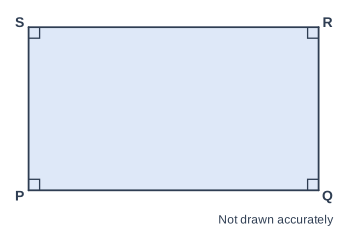
The diagram shows rectangle PQRS.

Side PQ is perpendicular to side QR. Which other side is perpendicular to side QR?

Geometry diagram, marked "Not drawn accurately". Rectangle PQRS (shaded). Angle SPQ is marked as a right angle (90°). Angle PQR is marked as a right angle (90°). Angle QRS is marked as a right angle (90°). Angle RSP is marked as a right angle (90°).

Model answer

RS

Explanation

Perpendicular sides meet at a right angle. Side QR meets two sides at right angles: PQ at corner Q and RS at corner R. So the other side is RS. Side SP is opposite QR, so it is parallel to QR, not perpendicular.

Mark scheme
  1. 1 mark

    RS

    Accept RS or SR. Do not accept SP or PS (parallel to QR, not perpendicular) or PQ (already given).

Question 2

2 marks

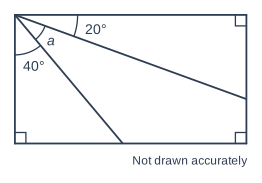
The diagram shows a rectangle. Two straight lines from one corner split the right angle at that corner into three angles.

Work out the size of angle a.

Geometry diagram, marked "Not drawn accurately". A rectangle (its vertices are not labelled). A sloping line with no labelled ends is drawn. A sloping line with no labelled ends is drawn. The angle at an unlabelled point is marked 20°. The angle at an unlabelled point is marked a. The angle at an unlabelled point is marked 40°. The angle at an unlabelled point is marked as a right angle (90°). The angle at an unlabelled point is marked as a right angle (90°). The angle at an unlabelled point is marked as a right angle (90°).

Model answer

The corner of a rectangle is 90°.
\(20 + 40 = 60\)
\(a = 90 - 60 = 30\)
a = 30°

Explanation

The corner of a rectangle is a right angle, so the three angles add up to 90°. The two you know make \(20 + 40 = 60\)°, so \(a = 90 - 60 = 30\)°. A common mistake is to use 180° or 360°: those are for a straight line and a full turn.

Mark scheme
  1. 1 mark

    \(20 + 40 = 60\), or \(90 - 20 - 40\); or the correct answer 30° with no working

  2. 1 mark

    30°

    Accept 30 or a = 30, with or without the degree sign. Do not accept 120 (180 − 60) or 300 (360 − 60). A correct answer with no working scores full marks.

Question 3

2 marks

Mo draws a shape with four sides and four right angles. Its perimeter is 20 cm. One of its sides is 5 cm long.

Mo says, "All four sides of my shape are 5 cm long."

Is Mo right? How do you know?

Model answer

Yes. The shape has four right angles, so opposite sides are equal. The side opposite the 5 cm side is also 5 cm. That leaves \(20 - 10 = 10\) cm for the other two sides, which are equal, so each is 5 cm. All four sides are 5 cm.

Explanation

A shape with four right angles is a rectangle, so its opposite sides are equal. Two sides of 5 cm make 10 cm, which leaves 10 cm shared equally between the other two sides: 5 cm each. So all four sides are 5 cm, and the shape is a square.

Mark scheme
  1. 1 mark

    Yes, with a relevant but incomplete reason, e.g. '5 + 5 + 5 + 5 = 20' with no link to the other sides, or 'the opposite side is also 5 cm' only

    'Yes' alone scores 0.

  2. 1 mark

    Yes, with a complete correct reason: the opposite side is also 5 cm, so the other two sides share \(20 - 10 = 10\) cm; they are equal, so each is 5 cm

    A complete correct reason on its own scores both marks. Accept: the shape is a rectangle, so its length and width add up to half the perimeter, 10 cm; one is 5 cm, so the other is 5 cm too.

Question 4

4 marks

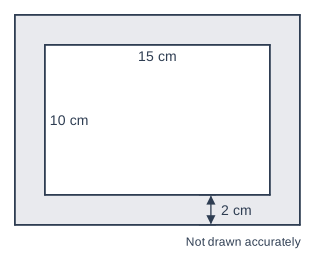
A rectangular photo is 15 cm long and 10 cm wide.

It is in a frame. The frame is 2 cm wide all the way round the photo, as the diagram shows.

Work out the length and the width of the outside of the frame.

Then work out the perimeter of the outside of the frame.

Geometry diagram, marked "Not drawn accurately". A frame (its vertices are not labelled) (shaded). A photo (its vertices are not labelled) (filled white). The unlabelled side going to the right is labelled 15 cm. The unlabelled side going upwards is labelled 10 cm. A double-headed dimension arrow alongside an unlabelled line going upwards (the distance from an unlabelled point to an unlabelled point) is labelled 2 cm.

Model answer

Length: \(15 + 2 + 2 = 19\) cm
Width: \(10 + 2 + 2 = 14\) cm
Perimeter: \(19 + 14 + 19 + 14 = 66\)
66 cm

Explanation

The frame adds 2 cm on both ends of each side, so add 4 cm to the length and 4 cm to the width: the outside is 19 cm by 14 cm. The outside of the frame is a rectangle too, so its perimeter is \(19 + 14 + 19 + 14 = 66\) cm. A common mistake is to add the 2 cm on one side only.

Mark scheme
  1. 1 mark

    One outside measurement correct: length \(15 + 2 + 2 = 19\) cm or width \(10 + 2 + 2 = 14\) cm; or the correct answers 19 cm, 14 cm and 66 cm with no working

  2. 1 mark

    Both correct: 19 cm long and 14 cm wide

    Do not accept 17 cm and 12 cm (the frame added on one side only).

  3. 1 mark

    \(19 + 14 + 19 + 14\), or \(2 \times (19 + 14)\)

    Follow through from their length and width.

  4. 1 mark

    66 cm

    Accept 66 with no unit. Do not accept 50 (the perimeter of the photo) or 58 (from 17 cm by 12 cm). A correct answer with no working scores full marks.

Ready to try the rest? Tap your answers and see straight away how you did.

Topic notes

Properties of rectangles

The big idea

A rectangle is a flat shape with four straight sides and four right angles. Every rectangle follows the same rules, called its properties. Once you know them, you can work out missing lengths and angles without measuring.

The properties

All rectangles share these properties:

  • four right angles (90° each);
  • opposite sides equal: the two long sides are the same length, and so are the two short sides;
  • opposite sides parallel.

A square is a special rectangle: it has all of these properties, and its four sides are all equal too.

Geometry diagram, drawn accurately to scale. Rectangle KLMN (shaded). Angle NKL is marked as a right angle (90°). Angle KLM is marked as a right angle (90°). Angle LMN is marked as a right angle (90°). Angle MNK is marked as a right angle (90°). KL and NM are each marked with one short dash (equal lengths). LM and KN are each marked with two short dashes (equal lengths).
Rectangle KLMN. The small squares show the four right angles. Sides with the same number of dashes are equal: KL = NM and LM = KN.

Parallel and perpendicular

Two lines are parallel when they run side by side, always the same distance apart, so they never meet, even if you extend them. Train tracks are parallel. Two lines are perpendicular when they meet at a right angle, like the edges at the corner of a book.

In rectangle KLMN:

  • KL is parallel to NM, and KN is parallel to LM: these are opposite sides.
  • KL is perpendicular to LM and to KN: these sides meet KL at its corners.

So each side of a rectangle is parallel to one side and perpendicular to the other two.

Missing lengths

Because opposite sides are equal, the length and the width tell you all four sides. In a shape made from rectangles, use the opposite sides of each rectangle to find lengths that are not written down.

A window is a rectangle 1.5 m wide and 1.4 m tall. It is made from 6 rectangular panes of glass, all the same size, in 2 rows of 3. How wide and how tall is each pane?

Change to centimetres: the window is 150 cm wide and 140 cm tall.

Across the window there are 3 panes side by side: \(150 \div 3 = 50\) cm.

Up the window there are 2 rows of panes: \(140 \div 2 = 70\) cm.

Each pane is 50 cm wide and 70 cm tall.

Missing angles at a corner

All four corners of a rectangle are right angles. If a line from a corner splits it into smaller angles, those angles make 90° altogether.

Geometry diagram, drawn accurately to scale. A rectangle (its vertices are not labelled). A sloping line with no labelled ends is drawn. The angle at an unlabelled point is marked 24°. The angle at an unlabelled point is marked 66°. The angle at an unlabelled point is marked as a right angle (90°). The angle at an unlabelled point is marked as a right angle (90°). The angle at an unlabelled point is marked as a right angle (90°).
A line from the bottom left corner splits the right angle into 24° and 66°. Together they make 90°.

Kit is making a picture frame that should be a rectangle. To check one corner, he fixes a strip of wood across it from the corner. The strip makes an angle of 48° with the bottom of the frame and 40° with the side. Is that corner a right angle?

The two angles fill the whole corner, so the corner is \(48 + 40 = 88°\).

A right angle is 90°, and 88° is 2° less.

No, the corner is not a right angle, so the frame is not yet a rectangle. Kit needs to open the corner out by 2°.

Remember

  • A rectangle has four right angles.
  • Opposite sides: equal in length and parallel.
  • A square is a special rectangle whose four sides are all equal.
  • Angles that split a corner of a rectangle total 90°.

Common mistakes

  • Thinking any shape with opposite sides equal is a rectangle. A shape that leans over has equal opposite sides but no right angles.
  • Mixing up parallel and perpendicular. Parallel lines never meet; perpendicular lines meet at a right angle.
  • Using 180° for the angles at a corner. The angles that split a corner make 90°.
  • Copying a length from the side next to the one you need, instead of from the opposite side.

Top tip

Mark the sides you know on the diagram, and write each length on the opposite side too. Then the missing lengths are much easier to spot.

Study Helper Hints first, answers after you try

Stuck on this one? Ask for a hint and I’ll point you in the right direction, without giving the answer away. Once you’ve checked your answer, I’ll show you how the marks are awarded.