Level:
Correct: 0
Incorrect: 0
Marks: 0/0
Practice
Course:
Topics:
Year 5 Maths Smart practice A mixed round aimed at your weak spots
Unit 1
Place value
Number and place value
Numbers up to one million
Quick practice6 skills
Rounding whole numbers
Quick practice6 skills
Negative numbers
Quick practice6 skills
Roman numerals
Quick practice5 skills
Unit 2
Addition and subtraction
Unit 3
Multiplication and division
Unit 4
Fractions
Unit 5
Decimals and percentages
Unit 6
Measurement
Measurement
Converting metric units
Quick practice6 skills
Imperial units
Quick practice5 skills
Time
Quick practice5 skills
Money and measure problems
Quick practice4 skills
Perimeter
Quick practice5 skills
Area
Quick practice6 skills
Volume and capacity
Quick practice5 skills
Unit 7
Shape and angles
Unit 8
Position and direction
Geometry: position and direction
Coordinates
Quick practice5 skills
Reflection
Quick practice5 skills
Translation
Quick practice5 skills
Unit 9
Statistics
Statistics
Tables, timetables and charts
Quick practice5 skills
Line graphs
Quick practice5 skills
Avg
score:
–
Topics
done:
0/47

Angles on a line and around a point

Practise 20 questions on Angles on a line and around a point for Year 5 Maths. Tap your answer and find out straight away if you are right, with the Study Helper on hand if you get stuck.

  • 20 questions
  • 1–4 marks each
  • Instant marking
  • No sign-up needed
20 questions, marked as you go

Sample questions with model answers

Here are 4 of the questions in this topic, each with a model answer, an explanation of why it earns the marks and the mark scheme.

Question 1

1 mark

A three-quarter turn is the same as 3 right angles.

How many degrees is a three-quarter turn?

Model answer

\(3 \times 90 = 270\)
270°

Explanation

A right angle is 90°, so 3 right angles are \(3 \times 90 = 270\)°. You can also think of it as three quarters of a full turn of 360°: a quarter is 90°, so three quarters is 270°.

Mark scheme
  1. 1 mark

    270°

    Accept 270 with or without the degree sign. Do not accept 300 or 75.

Question 2

2 marks

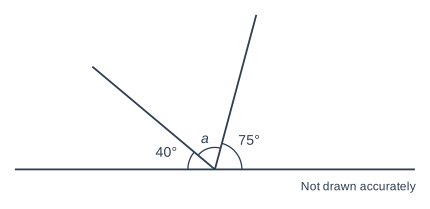
Three angles sit together on a straight line, as the diagram shows.

Find the size of angle a.

Geometry diagram, marked "Not drawn accurately". A horizontal line with no labelled ends is drawn. A sloping line with no labelled ends is drawn. A sloping line with no labelled ends is drawn. The angle at an unlabelled point is marked 40°. The angle at an unlabelled point is marked a. The angle at an unlabelled point is marked 75°.

Model answer

Angles on a straight line add up to 180°.
\(40 + 75 = 115\)
\(a = 180 - 115 = 65\)
a = 65°

Explanation

All three angles together make a straight line, so they add up to 180°. Add the two you know, \(40 + 75 = 115\), then take that from 180: \(180 - 115 = 65\)°. Check: \(40 + 65 + 75 = 180\).

Mark scheme
  1. 1 mark

    \(40 + 75 = 115\), or \(180 - 40 - 75\); or the correct answer 65° with no working

  2. 1 mark

    65°

    Accept 65 or a = 65, with or without the degree sign. Do not accept 245 (360 − 115). A correct answer with no working scores full marks.

Question 3

2 marks

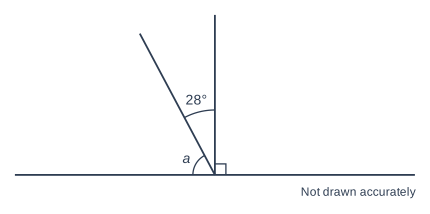
The diagram shows a straight line. One of the angles on it is a right angle.

Work out the size of angle a.

Geometry diagram, marked "Not drawn accurately". A horizontal line with no labelled ends is drawn. A vertical line with no labelled ends is drawn. A sloping line with no labelled ends is drawn. The angle at an unlabelled point is marked as a right angle (90°). The angle at an unlabelled point is marked 28°. The angle at an unlabelled point is marked a.

Model answer

Angles on a straight line add up to 180°.
The right angle is 90°.
\(90 + 28 = 118\)
\(a = 180 - 118 = 62\)
a = 62°

Explanation

The three angles make a straight line, so they add up to 180°. The right angle is 90°, so the other two angles make the other 90°: \(a = 90 - 28 = 62\)°. A common mistake is to leave out the right angle and work out \(180 - 28\).

Mark scheme
  1. 1 mark

    \(90 + 28 = 118\), or \(180 - 90 - 28\), or \(90 - 28\); or the correct answer 62° with no working

  2. 1 mark

    62°

    Accept 62 or a = 62, with or without the degree sign. Do not accept 152 (180 − 28, the right angle left out). A correct answer with no working scores full marks.

Question 4

4 marks

Sam makes a spinner with four sections: red, blue, green and yellow. Every section goes from the centre to the edge.

The red section has a right angle at the centre.
The angle of the blue section is twice the angle of the red section.
The green and yellow sections have equal angles.

Work out the angle of the green section.

Model answer

Red: 90°
Blue: \(2 \times 90 = 180\)°
Red and blue: \(90 + 180 = 270\)°
Green and yellow: \(360 - 270 = 90\)°
Green: \(90 \div 2 = 45\)°

Explanation

The four sections go all the way round the centre, so their angles add up to 360°. Red is 90° and blue is twice that, 180°, so together they make 270°. That leaves 90° for green and yellow, and they are equal, so green is \(90 \div 2 = 45\)°. A common mistake is to use 180° for the whole spinner.

Mark scheme
  1. 1 mark

    Blue section 180° (\(2 \times 90\)); or the correct answer 45° with no working

  2. 1 mark

    \(90 + 180 = 270\), or 360 − 90 − their blue

    Follow through from their blue angle.

  3. 1 mark

    \(360 - 270 = 90\) for green and yellow together, and halved

    Follow through from their total for red and blue.

  4. 1 mark

    45°

    Accept 45 with or without the degree sign. Do not accept 90 (green and yellow together) or 0 (from 180). A correct answer with no working scores full marks.

Ready to try the rest? Tap your answers and see straight away how you did.

Topic notes

Angles on a line and around a point

The big idea

Some angles fit together to make a turn you already know. Angles that share a straight line make a half turn, 180°. Angles that fill the space round a point make a whole turn, 360°. These two facts let you work out a missing angle without measuring it.

Angles on a straight line

A straight line is half a turn. So when angles meet at a point on a straight line, all on the same side of it, they make 180° together. To find a missing angle, add the angles you know and subtract the total from 180°.

Geometry diagram, drawn accurately to scale. A horizontal line with no labelled ends is drawn. A sloping line with no labelled ends is drawn. A vertical line with no labelled ends is drawn. The angle at an unlabelled point is marked a (it measures 70° on the drawing). The angle at an unlabelled point is marked 110°. The angle at an unlabelled point is marked as a right angle (90°). The text "ground" is written. The text "wall" is written. The text "ladder" is written.
A ladder against a wall. The ground is a straight line, so angle a and the 110° angle make 180° together.

People who use ladders have a rough safety rule: the angle between the ladder and the ground, on the wall side, should be about 75°. Ben measures the angle on the other side of his ladder: it is 110°. What is angle a? Should Ben move his ladder?

The two angles at the foot of the ladder lie on the ground, which is a straight line, so together they make 180°.

Angle a is \(180 - 110 = 70°\).

70° is 5° less than the 75° in the rule, so the ladder leans out a little too far. Ben should move its foot a little closer to the wall.

When an angle on the line is marked with a small square, it is a right angle: count it as 90°.

Angles around a point

Angles that fill the space round a point, with no gaps and no overlaps, make 360° together, a whole turn. This works however many angles there are, even when one of them is reflex.

Four straight paths meet at a fountain in a park. Three of the angles between neighbouring paths are 45°, 70° and 50°. What is the fourth angle, and what type of angle is it?

The four angles fill the space round the fountain, so they total 360°.

Add the three angles you know: \(45 + 70 + 50 = 165°\).

The fourth angle is \(360 - 165 = 195°\).

195° is more than 180°, so it is a reflex angle. The four paths all leave the fountain on one side, and the big gap goes the long way round.

Right angles and turns

Many angles are made of right angles:

TurnRight anglesDegrees
quarter turn190°
half turn2180°
three-quarter turn3270°
whole turn4360°

A turn can be clockwise, the way the hands of a clock go, or anticlockwise, the other way. On a compass, turning a quarter turn clockwise from north brings you to east. The points in between, such as north-east (NE), are halfway, so neighbouring points of the compass are 45° apart.

Geometry diagram, drawn accurately to scale. Line segments NS and WE are drawn. Dashed line segments NESW and NWSE are drawn. The angle at an unlabelled point between the lines to N and E is marked as a right angle (90°). The angle at an unlabelled point between the lines to E and SE is marked 45°.
The eight points of the compass. North to east is a right angle, and each point is 45° from the next.

A weather vane points east. The wind changes and the vane turns 135° anticlockwise. Which way does it point now?

Each step to the next compass point is 45°, and \(135 \div 45 = 3\), so the vane moves 3 points.

Anticlockwise from east: north-east (1), north (2), north-west (3).

The vane now points north-west.

Remember

  • On a straight line, the angles total 180°.
  • Around a point, the angles total 360°.
  • Every right angle is 90°: two make a half turn and four make a whole turn.
  • Clockwise goes the way clock hands turn; anticlockwise goes the other way.

Common mistakes

  • Using 360° for angles on a straight line, or 180° for angles around a point. Check which one the angles make.
  • Forgetting a right angle marked with a square. It still counts as 90°.
  • Turning the wrong way. Clockwise from north goes to east, not west.
  • Forgetting one of the angles when you add the ones you know.

Top tip

When you have found a missing angle, add up all the angles. They should make exactly 180° on a line or 360° around a point.

Study Helper Hints first, answers after you try

Stuck on this one? Ask for a hint and I’ll point you in the right direction, without giving the answer away. Once you’ve checked your answer, I’ll show you how the marks are awarded.