Level:
Correct: 0
Incorrect: 0
Marks: 0/0
Practice
Course:
Topics:
Year 5 Maths Smart practice A mixed round aimed at your weak spots
Unit 1
Place value
Number and place value
Numbers up to one million
Quick practice6 skills
Rounding whole numbers
Quick practice6 skills
Negative numbers
Quick practice6 skills
Roman numerals
Quick practice5 skills
Unit 2
Addition and subtraction
Unit 3
Multiplication and division
Unit 4
Fractions
Unit 5
Decimals and percentages
Unit 6
Measurement
Unit 7
Shape and angles
Unit 8
Position and direction
Geometry: position and direction
Coordinates
Quick practice5 skills
Reflection
Quick practice5 skills
Translation
Quick practice5 skills
Unit 9
Statistics
Statistics
Tables, timetables and charts
Quick practice5 skills
Line graphs
Quick practice5 skills
Avg
score:
–
Topics
done:
0/47

Converting metric units

Practise 22 questions on Converting metric units for Year 5 Maths. Tap your answer and find out straight away if you are right, with the Study Helper on hand if you get stuck.

  • 22 questions
  • 1–4 marks each
  • Instant marking
  • No sign-up needed
20 questions, marked as you go

Sample questions with model answers

Here are 4 of the questions in this topic, each with a model answer, an explanation of why it earns the marks and the mark scheme.

Question 1

1 mark

A paper clip is 3 cm long.

How long is the paper clip in millimetres?

Model answer

1 cm = 10 mm
\(3 \times 10 = 30\)
The paper clip is 30 mm long.

Explanation

There are 10 millimetres in 1 centimetre, so multiply by 10: \(3 \times 10 = 30\) mm. A common mistake is to multiply by 100, which is what you do to change metres into centimetres.

Mark scheme
  1. 1 mark

    30 mm

    Accept 30, with or without the unit. Do not accept 300 or 0.3.

Question 2

2 marks

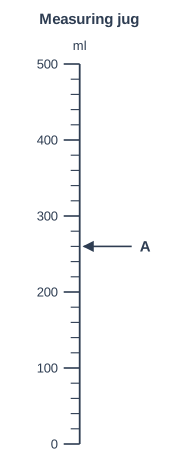
Ben pours some water into a measuring jug. The diagram shows the scale on the jug. Arrow A points to the top of the water.

How many millilitres of water are in the jug?

Measuring jug. A vertical scale from 0 to 500 ml, divided into 5 equal parts by long marks, each split into 5 small divisions by short marks. Every long mark is numbered (0, 100, 200, 300, 400 and 500). An arrow labelled A points to a mark on the scale.

Model answer

There are 5 gaps between 200 and 300, so each small mark is \(100 \div 5 = 20\) ml.
Arrow A is 3 small marks above 200.
\(200 + 20 + 20 + 20 = 260\)
There is 260 ml of water in the jug.

Explanation

First work out what each small mark is worth: there are 5 gaps between 200 ml and 300 ml, so each gap is \(100 \div 5 = 20\) ml. Arrow A is 3 gaps above 200 ml, so count on 220, 240, 260. A common mistake is to think every small mark is worth 10 ml without checking.

Mark scheme
  1. 1 mark

    Each small mark worked out as 20 ml (5 gaps between 200 ml and 300 ml); or the correct answer 260 ml with no working

    Accept a clear statement such as "each line is 20" or counting up in 20s from 200.

  2. 1 mark

    260 ml

    Accept 260, with or without the unit. Common wrong answers: 230 (each small mark counted as 10 ml), 275 (each small mark counted as 25 ml), 203. A correct answer with no working scores full marks.

Question 3

2 marks

A carton of milk holds 500 ml. The school kitchen uses 9 cartons of milk.

How many litres of milk does the kitchen use?

Model answer

\(9 \times 500 = 4{,}500\) ml
\(4{,}500 \div 1{,}000 = 4.5\)
The kitchen uses 4.5 litres of milk.

Explanation

First find the total in millilitres: \(9 \times 500 = 4{,}500\) ml. Then divide by 1,000 to change it into litres: 4.5 litres. Another way: 2 cartons make 1 litre, so 8 cartons make 4 litres, and 1 more carton is another half litre. A common mistake is to write 45 litres.

Mark scheme
  1. 1 mark

    \(9 \times 500 = 4{,}500\) ml, or 2 cartons make 1 litre; or the correct answer 4.5 litres with no working

    4,500 ml as a final answer scores this mark only (the question asks for litres).

  2. 1 mark

    4.5 litres

    Accept 4.5, 4 1/2 or 4 and a half, with or without the unit. Do not accept 45 or 0.45. A correct answer with no working scores full marks.

Question 4

4 marks

On a holiday flight, each suitcase must have a mass of 10 kg or less.

Max packs his suitcase with:
clothes: 4.5 kg
shoes: 1,200 g
books: 2.25 kg

The empty suitcase has a mass of 1.8 kg.

How much more could Max pack before his suitcase reaches 10 kg? Give your answer in grams.

Model answer

Shoes: 1,200 g = 1.2 kg
\(4.5 + 1.2 + 2.25 + 1.8 = 9.75\) kg
\(10 - 9.75 = 0.25\) kg
0.25 kg = 250 g
Max could pack 250 g more.

Explanation

Write all the masses in the same unit first. In kilograms they are 4.5, 1.2, 2.25 and 1.8, which add up to 9.75 kg. The limit is 10 kg, so Max has \(10 - 9.75 = 0.25\) kg to spare, which is 250 g. A common mistake is to forget the mass of the empty suitcase.

Mark scheme
  1. 1 mark

    1,200 g written as 1.2 kg, or all the masses written in grams (4,500 g, 1,200 g, 2,250 g, 1,800 g); or the correct answer 250 g with no working

  2. 1 mark

    Total mass 9.75 kg (or 9,750 g)

    Allow one error in changing units if their adding is correct for their values.

  3. 1 mark

    A correct method for what is left: \(10 - 9.75\) or \(10{,}000 - 9{,}750\)

    Follow through from their total, if it is less than 10 kg.

  4. 1 mark

    250 g

    Accept 250, with or without the unit. 0.25 kg scores the first three marks but not this one. A correct answer with no working scores full marks.

Ready to try the rest? Tap your answers and see straight away how you did.

Topic notes

Converting metric units

The big idea

We measure how long things are, how heavy they are and how much they hold with metric units, such as metres, grams and litres. Metric units are linked by 10, 100 and 1,000. So to convert a measure (change it into a different unit), you multiply or divide by 10, 100 or 1,000.

The units and how they link

What you measureUnitsHow they link
Length (how long)kilometres (km), metres (m), centimetres (cm), millimetres (mm)1 km = 1,000 m, 1 m = 100 cm, 1 cm = 10 mm
Mass (how heavy)kilograms (kg), grams (g)1 kg = 1,000 g
Capacity (how much a container holds)litres (l), millilitres (ml)1 l = 1,000 ml

The start of a unit's name is a clue. Kilo means a thousand, so a kilometre is 1,000 metres. Milli means a thousandth, so 1,000 millilitres make a litre. Centi means a hundredth, so 100 centimetres make a metre.

Multiply or divide?

  • To a smaller unit, multiply. Small units are tiny, so you need lots of them: 5.3 km = 5,300 m and 0.8 l = 800 ml.
  • To a bigger unit, divide. You need fewer of the big units: 250 cm = 2.5 m and 3,700 g = 3.7 kg.

Multiplying by 1,000 shifts each digit three columns left, so \(2.5 \times 1{,}000 = 2{,}500\). Dividing shifts the digits right.

Mixed units use two units together, such as 3 kg 400 g. You can write them in one unit: 3 kg 400 g = 3,400 g = 3.4 kg. Take care when the small part has only one digit: 5 m 6 cm = 506 cm.

Reading scales

Rulers, measuring jugs and weighing scales have numbered marks with small marks in between. Before you read one, find the value of one small mark: divide the jump between two numbers by the number of small gaps.

Measuring jug. A vertical scale from 0 to 1000 ml, divided into 4 equal parts by long marks, each split into 5 small divisions by short marks. Every long mark is numbered (0, 250, 500, 750 and 1000). Long marks are every 250 ml and each small division is 50 ml. Arrow A points to 650 ml.
The numbers go up in 250s with 5 small gaps between them, so each gap is 250 ÷ 5 = 50 ml. Arrow A points 3 gaps past 500 ml, at 650 ml.

Comparing measures

To compare measures, first change them all into one unit.

A recipe needs 1 kg of potatoes. A shop sells bags of 0.9 kg, 1,050 g, 1.2 kg and 980 g. Which is the smallest bag that has enough?

1 kg is 1,000 g, so change every bag into grams:

0.9 kg = 900 g, 1,050 g, 1.2 kg = 1,200 g, 980 g

"Enough" means 1,000 g or more, so only 1,050 g and 1,200 g will do.

The smaller of those is the 1,050 g bag.

Solving problems

A jug holds 1.75 l of lemonade. Kai pours 4 glasses of 200 ml each. How much lemonade is left in the jug?

The amounts use different units, so change the litres into millilitres: \(1.75 \times 1{,}000 = 1{,}750\) ml.

Kai pours \(4 \times 200 = 800\) ml.

Take it away: \(1{,}750 - 800 = 950\) ml.

There are 950 ml left. That is 0.95 l.

A cycle path is 3.2 km long. Nadia has cycled 1,850 m of it. How far does she still need to ride? Give your answer in kilometres.

Change 3.2 km into metres so both lengths are in the same unit: \(3.2 \times 1{,}000 = 3{,}200\) m.

Subtract the distance she has done: \(3{,}200 - 1{,}850 = 1{,}350\) m.

Change back into kilometres: \(1{,}350 \div 1{,}000 = 1.35\)

Nadia still needs to ride 1.35 km.

Remember

  • 1 km = 1,000 m, 1 m = 100 cm, 1 cm = 10 mm.
  • 1 kg = 1,000 g and 1 l = 1,000 ml.
  • To a smaller unit, multiply. To a bigger unit, divide.
  • Use one unit for every measure before you add, take away or compare.

Common mistakes

  • Using 100 instead of 1,000. 3 kg is 3,000 g, not 300 g.
  • Multiplying when you should divide. 400 cm is 4 m, not 40,000 m: a bigger unit always gives a smaller number.
  • Mixed units with a missing zero. 4 m 5 cm is 405 cm, not 450 cm.
  • Counting every small mark on a scale as 1 or 10 without checking. Work out what one gap is worth first.
  • Forgetting the units when you compare. 0.8 kg is heavier than 750 g, because 0.8 kg is 800 g.

Top tip

Write the unit next to every number in your working. Then you will see at once if two measures need changing into the same unit.

Study Helper Hints first, answers after you try

Stuck on this one? Ask for a hint and I’ll point you in the right direction, without giving the answer away. Once you’ve checked your answer, I’ll show you how the marks are awarded.