Level:
Correct: 0
Incorrect: 0
Marks: 0/0
Practice
Course:
Topics:
Year 5 Maths Smart practice A mixed round aimed at your weak spots
Unit 1
Place value
Number and place value
Numbers up to one million
Quick practice6 skills
Rounding whole numbers
Quick practice6 skills
Negative numbers
Quick practice6 skills
Roman numerals
Quick practice5 skills
Unit 2
Addition and subtraction
Unit 3
Multiplication and division
Unit 4
Fractions
Unit 5
Decimals and percentages
Unit 6
Measurement
Measurement
Converting metric units
Quick practice6 skills
Imperial units
Quick practice5 skills
Time
Quick practice5 skills
Money and measure problems
Quick practice4 skills
Perimeter
Quick practice5 skills
Area
Quick practice6 skills
Volume and capacity
Quick practice5 skills
Unit 7
Shape and angles
Unit 8
Position and direction
Geometry: position and direction
Coordinates
Quick practice5 skills
Reflection
Quick practice5 skills
Translation
Quick practice5 skills
Unit 9
Statistics
Statistics
Tables, timetables and charts
Quick practice5 skills
Line graphs
Quick practice5 skills
Avg
score:
–
Topics
done:
0/47

Long multiplication

Practise 22 questions on Long multiplication for Year 5 Maths. Tap your answer and find out straight away if you are right, with the Study Helper on hand if you get stuck.

  • 22 questions
  • 1–5 marks each
  • Instant marking
  • No sign-up needed
20 questions, marked as you go

Sample questions with model answers

Here are 4 of the questions in this topic, each with a model answer, an explanation of why it earns the marks and the mark scheme.

Question 1

1 mark

Kai is working out \(64 \times 35\) using long multiplication.

His first row is \(64 \times 5 = 320\)

What number should his second row be?

Model answer

The second row is \(64 \times 30\).
\(64 \times 3 = 192\), so \(64 \times 30 = 1{,}920\)
Answer: 1,920

Explanation

The 3 in 35 is 3 tens, so the second row is \(64 \times 30\), not \(64 \times 3\). Write a 0 in the ones place first, then multiply by 3: the row is 1,920. A common mistake is to forget the place-holder 0 and write 192.

Mark scheme
  1. 1 mark

    1,920

    The second row is \(64 \times 30\). Accept 1920. Do not accept 192 (the place-holder 0 is missing) or 2,240 (the final answer).

Question 2

2 marks

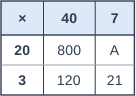
Sophie works out \(47 \times 23\) using a grid. The table shows her grid.

One number is missing. It is shown by the letter A.

What is the value of A? Then work out \(47 \times 23\)

Table with columns "×", "40", "7". ×: 20; 40: 800; 7: A | ×: 3; 40: 120; 7: 21.

Model answer

\(A = 7 \times 20 = 140\)
\(800 + 140 + 120 + 21 = 1{,}081\)
Answer: A = 140, and \(47 \times 23 = 1{,}081\)

Explanation

In a grid, each box is the number at the top of its column times the number at the start of its row. A is in the column for 7 and the row for 20, so \(A = 7 \times 20 = 140\). Then add all four boxes to get the answer. A common mistake is to write \(7 \times 2 = 14\) and forget that the 2 means 2 tens.

Mark scheme
  1. 1 mark

    A = 140

    A is \(7 \times 20\). Do not accept 14 or 1,400.

  2. 1 mark

    1,081

    Accept 1081. Follow through: \(800 + 120 + 21\) plus their A. A correct answer with no working scores this mark.

Question 3

2 marks

Work out \(472 \times 36\)

Model answer

\(472 \times 6 = 2{,}832\)
\(472 \times 30 = 14{,}160\)
\(2{,}832 + 14{,}160 = 16{,}992\)
Answer: 16,992

Explanation

Multiply 472 by 6, then by 30, and add the rows. Take care with the carries in each row, and line up the digits by place value when you add. An estimate of \(500 \times 35 = 17{,}500\) shows that 16,992 is sensible. A common mistake is to forget the place-holder 0 in the second row.

Mark scheme
  1. 1 mark

    A correct method (long multiplication, or a grid or partitioning method) with no more than one arithmetic error, e.g. \(472 \times 6 = 2{,}832\) and \(472 \times 30 = 14{,}160\), then \(2{,}832 + 14{,}160\); or the correct answer 16,992 with no working

    Pupils type their working, usually as lines rather than a column layout: accept any clear record of the partial products and their total, in either order, or a grid or partitioning method that records the partial products (pupils may type x for ×). The working must reach a final answer. Writing 1,416 in place of 14,160 for \(472 \times 30\) (a tens row without its zero) is a place-value error, not an arithmetic error, and does not score.

  2. 1 mark

    16,992

    Accept 16992. A correct answer with no working scores both marks.

Question 4

4 marks

You know that \(36 \times 24 = 864\)

Use this fact to work out \(36 \times 25\)

Then use the same fact to work out \(37 \times 24\)

Model answer

\(36 \times 25\) is one more 36 than \(36 \times 24\):
\(864 + 36 = 900\)
\(37 \times 24\) is one more 24 than \(36 \times 24\):
\(864 + 24 = 888\)

Explanation

\(36 \times 25\) means 25 lots of 36, which is one more 36 than 24 lots of 36, so add 36. \(37 \times 24\) means 37 lots of 24, which is one more 24 than 36 lots of 24, so add 24. Thinking about what each multiplication means saves a lot of work. A common mistake is to add the same number both times.

Mark scheme
  1. 1 mark

    \(864 + 36\) seen, or a correct long multiplication for \(36 \times 25\) with no more than one arithmetic error; or the correct answer 900 with no working

  2. 1 mark

    \(36 \times 25 = 900\)

    Do not accept 865 (adding 1 instead of 36).

  3. 1 mark

    \(864 + 24\) seen, or a correct long multiplication for \(37 \times 24\) with no more than one arithmetic error; or the correct answer 888 with no working

  4. 1 mark

    \(37 \times 24 = 888\)

    Do not accept 865 or 900. A correct answer with no working scores full marks for each part.

Ready to try the rest? Tap your answers and see straight away how you did.

Topic notes

Long multiplication

The big idea

Long multiplication is the written method for multiplying by a two-digit number, such as \(73 \times 26\). It breaks one hard multiplication into two easier ones, one for each digit of the two-digit number, and then adds the answers together.

Why it works

26 is 20 and 6. So 26 lots of 73 is the same as 6 lots of 73 plus 20 lots of 73:

\[ 73 \times 26 = 73 \times 6 + 73 \times 20 \]

Long multiplication sets out these two parts as two rows under the line.

The method

  1. Row 1: multiply the top number by the ones digit, using short multiplication.
  2. Row 2: start by putting 0 in the ones place. Then multiply the top number by the tens digit. That 0 is a place holder: it keeps the ones place empty, because the tens digit stands for tens, so this row must be 10 times bigger.
  3. Add the two rows. The total is the answer.

A café buys 73 packets of biscuits. Each packet holds 26 biscuits. How many biscuits does it buy?

Estimate: \(70 \times 30 = 2{,}100\). 26 was rounded up quite a lot, so expect a bit less than that.

\[ \begin{array}{ccccc} & & & 7 & 3 \\ \times & & & 2 & 6 \\ \hline & & 4 & 3 & 8 \\ & 1 & 4 & 6 & 0 \\ \hline & 1 & 8 & 9 & 8 \end{array} \]

Row 1, \(73 \times 6\): \(3 \times 6 = 18\), write 8 and carry 1. \(7 \times 6 = 42\), add 1 to get 43. Row 1 is 438.

Row 2, \(73 \times 20\): put 0 in the ones. Then \(3 \times 2 = 6\), so write 6. Next, \(7 \times 2 = 14\), so write 14. Row 2 is 1,460.

Add: \(438 + 1{,}460 = 1{,}898\).

The café buys 1,898 biscuits.

Three-digit numbers

Multiplying a three-digit number works the same way. The rows are just longer. When you add the rows, carry under the bottom line, just as in column addition.

A plane has 265 seats. It flies 37 times, full every time. How many passengers does it carry altogether?

Estimate: \(250 \times 40 = 10{,}000\).

\[ \begin{array}{ccccc} & & 2 & 6 & 5 \\ \times & & & 3 & 7 \\ \hline & 1 & 8 & 5 & 5 \\ & 7 & 9 & 5 & 0 \\ \hline & 9 & 8 & 0 & 5 \\ & {\scriptsize 1} & {\scriptsize 1} & & \end{array} \]

Row 1, \(265 \times 7\): \(5 \times 7 = 35\), write 5, carry 3. \(6 \times 7 = 42\), add 3 to get 45: write 5, carry 4. \(2 \times 7 = 14\), add 4 to get 18. Row 1 is 1,855.

Row 2, \(265 \times 30\): write 0. \(5 \times 3 = 15\), write 5, carry 1. \(6 \times 3 = 18\), add 1 to get 19: write 9, carry 1. \(2 \times 3 = 6\), add 1 to get 7. Row 2 is 7,950.

Add: \(1{,}855 + 7{,}950 = 9{,}805\). The tens and the hundreds both carry 1.

The plane carries 9,805 passengers, close to the estimate.

Checking your working

If an answer is far from your estimate, check each part on its own:

  • Row 1 should be the top number times the ones digit.
  • Row 2 must end in 0, and the rest of it should be the top number times the tens digit.
  • Then check the adding, column by column.

Stretch: four-digit numbers

An online shop sends 3,054 parcels every week. How many parcels does it send in 16 weeks?

Estimate: \(3{,}000 \times 16 = 48{,}000\).

\[ \begin{array}{cccccc} & & 3 & 0 & 5 & 4 \\ \times & & & & 1 & 6 \\ \hline & 1 & 8 & 3 & 2 & 4 \\ & 3 & 0 & 5 & 4 & 0 \\ \hline & 4 & 8 & 8 & 6 & 4 \end{array} \]

Row 1, \(3{,}054 \times 6\): the hundreds digit is 0, so that column is just the carry from the tens, which is 3. Row 1 is 18,324.

Row 2, \(3{,}054 \times 10\): write 0, then multiply by 1. Row 2 is 30,540.

Add: \(18{,}324 + 30{,}540 = 48{,}864\) parcels.

Common mistakes

  • Leaving out the place holder in row 2. Row 2 of \(73 \times 26\) is \(73 \times 20 = 1{,}460\), not \(73 \times 2 = 146\).
  • Adding a carried digit before multiplying instead of after.
  • Using carried digits from row 1 again in row 2. Cross them out when row 1 is finished.
  • Multiplying the two rows together. The rows are always added.

Top tip

Always estimate first by rounding both numbers. If your answer is about 10 times too small, the 0 in row 2 is probably missing.

Study Helper Hints first, answers after you try

Stuck on this one? Ask for a hint and I’ll point you in the right direction, without giving the answer away. Once you’ve checked your answer, I’ll show you how the marks are awarded.