Level:
Correct: 0
Incorrect: 0
Marks: 0/0
Practice
Course:
Topics:
Year 5 Maths Smart practice A mixed round aimed at your weak spots
Unit 1
Place value
Unit 2
Addition and subtraction
Unit 3
Multiplication and division
Unit 4
Fractions
Unit 5
Decimals and percentages
Unit 6
Measurement
Measurement
Converting metric units
Quick practice6 skills
Imperial units
Quick practice5 skills
Time
Quick practice5 skills
Money and measure problems
Quick practice4 skills
Perimeter
Quick practice5 skills
Area
Quick practice6 skills
Volume and capacity
Quick practice5 skills
Unit 7
Shape and angles
Unit 8
Position and direction
Geometry: position and direction
Coordinates
Quick practice5 skills
Reflection
Quick practice5 skills
Translation
Quick practice5 skills
Unit 9
Statistics
Statistics
Tables, timetables and charts
Quick practice5 skills
Line graphs
Quick practice5 skills
Avg
score:
–
Topics
done:
0/47

Roman numerals

Practise 16 questions on Roman numerals for Year 5 Maths. Tap your answer and find out straight away if you are right, with the Study Helper on hand if you get stuck.

  • 16 questions
  • 1–4 marks each
  • Instant marking
  • No sign-up needed
16 questions, marked as you go

Sample questions with model answers

Here are 4 of the questions in this topic, each with a model answer, an explanation of why it earns the marks and the mark scheme.

Question 1

1 mark

Which Roman numeral is 60?

Model answer

L = 50 and X = 10
\(50 + 10 = 60\)
LX

Explanation

L is 50, and putting X after it adds 10, so LX is 60. XL has the X before the L, so it means \(50 - 10 = 40\). LXX is 70, and VI is 6. A common mistake is to choose XL by mixing up which way round the letters go.

Mark scheme
  1. 1 mark

    LX

    Do not accept any other option.

Question 2

2 marks

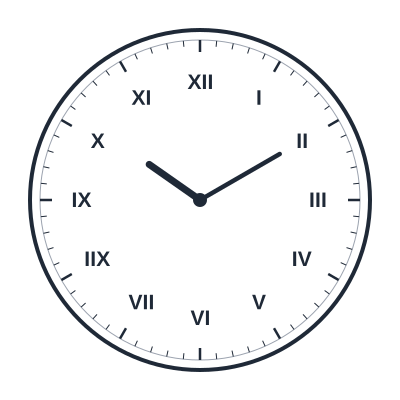
The picture shows a clock face with Roman numerals. One of the numerals has been written wrongly.

Which number should that numeral show? What is that numeral, written correctly?

A round clock face with Roman numerals for the hours. Going clockwise from the top, the numerals are XII, I, II, III, IV, V, VI, VII, IIX, IX, X and XI. The hour hand points just past the X and the minute hand points to the II.

Model answer

The numeral between VII and IX should be 8. It says IIX, but 8 is VIII.

Explanation

Go round the clock in order: I, II, III, IV, V, VI, VII, then the next one should be 8. 8 is \(5 + 3\), so it is written VIII. You can only put one smaller letter in front of a bigger one to take it away, so IIX is not allowed. A common mistake is to think IIX means \(10 - 2\).

Mark scheme
  1. 1 mark

    8 (the numeral IIX is wrong)

    Accept 'the 8', 'IIX' or 'the one between VII and IX'.

  2. 1 mark

    VIII

    Accept lower case (viii). Do not accept IIX or IIIIIIII.

Question 3

3 marks

Find all the numbers from 1 to 20 that are written with exactly two letters in Roman numerals.

For example, 3 is not one of them, because III has three letters.

Model answer

II = 2, IV = 4, VI = 6, IX = 9, XI = 11, XV = 15, XX = 20
So 2, 4, 6, 9, 11, 15 and 20.

Explanation

Write the numerals for 1 to 20 in order and count the letters in each one. Only seven have exactly two letters: II, IV, VI, IX, XI, XV and XX. Working through them in order means you do not miss any. A common mistake is to include 19, but XIX has three letters.

Mark scheme
  1. 1 mark

    At least 3 of the 7 numbers correct, with no more than one wrong number

    The 7 numbers are 2, 4, 6, 9, 11, 15 and 20 (II, IV, VI, IX, XI, XV, XX). Also award this mark for the answers in the next points.

  2. 1 mark

    At least 5 of the 7 numbers correct, with no wrong numbers; or all 7 with one wrong number

    Accept the Roman numerals instead of the numbers. Also award this mark for the fully correct answer.

  3. 1 mark

    All 7: 2, 4, 6, 9, 11, 15, 20, and no others

    Common wrong numbers: 19 (XIX has three letters), 14 (XIV), 5 or 10 (one letter).

Question 4

4 marks

The Riverside Cup is a football competition that happens once every year. The 1st Riverside Cup was in MCMXCVIII, the 2nd was the next year, and so on.

What is MCMXCVIII as a year in figures?

Which Riverside Cup is held in 2026? Give your answer in Roman numerals.

Model answer

MCMXCVIII = 1,000 + 900 + 90 + 8 = 1998
2026 is \(2026 - 1998 = 28\) years after the 1st cup.
The 1st was in 1998, the 2nd in 1999, ..., so 2026 is the \(28 + 1 = 29\)th.
29 = XXIX

Explanation

MCMXCVIII is 1998. From 1998 to 2026 is 28 years, but the first cup was in 1998 itself, so you add 1: the cup in 1999 was the 2nd, so the cup in 2026 is the 29th. Then 29 is XX and IX, so XXIX. A common mistake is to forget to add 1 and say the 28th.

Mark scheme
  1. 1 mark

    1998

    Do not accept 2198 (CM read as 1,100).

  2. 1 mark

    Finds the number of years from 1998 to 2026: 28; or the correct answer 29 (XXIX) with no working

    Follow through from the pupil's year: 2026 minus their year.

  3. 1 mark

    29 (the 29th Riverside Cup)

    Follow through: their 2026 minus their year, plus 1. Also award this mark if the pupil writes only the correct Roman numeral XXIX. Do not accept 28.

  4. 1 mark

    XXIX

    Follow through: their number written correctly in Roman numerals (e.g. 28 as XXVIII scores this mark). Accept lower case. A correct answer with no working scores full marks.

Ready to try the rest? Tap your answers and see straight away how you did.

Topic notes

Roman numerals

The big idea

Long ago, the Romans wrote numbers with letters. We call these Roman numerals. You can still spot them today on clock faces, on chapter numbers in books, and in years carved on old buildings or shown at the end of films.

The seven symbols

SymbolValue
I1
V5
X10
L50
C100
D500
M1,000

Usually the symbols go from biggest to smallest, and you add them: CLX is \(100 + 50 + 10 = 160\).

I, X, C and M can be used up to three times in a row: XXX is 30 and CCC is 300. V, L and D are only ever used once, so ten is X, never VV.

The subtraction rule

When a smaller symbol comes just before a bigger one, you take it away. Only six pairs work like this:

  • IV is 4 and IX is 9
  • XL is 40 and XC is 90
  • CD is 400 and CM is 900

Only I, X and C can be taken away, and only one at a time. That is why 45 is XLV, not VL.

Writing numbers in Roman numerals

  1. Partition the number: split off its hundreds, then its tens, then its ones.
  2. Write each part in Roman numerals.
  3. Join the parts together, biggest first.

For 746: 700 is DCC, 40 is XL and 6 is VI, so 746 is DCCXLVI. If a part is zero, leave it out: 503 is D and III, which is DIII. There is no Roman numeral for zero.

Reading Roman numerals and years

Split the numeral into parts, working from the left. A smaller symbol just before a bigger one makes a pair, and the pair counts as one part. Years work in the same way, using M for each thousand. MDCCLXXVI is M, DCC, LXX and VI, which is \(1{,}000 + 700 + 70 + 6\): the year 1776.

Which is bigger, CDXL or DX?

Split each numeral into parts.

CDXL is CD and XL, which is \(400 + 40 = 440\).

DX is D and X, which is \(500 + 10 = 510\).

DX is bigger, even though it has fewer symbols.

Use each of the symbols L, X and I once. Which numbers can you make?

Try every order and check it follows the rules.

  • LXI is \(50 + 10 + 1 = 61\).
  • LIX is L and IX, which is \(50 + 9 = 59\).
  • XLI is XL and I, which is \(40 + 1 = 41\).
  • XIL and ILX put I in front of L, which is not allowed: I can only go in front of V or X.
  • IXL would mean taking 9 away from 50. That is not allowed either, because you can only take away a single I, X or C.

You can make 41, 59 and 61.

Clock faces

Many clocks use Roman numerals for the hours, from I at one o'clock round to XII at twelve o'clock.

On a clock with Roman numerals, the minute hand points to III. The hour hand has just gone past IX. What time is it?

III is 3. When the minute hand points to 3, it is 15 minutes past the hour: a quarter past.

IX is 9, so the hour is 9.

The time is a quarter past nine (9:15).

Remember

  • I = 1, V = 5, X = 10, L = 50, C = 100, D = 500, M = 1,000.
  • A smaller symbol before a bigger one is taken away: IV, IX, XL, XC, CD and CM.
  • Never use the same symbol more than three times in a row.

Common mistakes

  • Adding every symbol. XC is 90, not 110, because the X comes before the C.
  • Using four of the same symbol: 40 is XL, not XXXX.
  • Mixing up the order. IX is 9, but XI is 11.
  • Taking I away from a symbol that is too big. 49 is XLIX (40 and 9), not IL.

Top tip

Always check your answer by changing your Roman numeral back into an ordinary number. If you do not get the number you started with, look at each part again.

Study Helper Hints first, answers after you try

Stuck on this one? Ask for a hint and I’ll point you in the right direction, without giving the answer away. Once you’ve checked your answer, I’ll show you how the marks are awarded.