Level:
Correct: 0
Incorrect: 0
Marks: 0/0
Practice
Course:
Topics:
Year 5 Maths Smart practice A mixed round aimed at your weak spots
Unit 1
Place value
Number and place value
Numbers up to one million
Quick practice6 skills
Rounding whole numbers
Quick practice6 skills
Negative numbers
Quick practice6 skills
Roman numerals
Quick practice5 skills
Unit 2
Addition and subtraction
Unit 3
Multiplication and division
Unit 4
Fractions
Unit 5
Decimals and percentages
Unit 6
Measurement
Unit 7
Shape and angles
Unit 8
Position and direction
Geometry: position and direction
Coordinates
Quick practice5 skills
Reflection
Quick practice5 skills
Translation
Quick practice5 skills
Unit 9
Statistics
Statistics
Tables, timetables and charts
Quick practice5 skills
Line graphs
Quick practice5 skills
Avg
score:
–
Topics
done:
0/47

Area

Practise 23 questions on Area for Year 5 Maths. Tap your answer and find out straight away if you are right, with the Study Helper on hand if you get stuck.

  • 23 questions
  • 1–5 marks each
  • Instant marking
  • No sign-up needed
20 questions, marked as you go

Sample questions with model answers

Here are 4 of the questions in this topic, each with a model answer, an explanation of why it earns the marks and the mark scheme.

Question 1

1 mark

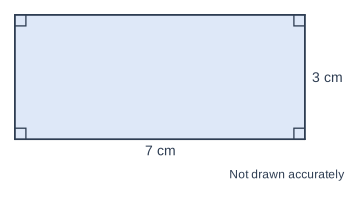
The diagram shows a rectangle.

Work out the area of the rectangle.

Geometry diagram, marked "Not drawn accurately". A rectangle (its vertices are not labelled) (shaded). The unlabelled side going to the right is labelled 7 cm. The unlabelled side going upwards is labelled 3 cm. The angle at an unlabelled point is marked as a right angle (90°). The angle at an unlabelled point is marked as a right angle (90°). The angle at an unlabelled point is marked as a right angle (90°). The angle at an unlabelled point is marked as a right angle (90°).

Model answer

\(7 \times 3 = 21\)
21 cm²

Explanation

The area of a rectangle is its length times its width, because there are 3 rows of 7 centimetre squares inside it. So the area is \(7 \times 3 = 21\) cm². A common mistake is to add the sides, which is how you start to find the perimeter.

Mark scheme
  1. 1 mark

    21 cm²

    Accept 21 with no unit. Do not accept 20 (the perimeter) or 10 (7 + 3).

Question 2

2 marks

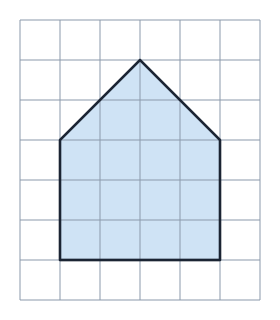
The diagram shows a shape drawn on a grid of centimetre squares. Some of the squares are cut in half by the edge of the shape.

Work out the area of the shape.

A shaded shape like a house, drawn on a grid of squares. The bottom part is a rectangle 4 squares wide and 3 squares tall. On top of it is a pointed roof, whose point is 2 squares above the middle of the rectangle's top edge. The two sloping sides of the roof go diagonally across squares, from corner to corner, cutting those squares in half.

Model answer

Whole squares: 14
Half squares: 4, and 4 halves make 2 whole squares
\(14 + 2 = 16\)
16 cm²

Explanation

Count the whole squares first: there are 14. Then count the half squares: there are 4, and two halves make one whole, so they make 2 whole squares. The area is \(14 + 2 = 16\) cm². A common mistake is to count each half square as a whole square.

Mark scheme
  1. 1 mark

    14 whole squares and 4 half squares counted, or two half squares counted as one whole square; or the correct answer 16 cm² with no working

  2. 1 mark

    16 cm²

    Accept 16 with no unit, or 16 squares. Do not accept 14 (the half squares left out) or 18 (each half square counted as a whole square). A correct answer with no working scores full marks.

Question 3

2 marks

A square has a perimeter of 20 cm.

Work out the area of the square.

Model answer

One side: \(20 \div 4 = 5\) cm
Area: \(5 \times 5 = 25\)
25 cm²

Explanation

A square has 4 equal sides, so each side is \(20 \div 4 = 5\) cm. Then the area is \(5 \times 5 = 25\) cm². A common mistake is to halve the perimeter to get the side, but halving gives two sides, not one.

Mark scheme
  1. 1 mark

    Length of one side \(20 \div 4 = 5\) cm; or the correct answer 25 cm² with no working

  2. 1 mark

    25 cm²

    Accept 25 with no unit. Do not accept 100 (side found as 10 by halving 20) or 400 (20 × 20). A correct answer with no working scores full marks.

Question 4

4 marks

Mr Patel's garden is a rectangle 10 m long and 9 m wide.

In the garden there is a rectangular pond 4 m long and 3 m wide. The rest of the garden is grass.

One box of grass seed covers 10 m².

How many boxes of grass seed does Mr Patel need to cover all the grass?

Model answer

Garden: \(10 \times 9 = 90\) m²
Pond: \(4 \times 3 = 12\) m²
Grass: \(90 - 12 = 78\) m²
7 boxes cover 70 m², which is not enough. 8 boxes cover 80 m².
8 boxes

Explanation

Find the area of the garden, \(10 \times 9 = 90\) m², and take away the pond, \(4 \times 3 = 12\) m², to leave 78 m² of grass. Seven boxes cover only 70 m², so Mr Patel needs 8 boxes. A common mistake is to stop at 7 boxes: you must round up, or part of the grass gets no seed.

Mark scheme
  1. 1 mark

    Area of the garden 90 m² or area of the pond 12 m²; or the correct answer 8 boxes with no working

  2. 1 mark

    Area of the grass \(90 - 12 = 78\) m²

  3. 1 mark

    \(78 \div 10\) (= 7.8 or 7 r 8), or 7 boxes cover 70 m² and 8 boxes cover 80 m²

    Follow through from their area of grass.

  4. 1 mark

    8 (boxes)

    Do not accept 7 or 7.8 (7 boxes leave 8 m² of grass with no seed), or 9 (the pond has been left in). A correct answer with no working scores full marks.

Ready to try the rest? Tap your answers and see straight away how you did.

Topic notes

Area

The big idea

The area of a flat shape is the amount of space inside it. We find it by counting how many squares cover the shape. You need area to work out how much carpet covers a floor or how much paper covers a book.

Square units

A square centimetre (cm²) is the area of a square with sides of 1 cm. A square metre (m²) is the area of a square with sides of 1 m. Use cm² for small things, such as a stamp or a page, and m² for big things, such as a room or a field.

On a grid of centimetre squares, the area of a shape equals how many squares fit inside it.

Area of a rectangle

A rectangle is covered by rows of squares. A rectangle 9 cm long and 7 cm wide is covered by 7 rows, with 9 squares in each. You do not need to count every square: multiply. \(9 \times 7 = 63\), so the area is 63 cm².

\[\text{area of a rectangle} = \text{length} \times \text{width}\]

A square has four equal sides, so its area is side × side. A square with sides of 30 m has an area of \(30 \times 30 = 900\) m².

A sheet of stickers is a rectangle 36 cm long and 12 cm wide. Each sticker is a square with sides of 4 cm, and the stickers cover the sheet with no gaps. How many stickers are on the sheet?

Along the length: \(36 \div 4 = 9\) stickers. Down the width: \(12 \div 4 = 3\) rows.

3 rows of 9 make 27 stickers.

Check with area: the sheet is \(36 \times 12 = 432\) cm² and each sticker is 16 cm². \(27 \times 16 = 432\), so there are 27 stickers.

Area and perimeter

Area and perimeter are different things, so do not mix them up.

PerimeterArea
What it isthe distance round the edgethe space inside
Rectangleadd all four sideslength × width
Unitscm, mcm², m²

Shapes with the same perimeter can have different areas. A rectangle 5 cm by 1 cm and a square 3 cm by 3 cm both have a perimeter of 12 cm, but their areas are 5 cm² and 9 cm².

A square vegetable patch has an area of 400 m². How much fence is needed to go all the way round it?

The area of a square is side × side, so find the number that multiplies by itself to make 400: \(20 \times 20 = 400\). Each side is 20 m.

The fence goes round the edge, so find the perimeter: \(20 + 20 + 20 + 20 = 80\) m.

80 m of fence is needed.

Estimating the area of other shapes

Some shapes, such as a puddle or a leaf, have curved edges, so you cannot multiply. Draw round the shape on squared paper and estimate (make a sensible guess at) its area:

  1. Count the whole squares.
  2. Count each square that is half covered or more as one whole square.
  3. Ignore squares with less than half of them covered.

The parts you ignore and the extra bits you count roughly balance out, which is why the total is a good estimate.

A sketch on a pair of axes (Each square is 1 cm wide across, Each square is 1 cm tall up) with no scale marked. The circle is a circle with centre (4.5, 4.5) and radius 2.5. (Equation (x − 4.5)² + (y − 4.5)² = 6.25.)
A round coaster drawn on centimetre squares. 21 squares are whole or more than half covered, and the 4 corner squares are only a little covered. So its area is about 21 cm².

Stretch: shapes made from rectangles

An L-shape is not a rectangle, so you cannot just multiply two of its sides. Split it into two rectangles, find each area, then add them.

Geometry diagram, drawn accurately to scale. A L-shape (its vertices are not labelled) (shaded). A dashed horizontal line with no labelled ends is drawn. The unlabelled side going to the right is labelled 8 m. The unlabelled side going upwards is labelled 6 m. The unlabelled side going to the left is labelled 3 m. The unlabelled side going downwards is labelled 4 m. The unlabelled side going to the left is labelled 5 m. The unlabelled side going downwards is labelled 2 m.
The floor of an L-shaped room. Every corner is a right angle, and the dashed line splits it into two rectangles.

Ravi says the area of the floor is \(8 \times 6 = 48\) m². Is he right?

No. 8 m by 6 m is the size of the whole rectangle around the floor, and the floor does not fill all of it.

Each rectangle. Bottom: 8 m by 2 m, so \(8 \times 2 = 16\) m². Right: 3 m by 4 m, so \(3 \times 4 = 12\) m².

Add: \(16 + 12 = 28\)

The area of the floor is 28 m², not 48 m².

Remember

  • Area measures the flat space a shape covers, in square units: cm² or m².
  • Area of a rectangle = length × width.
  • Estimate curved shapes by counting squares that are half covered or more.

Common mistakes

  • Adding the sides instead of multiplying. That gives the perimeter, not the area.
  • Writing cm instead of cm². Area always uses square units.
  • Counting every square that the edge of a curved shape touches. Squares with only a small part covered should be ignored.
  • Multiplying two lengths that belong to different rectangles in a shape made from rectangles.

Top tip

Check your units at the end. If your answer is an area, it must be in cm² or m². If you have written cm or m, you may have found the perimeter by mistake.

Study Helper Hints first, answers after you try

Stuck on this one? Ask for a hint and I’ll point you in the right direction, without giving the answer away. Once you’ve checked your answer, I’ll show you how the marks are awarded.