Level:
Correct: 0
Incorrect: 0
Marks: 0/0
Practice
Course:
Topics:
Year 5 Maths Smart practice A mixed round aimed at your weak spots
Unit 1
Place value
Unit 2
Addition and subtraction
Unit 3
Multiplication and division
Unit 4
Fractions
Unit 5
Decimals and percentages
Unit 6
Measurement
Measurement
Converting metric units
Quick practice6 skills
Imperial units
Quick practice5 skills
Time
Quick practice5 skills
Money and measure problems
Quick practice4 skills
Perimeter
Quick practice5 skills
Area
Quick practice6 skills
Volume and capacity
Quick practice5 skills
Unit 7
Shape and angles
Unit 8
Position and direction
Geometry: position and direction
Coordinates
Quick practice5 skills
Reflection
Quick practice5 skills
Translation
Quick practice5 skills
Unit 9
Statistics
Statistics
Tables, timetables and charts
Quick practice5 skills
Line graphs
Quick practice5 skills
Avg
score:
–
Topics
done:
0/47

Numbers up to one million

Practise 25 questions on Numbers up to one million for Year 5 Maths. Tap your answer and find out straight away if you are right, with the Study Helper on hand if you get stuck.

  • 25 questions
  • 1–5 marks each
  • Instant marking
  • No sign-up needed
20 questions, marked as you go

Sample questions with model answers

Here are 4 of the questions in this topic, each with a model answer, an explanation of why it earns the marks and the mark scheme.

Question 1

1 mark

What is the value of the digit 4 in 247,815?

Model answer

\(247{,}815 = 200{,}000 + 40{,}000 + 7{,}000 + 800 + 10 + 5\)
The 4 is worth 40,000.

Explanation

From the right, the columns are ones, tens, hundreds, thousands, ten thousands and hundred thousands. The 4 is in the ten thousands column, so it is worth 4 ten thousands, which is 40,000. A common mistake is to miscount the columns and say 4,000. The thousands digit is the 7, just before the comma.

Mark scheme
  1. 1 mark

    40,000 (forty thousand)

    Accept 40000 or 4 ten thousands. Do not accept 4, 4,000 or 400,000.

Question 2

2 marks

Which sign, < or >, goes in each box to make each statement correct?

\(74{,}516 \quad \square \quad 74{,}165\)

\(309{,}999 \quad \square \quad 310{,}000\)

Model answer

74,516 > 74,165, because 5 hundreds is more than 1 hundred.
309,999 < 310,000, because 309 thousands is less than 310 thousands.

Explanation

Compare the digits from the left until two are different. In the first pair, the first different digits are in the hundreds column: 5 hundreds is more than 1 hundred. In the second pair, 309,999 is less than 310,000 even though it has lots of 9s, because it has fewer ten thousands. Remember that the wide end of the sign faces the bigger number.

Mark scheme
  1. 1 mark

    \(74{,}516 > 74{,}165\)

    Accept the symbol > on its own if the pupil keeps the two answers in order, e.g. '>, <'. Accept 'greater than' or 'more than'.

  2. 1 mark

    \(309{,}999 < 310{,}000\)

    Accept the symbol < on its own (second in the list), or 'less than' or 'smaller than'.

Question 3

2 marks

Leah says, "Every six-digit number is greater than every five-digit number."

Is Leah right? How do you know?

Model answer

Yes. The smallest six-digit number is 100,000. The largest five-digit number is 99,999. 100,000 is greater than 99,999, so every six-digit number is greater.

Explanation

To show something is always true, look at the closest case. The smallest six-digit number, 100,000, is still 1 more than the largest five-digit number, 99,999. So any six-digit number beats any five-digit number. One example on its own does not show it is always true.

Mark scheme
  1. 1 mark

    Yes, with a reason that is relevant but incomplete, e.g. one example such as 123,456 > 98,765, or 'six-digit numbers have more digits'

    'Yes' on its own scores 0. Any answer that says Leah is wrong scores 0.

  2. 1 mark

    A complete reason: the smallest six-digit number (100,000) is greater than the largest five-digit number (99,999); or every six-digit number is at least 100,000 and every five-digit number is less than 100,000

    Accept 'a six-digit number has at least 1 hundred thousand, and a five-digit number has no hundred thousands'. A complete correct reason on its own scores both marks.

Question 4

4 marks

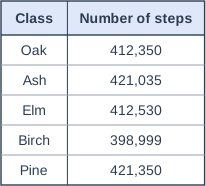
Five classes took part in a walking challenge. The table shows how many steps each class walked.

Put the five classes in order, from the most steps to the fewest.

One class walked four hundred and twenty-one thousand and thirty-five steps. Which class was it?

What is the number of steps that Birch class walked, in words?

Table with columns "Class", "Number of steps". Class: Oak; Number of steps: 412,350 | Class: Ash; Number of steps: 421,035 | Class: Elm; Number of steps: 412,530 | Class: Birch; Number of steps: 398,999 | Class: Pine; Number of steps: 421,350.

Model answer

Most steps to fewest: Pine (421,350), Ash (421,035), Elm (412,530), Oak (412,350), Birch (398,999)
Four hundred and twenty-one thousand and thirty-five is 421,035, so it was Ash.
Birch: three hundred and ninety-eight thousand, nine hundred and ninety-nine

Explanation

Compare the numbers column by column from the left. Birch is the only class with 3 hundred thousands, so it walked the fewest steps. Pine and Ash both have 421 thousand, so look at the hundreds: 3 hundreds beats 0 hundreds. Elm and Oak both have 412 thousand, and 5 hundreds beats 3 hundreds. A common mistake is to mix up 421,035 and 421,350.

Mark scheme
  1. 1 mark

    The order is right except that two classes are swapped; or all five are in the right order from fewest to most

    Also award this mark for the fully correct order.

  2. 1 mark

    Pine, Ash, Elm, Oak, Birch

    All five in this order, most steps first. Accept the numbers of steps instead of the names (421,350, 421,035, 412,530, 412,350, 398,999).

  3. 1 mark

    Ash

    Do not accept Pine (421,350).

  4. 1 mark

    three hundred and ninety-eight thousand, nine hundred and ninety-nine

    Accept without 'and', commas or hyphens. Ignore small spelling slips if the number is clear.

Ready to try the rest? Tap your answers and see straight away how you did.

Topic notes

Numbers up to one million

The big idea

Every number is written with the ten digits 0 to 9. What a digit is worth depends on its column. This is called place value, and it lets you read and compare numbers up to one million, such as crowds, distances and house prices.

The columns

Each column is worth 10 times the column on its right. Here is 652,307 in a place value table (HTh means hundred thousands, TTh ten thousands, Th thousands, H hundreds, T tens and O ones).

HThTThThHTO
652307

The 6 is worth 600,000, the 5 is worth 50,000 and the 2 is worth 2,000. The 0 shows there are no tens. It is a place holder: it keeps the 7 in the ones column.

Ten lots of 100,000 make one million, written 1,000,000. It is the first number with seven digits.

Reading and writing numbers

The comma splits a big number into two groups. Read the group before the comma and say "thousand", then read the rest. So 652,307 is "six hundred and fifty-two thousand, three hundred and seven".

To write a number from words, write the thousands first, then the hundreds, tens and ones. Put a 0 in any empty column. "Two hundred and seven thousand and thirty" is 207,030.

Partitioning

To partition a number means to split it into parts. The usual way uses the value of each digit:

\(652{,}307 = 600{,}000 + 50{,}000 + 2{,}000 + 300 + 7\)

You can split it in other ways too: 652 thousands and 307 ones, or \(650{,}000 + 2{,}307\).

A number is made of 4 hundred thousands, 15 thousands, 9 hundreds and 3 ones. What is the number?

Write each part as a number: 400,000, 15,000, 900 and 3.

Add them: \(400{,}000 + 15{,}000 = 415{,}000\), then \(415{,}000 + 900 + 3 = 415{,}903\).

The number is 415,903. The 15 thousands is too many for one column: it makes 1 ten thousand and 5 thousands.

Comparing and ordering

  1. Count the digits. A whole number with more digits is bigger: 100,250 is bigger than 99,870.
  2. If both have the same number of digits, compare the columns from the left. The first column where the digits differ decides.

The sign > means "is greater than" and < means "is less than". The sign opens wide towards the larger number: \(381{,}642 > 318{,}946\).

Sam's number is \(5\square 7{,}382\), but one digit is hidden. His number is greater than 547,000. What could the hidden digit be?

Both numbers have 5 hundred thousands, so look at the ten thousands. 547,000 has 4 of them.

Any hidden digit from 5 to 9 gives more ten thousands, so the number is greater.

A hidden digit of 4 gives 547,382. The thousands match, and 3 hundreds beats 0 hundreds, so it is still greater.

The hidden digit could be any digit from 4 to 9.

Counting in steps

When you count in steps of 10, 100, 1,000, 10,000 or 100,000, the digit in that column goes up by 1 for every step on, and down by 1 for every step back.

When that digit is a 9 and you count on, it becomes 0 and the column to its left goes up by 1. Counting on in hundreds from 41,850 goes 41,950, 42,050, 42,150.

Count on in steps of 1,000 from 297,500. How many steps does it take to reach 304,500?

The last three digits stay as 500, so just count the thousands: 298, 299, 300, 301, 302, 303, 304. That is 7 steps.

From 299,500 to 300,500, two 9s became 0s and the hundred thousands digit went up from 2 to 3.

Number lines and scales

On a number line, start by finding the value of one small part. Find the gap between two numbered marks, then count the equal parts.

A horizontal scale from 400000 to 600000, divided into 2 equal parts by long marks, each split into 5 small divisions by short marks. The marks are not numbered. Long marks are every 100000 and each small division is 20000. Words under the scale: "400,000" at 400000, "500,000" at 500000 and "600,000" at 600000. Arrow A points to 540000.
There are 5 equal gaps from 400,000 to 500,000, which makes each gap worth 20,000. Arrow A is 2 gaps past 500,000, so it points to 540,000.

Remember

  • Each column is worth 10 times the column on its right.
  • Zeros hold empty columns. Never leave them out.
  • One million is 1,000,000: ten hundred thousands.

Common mistakes

  • Giving the digit instead of its value. In 652,307 the 2 is worth 2,000, not 2.
  • Leaving out a place holder: two hundred and seven thousand and thirty is 207,030, not 20,730.
  • Thinking a number that starts with a bigger digit must be bigger. 92,500 is less than 125,000, because it has fewer digits.

Top tip

Say a big number aloud in two parts: the thousands, then the rest. The comma tells you when to say "thousand".

Study Helper Hints first, answers after you try

Stuck on this one? Ask for a hint and I’ll point you in the right direction, without giving the answer away. Once you’ve checked your answer, I’ll show you how the marks are awarded.