Level:
Correct: 0
Incorrect: 0
Marks: 0/0
Practice
Course:
Topics:
Year 5 Maths Smart practice A mixed round aimed at your weak spots
Unit 1
Place value
Number and place value
Numbers up to one million
Quick practice6 skills
Rounding whole numbers
Quick practice6 skills
Negative numbers
Quick practice6 skills
Roman numerals
Quick practice5 skills
Unit 2
Addition and subtraction
Unit 3
Multiplication and division
Unit 4
Fractions
Unit 5
Decimals and percentages
Unit 6
Measurement
Measurement
Converting metric units
Quick practice6 skills
Imperial units
Quick practice5 skills
Time
Quick practice5 skills
Money and measure problems
Quick practice4 skills
Perimeter
Quick practice5 skills
Area
Quick practice6 skills
Volume and capacity
Quick practice5 skills
Unit 7
Shape and angles
Unit 8
Position and direction
Geometry: position and direction
Coordinates
Quick practice5 skills
Reflection
Quick practice5 skills
Translation
Quick practice5 skills
Unit 9
Statistics
Statistics
Tables, timetables and charts
Quick practice5 skills
Line graphs
Quick practice5 skills
Avg
score:
–
Topics
done:
0/47

Mental addition and subtraction

Practise 22 questions on Mental addition and subtraction for Year 5 Maths. Tap your answer and find out straight away if you are right, with the Study Helper on hand if you get stuck.

  • 22 questions
  • 1–5 marks each
  • Instant marking
  • No sign-up needed
20 questions, marked as you go

Sample questions with model answers

Here are 4 of the questions in this topic, each with a model answer, an explanation of why it earns the marks and the mark scheme.

Question 1

1 mark

Work out \(46{,}000 + 7{,}000\)

Model answer

\(46 \text{ thousands} + 7 \text{ thousands} = 53 \text{ thousands}\)
53,000

Explanation

Use a fact you know: \(46 + 7 = 53\). So 46 thousands add 7 thousands is 53 thousands, which is 53,000. A common mistake is to forget to cross into the next ten thousand and write 43,000.

Mark scheme
  1. 1 mark

    53,000

    Accept 53000. Do not accept 43,000, 116,000 or 47,000.

Question 2

2 marks

Work out

\(250{,}000 + 70{,}000\)

\(140{,}000 - 60{,}000\)

Model answer

\(25 + 7 = 32\), so \(250{,}000 + 70{,}000 = 320{,}000\)
\(14 - 6 = 8\), so \(140{,}000 - 60{,}000 = 80{,}000\)

Explanation

Count in ten thousands. 250,000 is 25 ten thousands and 70,000 is 7 ten thousands, so the total is 32 ten thousands, which is 320,000. In the same way, 14 ten thousands take away 6 ten thousands leaves 8 ten thousands: 80,000. A common mistake is to treat 70,000 as 700,000 and get 950,000.

Mark scheme
  1. 1 mark

    320,000

    Accept 320000. Do not accept 950,000 or 220,000.

  2. 1 mark

    80,000

    Accept 80000. Do not accept 120,000 or 8,000.

Question 3

2 marks

Josh works out \(6{,}000 - 2{,}999\) like this.

"6,000 take away 3,000 is 3,000. Then I take away 1 more, so the answer is 2,999."

Is Josh right? How do you know?

Model answer

No. 3,000 is 1 more than 2,999, so when Josh took away 3,000 he took away 1 too many. He should add 1 back, not take 1 away.
\(6{,}000 - 2{,}999 = 3{,}001\)

Explanation

Taking away 3,000 instead of 2,999 takes away 1 too much, so the answer is too small by 1 and you must add 1 back: 3,001. You can check with an addition: \(3{,}001 + 2{,}999 = 6{,}000\). Josh's mistake is a common one: he adjusted in the wrong direction.

Mark scheme
  1. 1 mark

    No, with a reason that is relevant but incomplete, e.g. 'he should add 1' with no reason, or the correct answer 3,001 with no explanation

    'No' on its own scores 0. Any answer that says Josh is right scores 0.

  2. 1 mark

    A complete reason: taking away 3,000 takes away 1 more than 2,999, so he must add 1 back, giving 3,001; or a check such as \(2{,}999 + 2{,}999 = 5{,}998\), not 6,000

    Accept 'he took away too much, so he should add 1, not take away 1'. A complete correct reason on its own scores both marks.

Question 4

4 marks

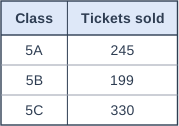
A school fair has 1,000 raffle tickets to sell. The table shows how many tickets three classes have sold.

How many tickets have the three classes sold altogether?

How many tickets are still left to sell?

Table with columns "Class", "Tickets sold". Class: 5A; Tickets sold: 245 | Class: 5B; Tickets sold: 199 | Class: 5C; Tickets sold: 330.

Model answer

\(245 + 199 = 245 + 200 - 1 = 444\)
\(444 + 330 = 774\)
774 to 800 is 26, and 800 to 1,000 is 200.
\(26 + 200 = 226\) tickets left

Explanation

Add the numbers one at a time, using easy jumps: adding 199 is adding 200 and taking away 1. Then find what makes 774 up to 1,000 by counting on: 26 to reach 800 and 200 more to reach 1,000. A common mistake is to make each digit up to 10, which gives the wrong answer 336.

Mark scheme
  1. 1 mark

    A correct total of two of the classes: 444 (5A and 5B), 575 (5A and 5C) or 529 (5B and 5C); or the correct answer 774 with no working

    Adding the three numbers in any order is fine.

  2. 1 mark

    774 sold altogether

    Do not accept 674 or 784.

  3. 1 mark

    A correct method for the tickets left, e.g. counting on from their total to 1,000, or 1,000 minus their total; or the correct answer 226 with no working

    Follow through from their total.

  4. 1 mark

    226 left

    Follow through: 1,000 minus their total, worked out correctly. Do not accept 336 (each digit made up to 10). A correct answer with no working scores full marks.

Ready to try the rest? Tap your answers and see straight away how you did.

Topic notes

Mental addition and subtraction

The big idea

You can add and subtract many big numbers in your head, without a written method. The trick is to use facts you already know, and to make the numbers friendlier before you start.

Using facts you know

If you know that \(7 + 5 = 12\), you also know:

  • \(70 + 50 = 120\)
  • \(700 + 500 = 1{,}200\)
  • \(7{,}000 + 5{,}000 = 12{,}000\)
  • \(70{,}000 + 50{,}000 = 120{,}000\)

Subtraction works in the same way: \(12 - 5 = 7\), so \(12{,}000 - 5{,}000 = 7{,}000\). Saying the numbers in thousands helps. For \(58{,}000 + 6{,}000\), think "58 thousand and 6 thousand is 64 thousand", which is 64,000.

Number bonds to 100 and 1,000

A number bond is a pair of numbers that make a total. 64 and 36 are a bond to 100. Ten times bigger, 640 and 360 are a bond to 1,000.

A bar model: one bar, made of 2 parts whose lengths are in the ratio 12.8 : 7.2; written in the parts (counting from the left): part 1: 640, part 2: 360. A brace above the bar spans the whole bar and is labelled 1,000.
A bar model of a number bond: the two parts, 640 and 360, make the whole, 1,000.

Another bond to 1,000 is 455 and 545.

To find a bond, count on: from 455, 5 more makes 460, 40 more makes 500, and 500 more makes 1,000. That is \(5 + 40 + 500 = 545\).

Work out \(470 + 285 + 530 + 115\) in your head.

You can add numbers in any order, so look for pairs that make friendly totals.

470 and 530 are a bond to 1,000: \(470 + 530 = 1{,}000\).

285 and 115 make a whole number of hundreds: \(285 + 115 = 400\).

\(1{,}000 + 400 = 1{,}400\). The total is 1,400.

Near multiples

A near multiple is a number just below or above a round number, such as 1,999 (just below 2,000). Use the round number, then put it right.

  • To add 1,999, add 2,000 and take away 1: \(6{,}420 + 1{,}999 = 8{,}420 - 1 = 8{,}419\).
  • To subtract 1,999, take away 2,000 and add 1 back: \(6{,}420 - 1{,}999 = 4{,}420 + 1 = 4{,}421\).

When you subtract, the round number takes away 1 more than you wanted, so give that 1 back.

Partitioning and counting on

Partitioning means splitting a number into parts and adding them one at a time. For \(45{,}600 + 23{,}300\), add the thousands first to get 68,600, then add the 300 to get 68,900.

Work out \(3{,}650 + 2{,}870\) in your head.

3,650 needs 350 more to make 4,000. Take that 350 from the 2,870, which leaves 2,520.

Now the sum is easy: \(4{,}000 + 2{,}520 = 6{,}520\).

The answer is 6,520.

To find a difference (how far apart two numbers are), count on from the smaller number. For \(8{,}000 - 4{,}350\), jump 50 to 4,400, then 600 to 5,000, then 3,000 to 8,000. The jumps add up to \(50 + 600 + 3{,}000 = 3{,}650\).

Work out \(8{,}000 - 7{,}994\) and \(8{,}000 - 994\). Choose a good way for each.

In \(8{,}000 - 7{,}994\), the numbers are very close together, so count on. From 7,994, 6 more makes 8,000. The answer is 6.

In \(8{,}000 - 994\), the numbers are far apart, and 994 is a near multiple of 1,000. Take away 1,000 to get 7,000. That took away 6 more than 994, so add 6 back. The answer is 7,006.

Missing numbers

Use the inverse, the opposite operation, to find a missing number. In \(\square + 4{,}500 = 12{,}000\), take 4,500 away from 12,000 to get 7,500.

Common mistakes

  • Making every digit up to 10 for a bond. 640 and 460 make 1,100, not 1,000.
  • Putting a near multiple right the wrong way. \(6{,}420 - 1{,}999\) is 4,421, not 4,419.
  • Losing a zero: \(70{,}000 + 50{,}000\) is 120,000, not 12,000.
  • Forgetting to add up all the jumps when you count on.

Top tip

Look at the numbers before you start. If a number is close to a round number, use the round number and put it right. If two numbers make a bond, add those first.

Study Helper Hints first, answers after you try

Stuck on this one? Ask for a hint and I’ll point you in the right direction, without giving the answer away. Once you’ve checked your answer, I’ll show you how the marks are awarded.