Practise 20 questions on Perimeter for Year 5 Maths. Tap your answer and find out straight away if you are right, with the Study Helper on hand if you get stuck.
20 questions
1–5 marks each
Instant marking
No sign-up needed
20 questions, marked as you go
Sample questions with model answers
Here are 4 of the questions in this topic, each with a model answer, an explanation of why it earns the marks and the mark scheme.
Question 1
1 mark
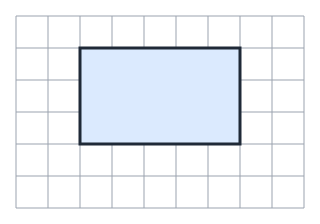
The picture shows a rectangle drawn on a grid of centimetre squares.
What is the perimeter of the rectangle?
Model answer
The rectangle is 5 cm long and 3 cm wide. \(5 + 3 + 5 + 3 = 16\) The perimeter is 16 cm.
Explanation
Count the edges of the squares all the way round the outside of the rectangle: 5 along the top, 3 down the side, 5 along the bottom and 3 up the other side. That makes 16 cm. A common mistake is to count the squares inside the shape, which gives the area instead.
Mark scheme
1 mark
16 cm
Accept 16, with or without the unit. Do not accept 15 (counting the squares inside) or 8.
Question 2
2 marks
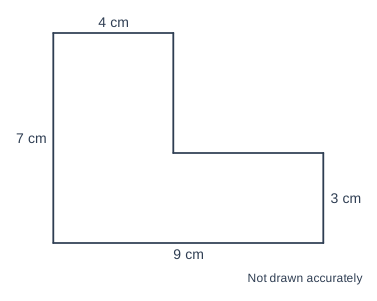
The diagram shows an L-shape. All its corners are right angles. Two of its sides have no length written on them.
Work out the perimeter of the L-shape.
Model answer
Missing horizontal side: \(9 - 4 = 5\) cm Missing vertical side: \(7 - 3 = 4\) cm \(9 + 3 + 5 + 4 + 4 + 7 = 32\) The perimeter is 32 cm.
Explanation
Use the sides you know to find the missing ones. The bottom is 9 cm and the top is 4 cm, so the short horizontal side is \(9 - 4 = 5\) cm. The left side is 7 cm and the right side is 3 cm, so the short vertical side is \(7 - 3 = 4\) cm. Then add all six sides: 32 cm. A common mistake is to leave out the sides with no labels.
Mark scheme
1 mark
Both missing sides found: 5 cm and 4 cm; or the correct answer 32 cm with no working
Also award this mark for one missing side correct with all six sides added.
1 mark
32 cm
Accept 32, with or without the unit. Do not accept 23 (the unlabelled sides left out) or 41. A correct answer with no working scores full marks.
Question 3
2 marks
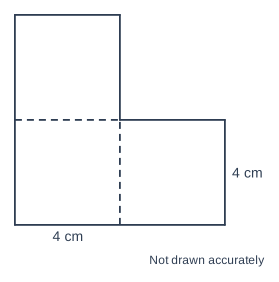
Three squares are joined to make the L-shape in the diagram. Each square has sides of 4 cm. The dashed lines show where the squares meet.
Work out the perimeter of the L-shape.
Model answer
Going round the outside there are 8 edges of 4 cm. \(8 \times 4 = 32\) The perimeter is 32 cm.
Explanation
The perimeter only goes round the outside of the L-shape, so the dashed lines inside do not count. Going round the outside, there are 8 square edges, each 4 cm long, so the perimeter is \(8 \times 4 = 32\) cm. A common mistake is to add the perimeters of the three squares (48 cm), which counts the edges where the squares meet.
Mark scheme
1 mark
The outside is made of 8 sides of 4 cm, or the side lengths 8, 4, 4, 4, 4 and 8 cm; or the correct answer 32 cm with no working
1 mark
32 cm
Accept 32, with or without the unit. Do not accept 48 (the three squares' perimeters added, which counts the dashed lines) or 40. A correct answer with no working scores full marks.
Question 4
4 marks
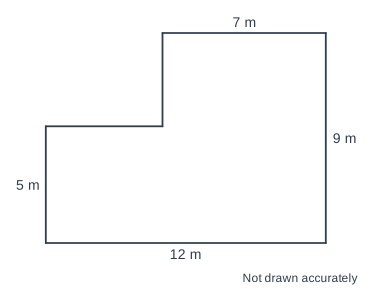
The diagram shows the plan of a garden. All its corners are right angles.
Mr Shah puts a fence all the way round the garden. The fence costs £6 for each metre.
How much does the fence cost?
Model answer
Short vertical side: \(9 - 5 = 4\) m Short horizontal side: \(12 - 7 = 5\) m Perimeter: \(12 + 9 + 7 + 4 + 5 + 5 = 42\) m Cost: \(42 \times 6 = 252\) The fence costs £252.
Explanation
First find the two missing sides from the sides you know: \(9 - 5 = 4\) m and \(12 - 7 = 5\) m. The perimeter is \(12 + 9 + 7 + 4 + 5 + 5 = 42\) m. Each metre of fence costs £6, so the fence costs \(42 \times 6 = 252\) pounds: £252. A common mistake is to add only the labelled sides.
Mark scheme
1 mark
Both missing sides found: 4 m and 5 m; or the correct answer £252 with no working
1 mark
Perimeter 42 m
Follow through from their missing sides, if all six sides are added.
1 mark
A correct method for the cost: their perimeter multiplied by 6, e.g. \(42 \times 6\)
1 mark
£252
Accept 252 or £252.00. Do not accept £198 (33 m, with the two unlabelled sides missed). A correct answer with no working scores full marks.
Ready to try the rest? Tap your answers and see straight away how you did.
Ctrl + Enter to check
Study HelperHints first, answers after you try
Stuck on this one? Ask for a hint and I’ll point you in the right direction, without giving the answer away. Once you’ve checked your answer, I’ll show you how the marks are awarded.