Level:
Correct: 0
Incorrect: 0
Marks: 0/0
Practice
Course:
Topics:
Year 5 Maths Smart practice A mixed round aimed at your weak spots
Unit 1
Place value
Number and place value
Numbers up to one million
Quick practice6 skills
Rounding whole numbers
Quick practice6 skills
Negative numbers
Quick practice6 skills
Roman numerals
Quick practice5 skills
Unit 2
Addition and subtraction
Unit 3
Multiplication and division
Unit 4
Fractions
Unit 5
Decimals and percentages
Unit 6
Measurement
Measurement
Converting metric units
Quick practice6 skills
Imperial units
Quick practice5 skills
Time
Quick practice5 skills
Money and measure problems
Quick practice4 skills
Perimeter
Quick practice5 skills
Area
Quick practice6 skills
Volume and capacity
Quick practice5 skills
Unit 7
Shape and angles
Unit 8
Position and direction
Geometry: position and direction
Coordinates
Quick practice5 skills
Reflection
Quick practice5 skills
Translation
Quick practice5 skills
Unit 9
Statistics
Statistics
Tables, timetables and charts
Quick practice5 skills
Line graphs
Quick practice5 skills
Avg
score:
–
Topics
done:
0/47

Understanding percentages

Practise 20 questions on Understanding percentages for Year 5 Maths. Tap your answer and find out straight away if you are right, with the Study Helper on hand if you get stuck.

  • 20 questions
  • 1–5 marks each
  • Instant marking
  • No sign-up needed
20 questions, marked as you go

Sample questions with model answers

Here are 4 of the questions in this topic, each with a model answer, an explanation of why it earns the marks and the mark scheme.

Question 1

1 mark

What is 59% as a fraction with a denominator of 100?

Model answer

59% means 59 out of 100.
\(\dfrac{59}{100}\)

Explanation

Per cent means 'out of 100', so 59% is 59 parts out of 100. As a fraction this is \(\dfrac{59}{100}\): the numerator is the number of parts and the denominator is 100.

Mark scheme
  1. 1 mark

    \(\dfrac{59}{100}\)

    Accept 59/100. Do not accept 0.59 (not a fraction) or 59/10.

Question 2

2 marks

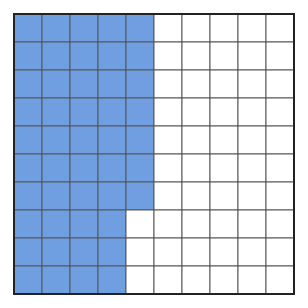
The diagram shows a 100-square. Some of the small squares are shaded.

What percentage of the 100-square is shaded? What percentage is not shaded?

A 10 by 10 grid of 100 small squares. The 4 columns on the left are shaded blue, and so are the top 7 squares of the fifth column. The other squares are white.

Model answer

Shaded: 4 full columns = 40 squares, and 7 more
\(40 + 7 = 47\), so 47% is shaded.
Not shaded: \(100 - 47 = 53\), so 53%

Explanation

There are 100 small squares, so each one is 1%. Count the shaded squares in tens and ones: 47 squares, so 47% is shaded. The shaded and unshaded parts make the whole square, which is 100%, so \(100\% - 47\% = 53\%\) is not shaded. You can check by counting the white squares.

Mark scheme
  1. 1 mark

    Shaded: 47%

    Accept 47 without the % sign.

  2. 1 mark

    Not shaded: 53%

    Follow through: 100 minus their shaded percentage. Accept 53 without the % sign. A correct answer with no working scores full marks.

Question 3

2 marks

In Ben's class, 50% of the pupils walk to school. In Ali's class, 50% of the pupils walk to school too.

Ben says, "So the same number of pupils walk to school in both classes."

Is Ben right? How do you know?

Model answer

No, not always.
50% means half of the class.
If Ben's class has 30 pupils, 15 walk.
If Ali's class has 28 pupils, 14 walk.
The numbers are only the same if the classes are the same size.

Explanation

A percentage is always a percentage of something. 50% of Ben's class means half of Ben's class, and 50% of Ali's class means half of Ali's class. If one class is bigger, half of it is a bigger number. So the same percentage can be different numbers of pupils.

Mark scheme
  1. 1 mark

    No (or 'not always'), with a relevant but incomplete reason, e.g. 'the classes might be different'

  2. 1 mark

    A complete correct reason: 50% is half of each class, so it depends on how many pupils are in each class; the numbers are only the same if the classes are the same size; or an example such as 50% of 30 is 15 but 50% of 28 is 14

    A complete correct reason on its own scores both marks. Accept 'not always', 'not necessarily' or 'we cannot tell' in place of 'No'. 'No' alone scores 0. 'Yes' scores 0.

Question 4

4 marks

Leah colours every square of a 100-square. Each square is red, blue or white.

40% of the squares are white.
There are 20 more blue squares than red squares.

What percentage of the squares are red? What percentage are blue?

Model answer

White: 40 squares, so red and blue: \(100 - 40 = 60\) squares
Blue is 20 more than red.
\(60 - 20 = 40\), \(40 \div 2 = 20\)
Red: 20 squares, Blue: \(20 + 20 = 40\) squares
Check: \(20 + 40 + 40 = 100\)
Red 20%, Blue 40%

Explanation

The whole square is 100%, so red and blue together make \(100\% - 40\% = 60\%\). Blue has 20 more than red, so take away the extra 20 and share what is left equally: \(40 \div 2 = 20\). So red is 20% and blue is \(20\% + 20\% = 40\%\). Always check your answer: \(20 + 40 + 40 = 100\). A common mistake is to share 60 equally and give 30% for each colour.

Mark scheme
  1. 1 mark

    Red and blue together: 60 squares (60%); or the correct answers 20% and 40% with no working

  2. 1 mark

    A correct method to split 60 so that blue is 20 more than red, e.g. \(60 - 20 = 40\) then \(40 \div 2 = 20\); or trying pairs that add to 60

  3. 1 mark

    Red: 20%

  4. 1 mark

    Blue: 40%

    Follow through: 60 minus their red, if it is 20 more than their red. Accept answers without the % sign, or as 20 and 40 squares. A correct answer with no working scores full marks.

Ready to try the rest? Tap your answers and see straight away how you did.

Topic notes

Understanding percentages

The big idea

Per cent means "out of 100". The sign for it is %. "Cent" means 100, just as a century is 100 years. So 41% means 41 out of every 100. You see percentages on phone batteries, in shop sales and on food labels.

Out of 100

Picture a 100-square: a big square split into 10 rows of 10, which makes 100 small squares. Each small square is 1 of the 100, which makes it 1% of the big square.

A 100-square: 10 rows of 10 small squares. 41 squares are coloured: 4 full columns of 10 and 1 more square.
A 100-square. 4 full columns of 10 squares and 1 more square are coloured: 41 squares out of 100, which is 41% of the big square.
  • If 41 small squares are coloured, 41% of the square is coloured.
  • If every square is coloured, that is 100%: the whole thing.
  • If no squares are coloured, that is 0%.

A full row or column of 10 squares is 10%, so count the full rows or columns in tens, then add the single squares.

Percentages as fractions and decimals

A percentage is a number of hundredths. So any percentage can be written as a fraction over 100 (a denominator, or bottom number, of 100), and as a decimal with two decimal places.

PercentageFractionDecimal
41%\(\dfrac{41}{100}\)0.41
7%\(\dfrac{7}{100}\)0.07
60%\(\dfrac{60}{100}\)0.60, which is 0.6
100%\(\dfrac{100}{100}\)1

To go from a decimal to a percentage, count the hundredths, or multiply by 100: 0.35 is 35 hundredths, so it is 35%, and 0.9 is 90 hundredths, so it is 90%.

A bag holds 100 sweets. 7 of them are red. Write the red sweets as a fraction, a decimal and a percentage of the bag.

7 out of 100 is \(\dfrac{7}{100}\).

7 hundredths has no tenths, so the decimal needs a place holder zero: 0.07.

7 out of 100 is 7%.

Percentages that make 100%

The whole of something is 100%. If you know one part as a percentage, the rest is 100% take away that part. A full tablet battery is 100%, so if it now shows 71%, then 29% has been used: \(71 + 29 = 100\).

Mo is running a 100 m race. He has run 0.58 of the race. What percentage of the race does he still have to run?

Change the decimal to a percentage: 0.58 is 58 hundredths, which is 58%.

The whole race is 100%: \(100 - 58 = 42\).

Mo still has to run 42% of the race. On a 100 m track, that is 42 m.

Stretch: finding 50%, 25% and 10%

Some percentages are easy fractions. 50% is a half, so divide by 2. 25% is a quarter, so divide by 4. 10% is a tenth, so divide by 10.

A bar model: one bar, labelled "bottle" split into 10 equal boxes; written in the boxes (counting from the left): box 1: 10%, box 2: 10%, box 3: 10%, box 4: 10%, box 5: 10%, box 6: 10%, box 7: 10%, box 8: 10%, box 9: 10%, box 10: 10%; boxes 1, 2, 3, 4 and 5 shaded. A brace above the bar spans the whole bar and is labelled 100% = 800 ml. A brace below the bar spans boxes 1 to 5 and is labelled 50% = 400 ml. A brace below the bar spans box 10 and is labelled 80 ml. (The brace labelled 80 ml covers 1 unit, so one unit = 80 ml.)
The bottle split into 10 equal parts. Each part is 10%, which is 80 ml. Five parts make 50%, which is 400 ml.

A water bottle holds 800 ml. Find 50%, 25% and 10% of it.

50% is a half: \(800 \div 2 = 400\) ml.

25% is a quarter: \(800 \div 4 = 200\) ml. (Or halve 400 ml.)

10% is a tenth: \(800 \div 10 = 80\) ml.

Remember

  • Per cent means "out of 100".
  • 1% is \(\dfrac{1}{100}\), which is 0.01.
  • 100% is the whole thing.
  • All the parts of something together make 100%.

Common mistakes

  • Putting the digit in the tenths. 4% is 0.04, not 0.4. 0.4 is 40%.
  • Just adding a % sign to a decimal. 0.3 is 30%, not 0.3% or 3%.
  • Making a slip when taking away from 100. Check by adding: \(71 + 29 = 100\).
  • Thinking the same percentage is always the same number. 50% of 26 children is 13, but 50% of 32 children is 16.

Top tip

Think of a percentage as a number of hundredths. Hundredths need two digits after the decimal point, so 8% is 0.08 and 80% is 0.80, which is 0.8.

Study Helper Hints first, answers after you try

Stuck on this one? Ask for a hint and I’ll point you in the right direction, without giving the answer away. Once you’ve checked your answer, I’ll show you how the marks are awarded.