Practise 21 questions on 3D shapes for Year 5 Maths. Tap your answer and find out straight away if you are right, with the Study Helper on hand if you get stuck.
21 questions
1–5 marks each
Instant marking
No sign-up needed
20 questions, marked as you go
Sample questions with model answers
Here are 4 of the questions in this topic, each with a model answer, an explanation of why it earns the marks and the mark scheme.
Question 1
1 mark
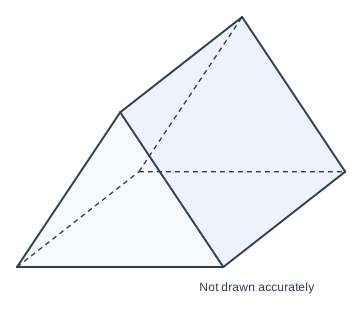
The diagram shows a triangular prism. Hidden edges are shown as dashed lines.
How many edges does the triangular prism have?
Model answer
3 edges on the front triangle, 3 on the back triangle and 3 joining them. \(3 + 3 + 3 = 9\) edges
Explanation
Count the edges in groups so you do not miss any: 3 round the front triangle, 3 round the back triangle and 3 long edges joining them. That makes 9. The dashed lines are edges at the back that you cannot see, but they still count. A common mistake is to count only the solid lines.
Mark scheme
1 mark
9
Accept 'nine'. Do not accept 6 (the vertices, or only the solid lines) or 5 (the faces).
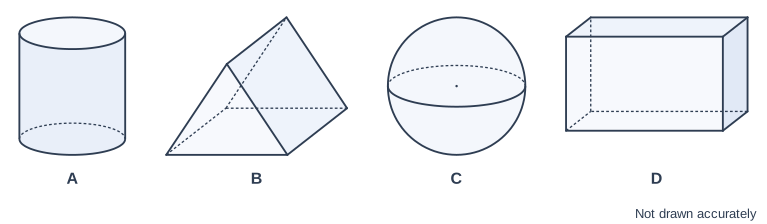
Look at the faces of each shape. A has two flat circles at its ends and a curved side, so it is a cylinder. B has a triangle at each end joined by rectangles, so it is a triangular prism. C is round all over, like a ball, so it is a sphere, and D has 6 rectangle faces, so it is a cuboid. A common mistake is to give the name of a 2D shape, such as circle or rectangle.
Mark scheme
1 mark
At least two of the four shapes named correctly: A cylinder, B triangular prism, C sphere, D cuboid
Two or three correct names score 1 mark. B: 'prism' alone is not enough. D: accept 'rectangular prism'. Do not accept 2D names such as circle, triangle or rectangle, or 'ball', 'box' or 'cube'. Ignore small spelling errors such as 'cilinder' or 'cubiod'.
1 mark
All four correct: A cylinder, B triangular prism, C sphere, D cuboid
All four correct names score both marks. The names can be in a list with or without the letters, as long as the order is A, B, C, D.
Question 3
3 marks
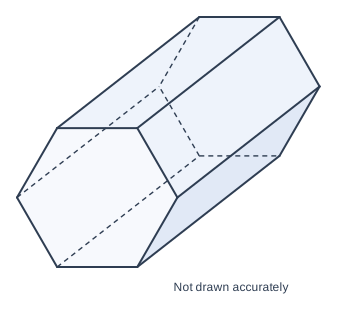
A new pencil is shaped like a hexagonal prism. The diagram shows a hexagonal prism. Hidden edges are shown as dashed lines.
How many faces does it have? How many edges does it have? How many vertices does it have?
Use the hexagon at each end to help you count. There are 2 hexagon faces and one rectangle for each side of the hexagon, so \(2 + 6 = 8\) faces. There are 6 edges round each hexagon and 6 long edges joining them, so 18 edges. Each hexagon has 6 corners, so there are 12 vertices. A common mistake is to miss the dashed edges at the back.
Mark scheme
1 mark
8 faces
2 hexagons and 6 rectangles. Accept 8 with no unit.
1 mark
18 edges
6 round each hexagon and 6 joining them. Accept 18 with no unit.
1 mark
12 vertices
6 on each hexagon. Accept 12 with no unit. The three answers can be in any order if each is clearly labelled.
Question 4
4 marks
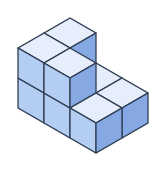
The diagram shows a shape made from cubes. Every cube sits on the table or on top of another cube.
How many cubes are in the shape?
Jack adds cubes so that every stack is 2 cubes high. The shape is then a cuboid. How many cubes does Jack add? How many cubes are in the cuboid?
Then Jack makes every stack 3 cubes high. How many more cubes does he need now?
Model answer
Back row: \(2 + 1 + 1 = 4\), front row: \(2 + 2 + 1 = 5\), so 9 cubes. The base has 6 stacks. 2 high: \(6 \times 2 = 12\) cubes in the cuboid. \(12 - 9 = 3\) cubes added. 3 high needs one more layer of 6 cubes, so 6 more cubes.
Explanation
Count stack by stack: 2, 1, 1 at the back and 2, 2, 1 at the front makes 9 cubes. The base has 6 stacks, so a cuboid 2 cubes high has \(6 \times 2 = 12\) cubes, and Jack must add \(12 - 9 = 3\). Making every stack 3 high adds one more layer, which is 6 cubes. A common mistake is to forget the hidden cubes at the bottom of the stacks.
Mark scheme
1 mark
9 (cubes in the shape)
The back row of stacks has 2, 1 and 1 cubes; the front row has 2, 2 and 1.
1 mark
3 (cubes added)
Follow through: 12 minus their number of cubes in the shape.
1 mark
12 (cubes in the cuboid)
The cuboid is 3 cubes long, 2 cubes from front to back and 2 cubes high. Accept 12 found as their 9 + their 3 only if it is correct.
1 mark
6 (more cubes)
One more layer of \(3 \times 2 = 6\) cubes. Do not accept 18 (the whole new cuboid). A correct answer with no working scores full marks.
Ready to try the rest? Tap your answers and see straight away how you did.
Ctrl + Enter to check
Study HelperHints first, answers after you try
Stuck on this one? Ask for a hint and I’ll point you in the right direction, without giving the answer away. Once you’ve checked your answer, I’ll show you how the marks are awarded.